Facts
The respondent, a Peon at a Government Boys Senior Secondary School, was issued a charge sheet on December 2, 2012, under Rule 14 of the CCS (CCA) Rules, 1965, for unauthorized absence.
Source reference: para. 1-2The charges alleged absence from 12.04.2011 to 31.05.2011 and from 23.07.2011 onwards, while also noting he was a "habitual absentee" having previously availed 1230 days of leave.
Source reference: para. 2The Disciplinary Authority (DA), via order dated 01.06.2013, removed the respondent from service, citing the 1200+ days of leave as evidence of lack of devotion to duty.
Source reference: para. 5The Central Administrative Tribunal (CAT) subsequently set aside this punishment as disproportionate and remanded the matter to the DA for a lesser penalty.
Source reference: para. 9The Petitioner (Govt. of NCT of Delhi) challenged the Tribunal's order before the High Court.
Source reference: para. 9Issues
1. Whether leave periods that have been duly sanctioned and regularized by the employer can legally constitute a basis for a charge sheet or disciplinary action.
Source reference: para. 32. Whether the punishment of removal from service was sustainable when the primary justification relied on regularized leave.
Source reference: para. 6-7Law Applied
The court applied Rule 14 of the CCS (Classification, Control & Appeal) Rules, 1965, and Rule 3 of the CCS (Conduct) Rules, 1964.
Source reference: para. 1-2State of Punjab v. Dr. P.L. Singla (2008) 8 SCC 469, which establishes that if periods of absence are duly sanctioned or regularized, they cannot subsequently form the basis of a charge sheet for misconduct.
Source reference: para. 3, 6Reasoning
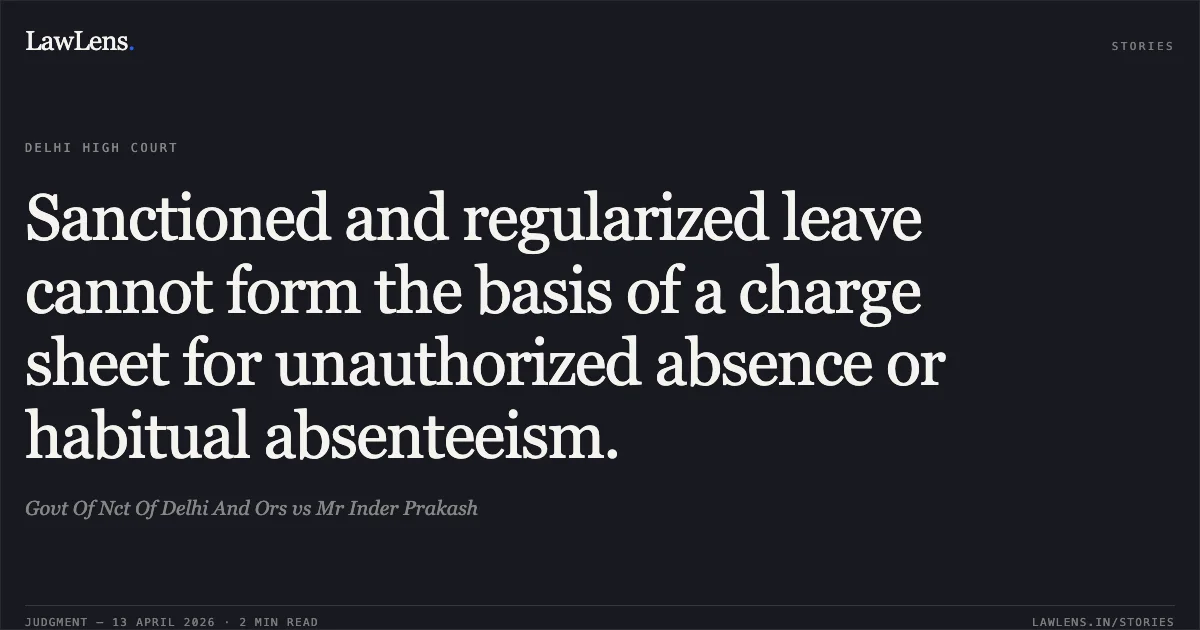
The High Court found that the petitioner’s counsel admitted the 1230 days of leave previously availed by the respondent were duly sanctioned and regularized.
Source reference: para. 3Following the P.L. Singla precedent, these periods could not be used to justify the charge of habitual absenteeism.
Source reference: para. 6The Court further noted that the DA had prima facie accepted the respondent’s medical explanation for the first period of absence (April to May 2011).
Source reference: para. 6Consequently, the DA’s decision to terminate service was legally unsustainable as it relied heavily on regularized leave as a ground for punishment.
Source reference: para. 7The only surviving portion of the charge was the unauthorized absence from July 23, 2011, to December 2, 2012.
Source reference: para. 4, 8The court reasoned that the DA must reconsider the quantum of punishment based solely on this specific timeframe, excluding the regularized periods.
Source reference: para. 8, 10Holding
The High Court disposed of the writ petition by upholding the Tribunal's direction to set aside the removal.
The Court directed the DA to conduct de novo proceedings limited to the allegation of unauthorized absence for the period 23.07.2011 to 02.12.2012.
Source reference: para. 10The DA was ordered to allow the respondent to submit a supplementary defense and provide a personal hearing, with a final decision to be rendered within six weeks.
Source reference: para. 10The Court reiterated the Tribunal's holding that the final punishment must be lesser than dismissal, removal, or cessation of service.
Source reference: para. 12Original Court PDF
Govt Of Nct Of Delhi And OrsvsMr Inder Prakash
Click to open original judgment
Original judgment, available to read, download and summarize on LawLens.in