Facts
The borrower had mortgaged the property to Indian Overseas Bank in 2007.
Source reference: no citationThe Central Excise Department later attached the property in 2014 for statutory dues.
Source reference: no citationThe Bank sold the property under the SARFAESI Act to the fourth respondent, whose sale notice and sale certificate disclosed the Department’s attachment as a known encumbrance.
Source reference: para. 8The auction purchaser did not discharge the Department’s dues.
Source reference: para. 8The Bank sought a direction requiring the registration authorities to remove the attachment entry from the encumbrance certificate.
Source reference: no citationA Single Judge dismissed the writ petition, and the Bank appealed.
Source reference: no citationThe Division Bench recorded that the sale certificate had been registered and that the Bank’s recovery proceedings before the DRT remained pending.
Source reference: paras. 4, 35–36Issues
1. Whether a secured creditor may require the registration department to remove a disclosed encumbrance from the encumbrance certificate without first settling the dues associated with it
Source reference: paras. 1, 92. Whether the Bank became functus officio, and its writ petition was therefore not maintainable, after issuing and registering the sale certificate
Source reference: para. 2(a)3. Whether statutory priority provisions for secured creditors displace the requirements of Rules 9(6)–(10) of the Security Interest (Enforcement) Rules, 2002
Source reference: paras. 2(b)–(c), 20–224. Whether the attachment recorded by the Department constituted an encumbrance for the purposes of Rule 9(7)
Source reference: para. 375. Whether the Single Judge’s decision was inconsistent with the cited precedents on the priority of secured creditors
Source reference: para. 2(d)Law Applied
Rule 9(6)–(10) of the Security Interest (Enforcement) Rules, 2002 governs the issue of a sale certificate and delivery of secured property where known encumbrances exist: the purchaser may deposit the amount needed to discharge them; the authorised officer must take steps concerning payment to the interested parties; delivery free of known encumbrances follows the required deposit; and the sale certificate must state whether the property was purchased free of those encumbrances.
Source reference: paras. 13–19Sections 26E and 35 of the SARFAESI Act and Section 31B of the Recovery of Debts and Bankruptcy Act give priority to secured creditors over government dues, but do not dispense with compliance with Rule 9(6)–(10).
Source reference: paras. 29–33The Court also considered Section 11E of the Central Excise Act and Section 142A of the Customs Act in the context of statutory claims.
Source reference: paras. 20, 31–33It treated the Department’s attachment, recorded in the encumbrance certificate and restricting alienation, as an encumbrance for Rule 9(7).
Source reference: para. 37The authorities cited on secured-creditor priority—including UTI Bank Ltd. v. Deputy Commissioner of Central Excise, Punjab National Bank v. Union of India, Dena Bank v. Bhikhabhai Prabhudas Parekh and Assistant Commissioner of Customs (Bonds) v. M/s. Annam Steels Pvt. Ltd.—were acknowledged as supporting that priority, without overriding the Rules’ requirements.
Source reference: para. 25Reasoning
The sale documents expressly disclosed the Department’s attachment, and the purchaser proceeded with knowledge of it; neither the Bank nor the purchaser had paid the Department’s dues.
Source reference: para. 8The Court held that the statutory priority of secured creditors did not entitle the Bank or purchaser to remove the disclosed entry without complying with Rule 9(6)–(10).
Source reference: paras. 21–24, 29–33Granting that relief would effectively allow the property to be treated as sold free of an encumbrance that the sale certificate expressly identified.
Source reference: paras. 21–24, 29–33The Court rejected the argument that the attachment was not an encumbrance because it restricted alienation and was recorded as a claim against the property.
Source reference: para. 37The Bank was not functus officio: its full debt remained unrecovered and its DRT proceedings were pending.
Source reference: paras. 35–36The Court treated the other priority-related questions as academic to the outcome once the purchaser’s failure to discharge the disclosed encumbrance was established.
Source reference: paras. 28–33Holding
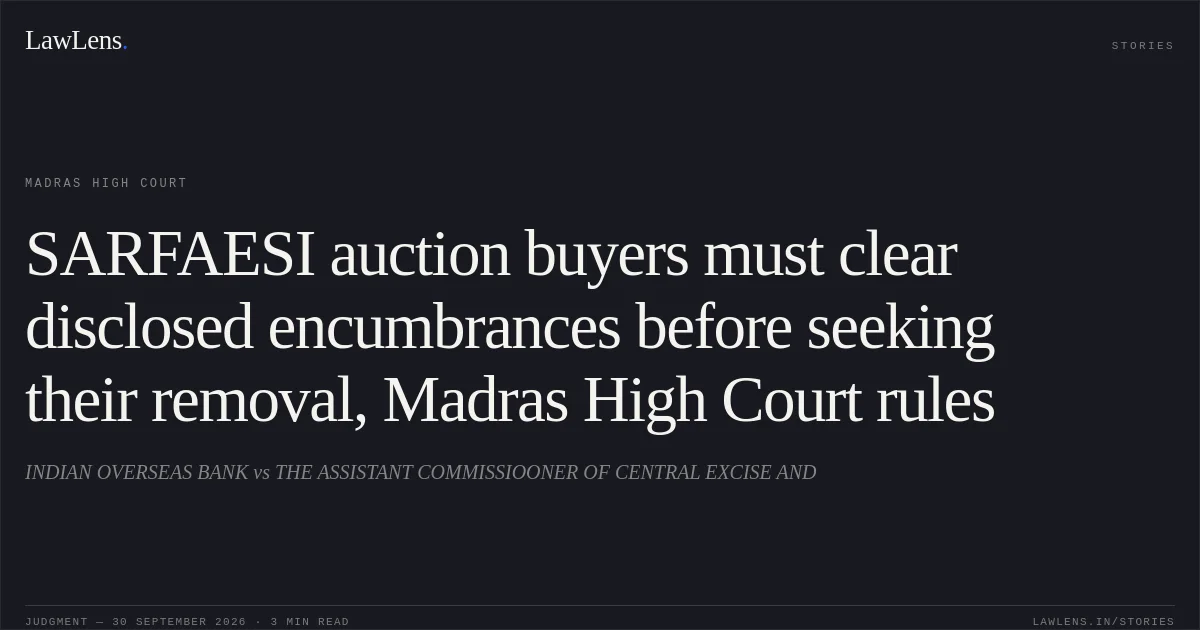
The Court held that the Bank could not obtain an order directing removal of the Department’s attachment from the encumbrance certificate while the disclosed dues remained unpaid.
The Bank was not functus officio, but that finding did not alter the result.
Source reference: paras. 35–36Finding no error in the Single Judge’s dismissal of the writ petition, the Division Bench dismissed the writ appeal and closed the connected applications, with no order as to costs.
Source reference: paras. 26, 28, 34–38Acts & Sections Cited
5 provisions across 4 statutes referred to in this judgment. Each provision opens on LawLens.
Securitisation and Reconstruction of Financial Assets and Enforcement of Security Interest Act, 20022
Recovery Of Debts And Bankruptcy Act, 19931
Central Excise Act, 19441
Transfer of Property Act, 18821
Original Court PDF
INDIAN OVERSEAS BANKvsTHE ASSISTANT COMMISSIOONER OF CENTRAL EXCISE AND
Click to open original judgment
Original judgment, available to read, download and summarize on LawLens.in
![Casual presenters who hold no civil post fall outside the Tribunal’s jurisdiction.. DINESH CHANDRA JHA vs All India Radio. CAT - ['Patna']. LawLens](/stories/thumbnails/casual-presenters-who-hold-no-civil-post-fall-outside-the-tribunals-jurisdiction-58712bb7af604542b7f330a13641534b.webp)