Facts
Respondent No. 2, proprietor of M/s D.K. Enterprises, was offered the distributorship of “Saraswati” camphor by M/s Oriental Aromatics Limited for the period from 01.04.2024 to 01.04.2027. He paid ₹52,000 as token money and thereafter remitted ₹73,00,000 as advance in six instalments. The Company supplied goods worth ₹31,49,167 under four bills, but subsequently stopped supplies after a dispute arose regarding differential pricing and allegedly failed to refund the balance amount of ₹41,50,833.
Source reference: paras. 3–4; pp. 2–3On the basis of the respondent’s written information, Kotwali P.S. Case No. 323 of 2024 was registered against the appellants—senior officers and an employee of the Company—for offences under Sections 316(2), 318(4) and 3(5) of the Bharatiya Nyaya Sanhita, 2023 (“BNS”). The Jharkhand High Court declined to quash the FIR, leading to the present appeals.
Source reference: paras. 2–3; pp. 1–2Issues
Whether the allegations in the FIR, accepted at face value and in their entirety, disclosed the commission of offences under Sections 318(4) and 316(2) of the BNS?
Source reference: para. 7; p. 5Whether a civil or commercial dispute arising from a distributorship agreement had been given a criminal colour, warranting exercise of the quashing jurisdiction?
Source reference: para. 7; p. 5Law Applied
The Court applied Section 318(4) BNS, corresponding to Section 420 IPC, which requires deception and dishonest or fraudulent intention at the inception of the transaction; a mere subsequent breach of contract does not constitute cheating. It applied Section 316(2) BNS, corresponding to Section 406 IPC, under which criminal breach of trust requires entrustment of property and dishonest misappropriation or conversion thereafter.
Source reference: paras. 8–10, 18–19; pp. 5, 11–12Relying on Delhi Race Club (1940) Ltd. v. State of U.P., the Court held that dishonest intention must exist at the time of inducement and that cheating and criminal breach of trust are conceptually distinct offences. It also relied on Hridaya Ranjan Prasad Verma v. State of Bihar for the principle that culpable intention cannot be presumed merely from failure to perform a promise. Under the first category in State of Haryana v. Bhajan Lal, the High Court may quash proceedings where the allegations, even if accepted in their entirety, do not prima facie constitute an offence.
Source reference: paras. 9–11; pp. 5–7Reasoning
The FIR did not allege any fact showing that the appellants had a dishonest intention when the distributorship was offered, the agreement was executed, or the advance payments were received. It did not assert that the appellants never intended to confer the distributorship, knew that supplies could not be made, or made a knowingly false representation regarding an existing fact. The references to being “cheated” and “deceived” were merely conclusions unsupported by foundational facts.
Source reference: paras. 13–14; pp. 7–9The agreement was actually executed, the distributorship was conferred, and goods worth ₹31,49,167 were supplied, conduct consistent with an intention to perform rather than an initial fraudulent design. The subsequent termination of the distributorship and alleged non-refund of the balance amount could, at most, constitute a contractual or commercial breach, not cheating absent an allegation that the termination formed part of a design existing from the outset.
Source reference: paras. 15–16; pp. 9–10Section 316(2) BNS was also not attracted because the advance payment was made as consideration under the contract and was not entrusted to the appellants to be held, used for a specified purpose, or returned in specie.
Source reference: paras. 18–19; pp. 11–12The Court additionally noted that the contemporaneous legal notices complained primarily of higher pricing and did not initially allege wrongful retention of ₹41,50,833, supporting the conclusion that the criminal case was a later attempt to escalate a commercial dispute.
Source reference: para. 17; pp. 10–11Holding
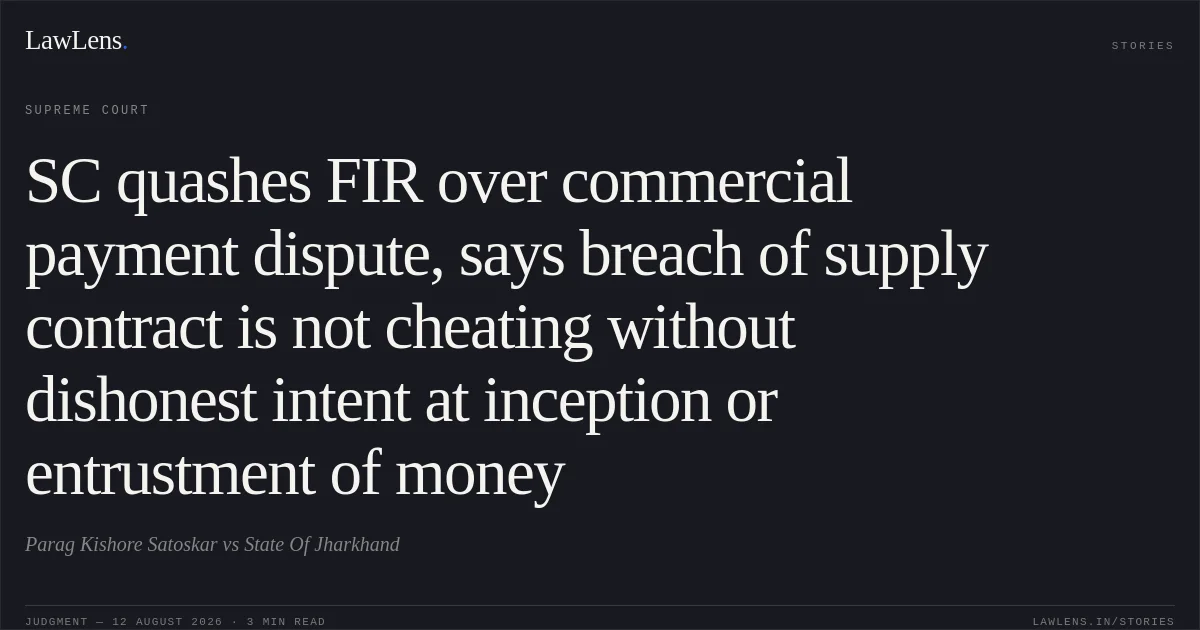
The Supreme Court held that the FIR did not disclose the essential ingredient of dishonest intention at inception required for an offence under Section 318(4) BNS, nor the essential ingredient of entrustment required under Section 316(2) BNS.
The dispute arose from a written commercial contract and its continuation through criminal process would amount to an abuse of process falling within the first Bhajan Lal category. The appeals were allowed; the Jharkhand High Court’s order dated 19.02.2025 was set aside, and Kotwali P.S. Case No. 323 of 2024, along with all proceedings arising from it, was quashed. The Court clarified that the judgment expressed no opinion on the merits of any civil, arbitral or other proceedings between the parties.
Source reference: paras. 23–25; pp. 14–15Acts & Sections Cited
6 provisions across 3 statutes referred to in this judgment. Each provision opens on LawLens.
Bharatiya Nyaya Sanhita, 20233
Indian Penal Code, 18602
Code of Criminal Procedure, 19731
Original Court PDF
Parag Kishore SatoskarvsState Of Jharkhand
Click to open original judgment
Original judgment, available to read, download and summarize on LawLens.in