Facts
The prosecution alleged that, on 2 August 2016, the first appellant abused PW2, the complainant’s wife, and that both appellants assaulted the complainant after he intervened.
Source reference: pp. 6–7, para. 13The complainant and his wife belonged to the Hindu Pallar Scheduled Caste; the appellants belonged to the Hindu Nathamaan Udayar community.
Source reference: pp. 6–7, para. 13The trial court convicted the appellants under Section 323 IPC read with Section 3(2)(va) of the SC/ST (Prevention of Atrocities) Act, Section 4 of the Tamil Nadu Prohibition of Harassment of Women Act, and Sections 3(1)(r) and (s) of the SC/ST Act, while acquitting them of other charges.
Source reference: p. 5, paras. 9–10The appellants challenged the convictions and sentences in appeal under Section 374(2) CrPC.
Source reference: pp. 1, 5, para. 11Issues
Whether the convictions and sentences imposed on the appellants were sustainable on the evidence and applicable law.
Source reference: p. 6, para. 12Whether the evidence established the offences under Sections 3(1)(r) and (s) of the SC/ST Act, including the requirement that the alleged conduct occur in a place within public view.
Source reference: p. 12, para. 26Whether the evidence proved the assault and harassment offences beyond reasonable doubt, or instead warranted acquittal on benefit of doubt.
Source reference: pp. 11–13, paras. 23–30Law Applied
Section 162 CrPC restricts the use of statements made to police during investigation; the Court treated Ex.P1 as inadmissible under that provision after finding that the original complaint had been suppressed and Ex.P1 was a police-recorded statement.
Source reference: p. 11, paras. 24–25Sections 3(1)(r) and (s) of the SC/ST Act require the alleged offence to occur in a place within public view.
Source reference: p. 12, para. 26The Court also applied the principle that prior enmity is a double-edged circumstance: it may supply a motive for the offence but may also support a possibility of false implication; it relied on Aslam Alias Imran v. State of Madhya Pradesh, 2025 INSC 403.
Source reference: pp. 13–14, para. 29The convictions also concerned Section 323 IPC read with Section 3(2)(va) of the SC/ST Act and Section 4 of the Tamil Nadu Prohibition of Harassment of Women Act.
Source reference: p. 5, para. 9Reasoning
The Court found material differences between PW1’s and PW2’s accounts of how the assault occurred, and noted that PW1 did not testify to the alleged assault on PW2.
Source reference: pp. 10–11, paras. 22–23It further considered the prosecution’s failure to produce the original complaint, treating Ex.P1 as barred by Section 162 CrPC.
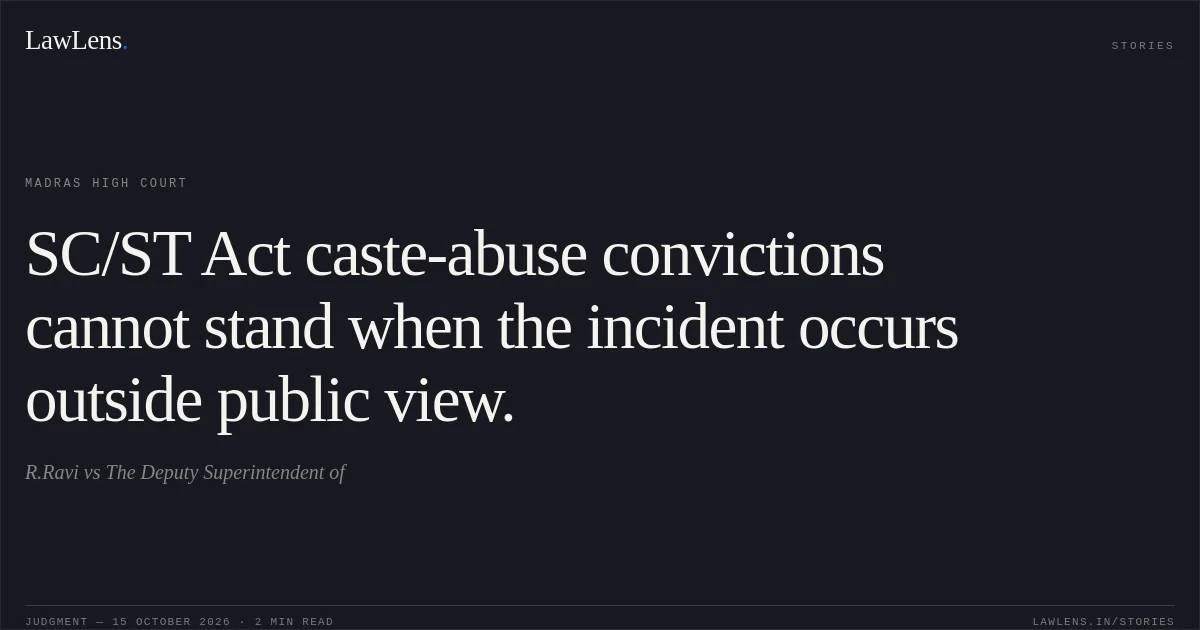
Source reference: p. 11, paras. 24–25As PW2 stated that no one was present during the alleged caste-based abuse, the Court held that the “public view” requirement was not met.
Source reference: p. 12, para. 26The medical evidence recorded a small abrasion, and the doctor accepted that it could have resulted from a fall while the complainant was under the influence of alcohol.
Source reference: pp. 12–13, para. 27In light of the evidentiary inconsistencies and prior land-related enmity, the Court found that false implication could not be ruled out and extended the benefit of doubt to the appellants.
Source reference: pp. 13–14, paras. 28–30Holding
The High Court held that the convictions and sentences were unsustainable and allowed the appeal.
It set aside the trial court’s judgment, acquitted the appellants, discharged their bail bonds, and directed that any fine paid be refunded.
Source reference: p. 14, paras. 30–31Acts & Sections Cited
8 provisions across 3 statutes referred to in this judgment. Each provision opens on LawLens.
Code of Criminal Procedure, 19734
Indian Penal Code, 18603
Scheduled Castes and the Scheduled Tribes (Prevention of Atrocities) Act, 19891
Original Court PDF
R.RavivsThe Deputy Superintendent of
Click to open original judgment
Original judgment, available to read, download and summarize on LawLens.in
![The competent authority must decide the appeal by a reasoned, speaking order within four weeks.. DR NISHANT GOYAL vs HEALTH. CAT - ['Delhi']. LawLens](/stories/thumbnails/the-competent-authority-must-decide-the-appeal-by-a-reasoned-speaking-order-within-four-we-51ef3c532385466483f4156703e7e0bc.webp)
![Competent authority must decide the pending representation by a reasoned order within four weeks.. AJAY YADAV vs MUNICIPAL CORPORATION OF DELHI (GNCTD). CAT - ['Delhi']. LawLens](/stories/thumbnails/competent-authority-must-decide-the-pending-representation-by-a-reasoned-order-within-four-1bec6310839148709c127f0a0c64e2b5.webp)
