Facts
The complainant alleged that on 14 September 2016, the accused used caste-related derogatory language and behaved vulgarly, including allegedly removing his pants, in the presence of the complainant’s family.
Source reference: paras. 1–5, pp. 1–3An FIR was registered under Sections 354A, 294B and 506(2) of the IPC and Sections 3(1)(r), 3(1)(s) and 3(2)(5-A) of the SC/ST (Prevention of Atrocities) Act.
Source reference: paras. 1–5, pp. 1–3After trial, the Special Court acquitted the accused on 27 August 2018.
Source reference: paras. 1–5, pp. 1–3The State appealed under Section 378 CrPC.
Source reference: paras. 1–5, pp. 1–3Issues
Whether the trial court was justified in acquitting the accused
Source reference: para. 8, p. 5Whether the trial court properly appreciated the prosecution evidence and whether its acquittal judgment disclosed any illegality, irregularity or perversity warranting appellate interference
Source reference: para. 8, p. 5Law Applied
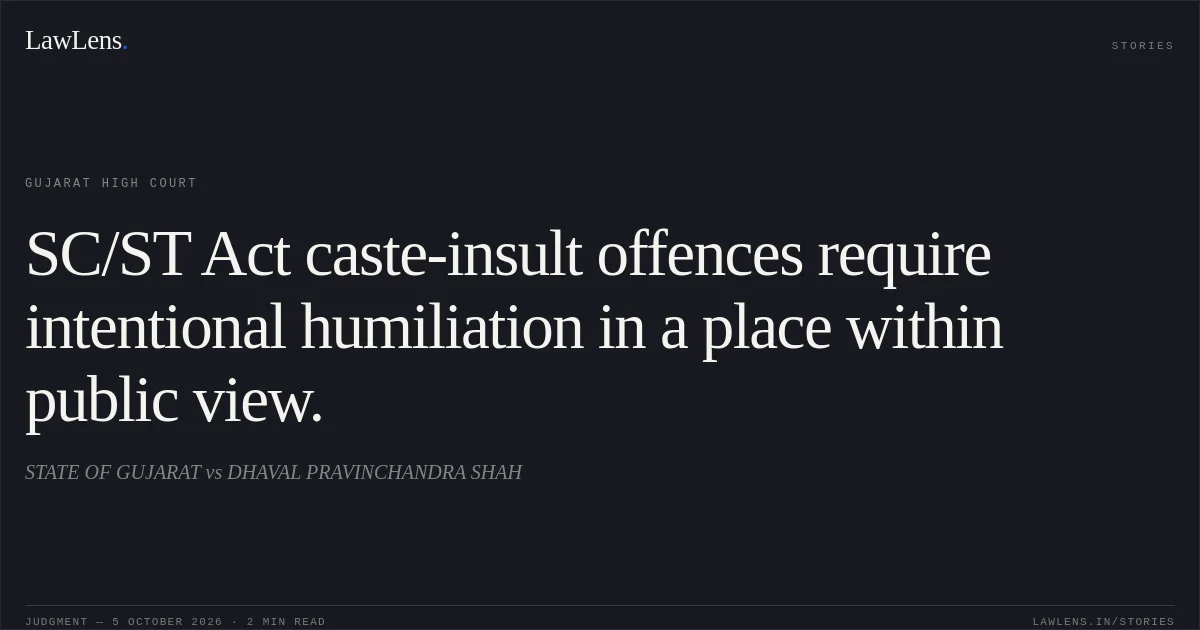
Sections 3(1)(r) and 3(1)(s) of the SC/ST Act require proof of the statutory ingredients of intentional insult or intimidation to humiliate a member of an SC/ST community, including the relevant requirement that the conduct occur within public view, as discussed in Gunjan alias Girija Kumari v. State (NCT of Delhi), 2026 INSC 468.
Source reference: para. 12, p. 7The Court also referred to Sections 354A and 294B IPC and the prosecution’s obligation to establish the charged offences through satisfactory evidence.
Source reference: paras. 10, 12–13, pp. 6–8On an appeal against acquittal, the appellate court may review and reappreciate the evidence, but must account for the reinforced presumption of innocence; where two reasonable views are possible, it should not disturb the acquittal.
Source reference: paras. 14–17, pp. 8–11These principles were drawn from Chandrappa v. State of Karnataka, (2007) 4 SCC 415, Rajesh Prasad v. State of Bihar, (2022) 3 SCC 471, Babu Sahebagouda Rudragoudar v. State of Karnataka, (2024) 8 SCC 149, and Ramesh v. State of Karnataka, (2024) 9 SCC 169.
Source reference: paras. 14–17, pp. 8–11Reasoning
The Court found that the complainant had not specified the alleged caste-related words or shown that they were used with the required intent to insult or humiliate; the public-view ingredient was also not established.
Source reference: paras. 10, 12, pp. 6–7The allegations of vulgar conduct and offences under Sections 354A and 294B IPC were unsupported by satisfactory evidence: the complainant’s family members had gone inside during the altercation and could not see whether the accused removed his pants or acted indecently.
Source reference: para. 12, p. 7The Court also noted the FIR omissions, the investigating officer’s failure to examine neighbouring occupants, and evidence of a parking dispute between the parties.
Source reference: paras. 10–11, pp. 6–7Applying the restraint required in an appeal against acquittal, it concluded that the trial court’s assessment was not perverse or legally erroneous.
Source reference: paras. 13–19, pp. 8–12Holding
The High Court held that the prosecution had failed to prove the charges beyond reasonable doubt and that no ground existed to interfere with the acquittal.
The State’s appeal was dismissed, the trial court’s acquittal was confirmed, the bail bond was cancelled, and the record and proceedings were ordered returned to the trial court.
Source reference: para. 20, p. 12Acts & Sections Cited
5 provisions across 3 statutes referred to in this judgment. Each provision opens on LawLens.
Code of Criminal Procedure, 19732
Indian Penal Code, 18602
Scheduled Castes and the Scheduled Tribes (Prevention of Atrocities) Act, 19891
Original Court PDF
STATE OF GUJARATvsDHAVAL PRAVINCHANDRA SHAH
Click to open original judgment
Original judgment, available to read, download and summarize on LawLens.in