Facts
The complainants, Sunder Singh and Puran Chand, alleged that they belonged to a Scheduled Caste and had been subjected to caste-based harassment by the accused, including obstruction of access to a village water source, denial of use of common paths and irrigation facilities, caste-based abuse, assault, forcible occupation of property, and poisoning of their oxen.
Source reference: pp.2–5, paras 2–4They initially approached the Chief Judicial Magistrate under Section 156(3) CrPC; an FIR was registered, but the police submitted a cancellation report.
Source reference: pp.2–5, paras 2–4The complainants filed a protest petition, which was treated as a complaint, and the accused were summoned and later charged under Sections 3(1)(ii), (v), (x) and (xii) of the Scheduled Castes and Scheduled Tribes (Prevention of Atrocities) Act, 1989, and Sections 147, 323 and 429 read with Section 149 IPC.
Source reference: pp.2–5, paras 2–4The Trial Court acquitted the accused, principally finding unexplained delay, absence of caste certificates, material contradictions in the prosecution evidence, and failure to prove the alleged poisoning of the oxen.
Source reference: pp.5–6, para 7The State and the complainants filed separate appeals against the acquittal.
Source reference: pp.6–7, paras 8–9Issues
Whether the Trial Court’s acquittal was perverse, manifestly illegal, wholly unsustainable, or otherwise warranted interference in an appeal against acquittal?
Source reference: p.9, paras 14–15Whether the offences under the SC/ST Act were proved in the absence of caste certificates or other legally sufficient evidence establishing the complainants’ Scheduled Caste status?
Source reference: pp.12–13, paras 16–17Whether the unexplained delay in initiating criminal proceedings and the material inconsistencies in the prosecution evidence rendered the prosecution case unreliable?
Source reference: pp.13–17, paras 18–24Whether the allegations concerning poisoning of the oxen, forcible occupation of the house and cow shed, and other acts of violence were proved beyond reasonable doubt?
Source reference: pp.17–18, paras 25–26Whether the Magistrate acted lawfully in treating the protest petition against the cancellation report as a complaint?
Source reference: pp.18–21, paras 27–28Law Applied
In an appeal against acquittal, the appellate court must respect the reinforced presumption of innocence and interfere only where the acquittal is impossible, perverse, wholly unsustainable, manifestly illegal, or causes a miscarriage of justice; where two reasonable views are possible, the one favourable to the accused must prevail, as explained in Kali Ram v. State of Himachal Pradesh, Ghurey Lal v. State of Uttar Pradesh, Chandrappa v. State of Karnataka, Mrinal Das v. State of Tripura, and Sanjay Kumar v. State of Bihar.
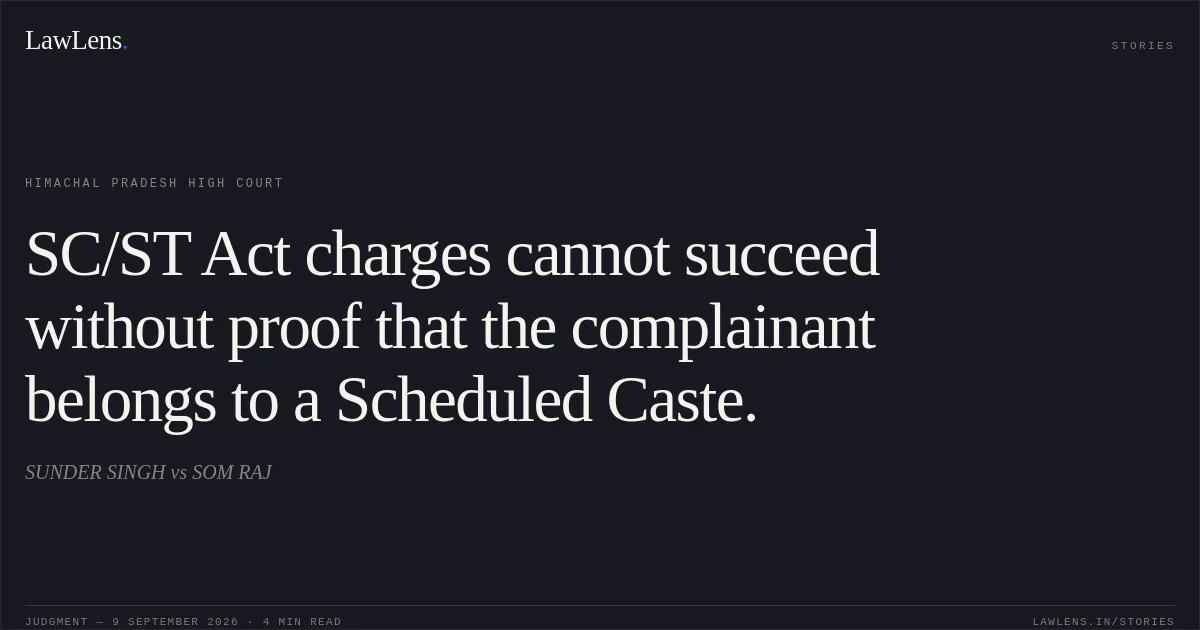
Source reference: pp.9–11, para 14The SC/ST Act applies only where the statutory status of the victim as a member of a Scheduled Caste or Scheduled Tribe is proved; relying on Chandu Ram v. Nathu Ram, the Court held that failure to establish Scheduled Caste status was fatal to the charges under the Act.
Source reference: pp.12–13, paras 16–17Unexplained delay in lodging an FIR may create a risk of embellishment and fabrication, although delay is not automatically fatal if satisfactorily explained, pursuant to Mehraj Singh v. State of U.P., P. Rajagopal v. State of Tamil Nadu, and Sekaran v. State of Tamil Nadu.
Source reference: pp.13–16, paras 18–21Omnibus allegations against multiple accused, without specifying the acts and roles of individual accused, are unsafe for recording conviction under Pandurang v. State of Hyderabad.
Source reference: pp.16–17, paras 23–24Under Vishnu Kumar Tiwari v. State of U.P., a protest petition may be treated as a complaint where it discloses an offence and satisfies the substantive requirements of a complaint.
Source reference: pp.18–21, paras 27–28Reasoning
The High Court found that the Trial Court had adopted a reasonable view of the evidence and that the stringent standard for interfering with an acquittal was not met.
Source reference: pp.9–11, paras 14–15, 30The complainants’ and accused persons’ caste certificates were not produced, and the Court held that the essential statutory condition for applying the SC/ST Act had therefore not been established.
Source reference: pp.12–13, paras 16–17The complaint was filed approximately one year after the alleged water-source incident, without a satisfactory explanation, justifying cautious scrutiny of the prosecution case.
Source reference: p.13, para 18; p.16, para 21The evidence also contained material inconsistencies: Som Dutt’s testimony indicated that water was drawn from a source approximately one kilometre away, contradicting the allegation that the accused had fenced a spring near the complainants’ house.
Source reference: p.16, para 22Bhagati Devi made a vague omnibus assertion that the accused had beaten the complainants’ family, without identifying the date, victims, or individual assailants.
Source reference: pp.16–17, paras 23–24The allegations that the oxen had been poisoned were unsupported by eyewitness testimony or post-mortem reports, while the claim concerning forcible occupation of the house and cow shed was not supported by title or possession documents.
Source reference: pp.17–18, paras 25–26Conversely, the Magistrate’s decision to treat the protest petition as a complaint was consistent with the principle that a protest petition may be proceeded with as a complaint where it discloses the commission of an offence.
Source reference: pp.18–21, paras 27–28Holding
The High Court dismissed both appeals and affirmed the acquittal of Som Raj and the other accused, holding that the Trial Court had taken a reasonable and legally sustainable view of the evidence and that no ground for appellate interference was established.
The Court further directed each respondent/accused to furnish bail bonds of ₹25,000, with one surety in the like amount, under Section 437-A CrPC, corresponding to Section 481 of the Bharatiya Nagarik Suraksha Sanhita, 2023, valid for six months and subject to appearance before the Supreme Court if required in any further proceedings.
Source reference: p.21, para 32Acts & Sections Cited
18 provisions across 4 statutes referred to in this judgment. Each provision opens on LawLens.
Code of Criminal Procedure, 19738
Scheduled Castes and the Scheduled Tribes (Prevention of Atrocities) Act, 19893
Indian Penal Code, 18606
Bharatiya Nagarik Suraksha Sanhita, 20231
Original Court PDF
SUNDER SINGHvsSOM RAJ
Click to open original judgment
Original judgment, available to read, download and summarize on LawLens.in