Facts
The State of Gujarat appealed a judgment dated 24.01.2013 by the Special Judge (Atrocity), Mehsana, which acquitted the respondents of charges under Sections 323, 504, and 114 of the Indian Penal Code (IPC), Section 3(1)(x) of the Scheduled Castes and the Scheduled Tribes (Prevention of Atrocities) Act ("SC/ST Act"), and Section 135 of the Bombay Police Act
Source reference: p. 1The prosecution alleged that on 02.04.2010, the accused assaulted the complainant with sticks at a public vegetable market in Village Palli due to a grudge over a financial dispute involving Rs. 16,700
Source reference: p. 2It was further alleged that the accused humiliated the complainant by insulting his caste in public
Source reference: p. 2The trial court acquitted the accused, holding that the prosecution failed to prove the case beyond reasonable doubt
Source reference: p. 3Issues
1. Whether the trial court erred in its appreciation of evidence by giving undue emphasis to contradictions and omissions
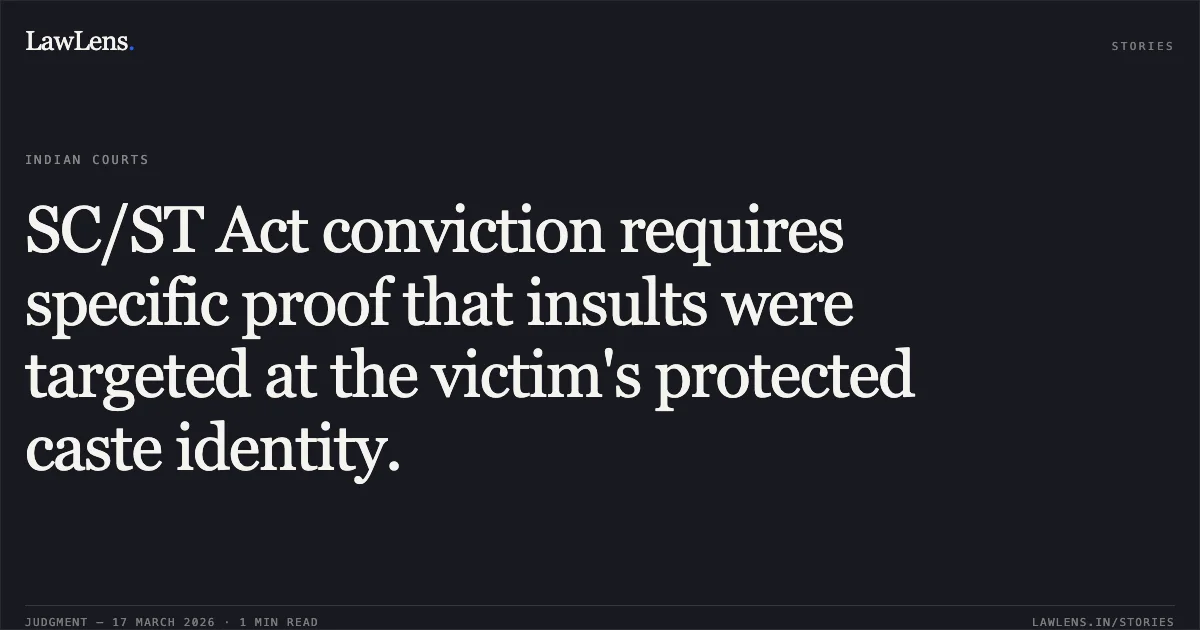
Source reference: p. 32. Whether the alleged insults and intimidation were directed at the complainant specifically because of his caste to attract liability under Section 3(1)(x) of the SC/ST Act
Source reference: p. 83. Whether the High Court, in an appeal against acquittal, should interfere with the trial court's findings if they represent a "possible" and "reasonable" view
Source reference: p. 12-14Law Applied
The Court primarily applied Section 3(1)(x) of the SC/ST Act, 1989, alongside Sections 323 and 504 of the IPC.
Source reference: p. 8It relied on Sajan Sakhariya v. State of Kerala (AIR 2024 SC 4557), which clarifies that an insult only constitutes an offence under the SC/ST Act if it targets the victim specifically due to their caste status
Source reference: p. 8Regarding the scope of appellate interference in acquittals under Section 378 of the CrPC, the Court followed Chandrappa v. State of Karnataka [(2007) 4 SCC 415] and Constable 907 Surendra Singh v. State of Uttarakhand [(2025) 5 SCC 433], which mandate that the "double presumption of innocence" must be respected unless the trial court’s judgment is patently perverse or suffers from a misreading of material evidence
Source reference: p. 13-15Reasoning
The Court found that the prosecution's case rested on the testimony of the complainant and his immediate family, who were deemed interested witnesses
Source reference: p. 7-8Despite the incident occurring in a public square near a temple, dairy, and shops where 20-25 people had gathered, the prosecution failed to examine any independent witnesses
Source reference: p. 5, 7-8Medical evidence through P.W.4 and Exh. 23 confirmed the absence of fractures, weakening the assault claim
Source reference: p. 6Furthermore, the Court noted significant contradictions regarding the alleged caste-based abuse and observed that the dispute was rooted in financial accounting rather than caste animus
Source reference: p. 8-9Applying the principles of Chandrappa, the Court reasoned that since the trial court's view was plausible and based on a detailed analysis of the lack of corroborating evidence, there was no ground to substitute it with a different opinion
Source reference: p. 14-15Holding
The High Court dismissed the appeal and upheld the acquittal of the respondents
It held that the prosecution failed to prove the charges beyond reasonable doubt and that the trial court’s findings were neither perverse nor illegal
Source reference: p. 15-16The Court endorsed the trial court’s reasoning that every insult does not amount to an atrocity under the SC/ST Act unless motivated by the victim's caste
Source reference: p. 8-9The Record & Proceedings were ordered to be remitted to the trial court
Source reference: p. 16Acts & Sections Cited
6 provisions across 3 statutes referred to in this judgment. Each provision opens on LawLens.
Indian Penal Code, 18603
Scheduled Castes and the Scheduled Tribes (Prevention of Atrocities) Act, 19891
Code of Criminal Procedure, 19732
Original Court PDF
STATE OF GUJARATvsRABARI MAFABHAI LEMBABHAI
Click to open original judgment
Original judgment, available to read, download and summarize on LawLens.in