Facts
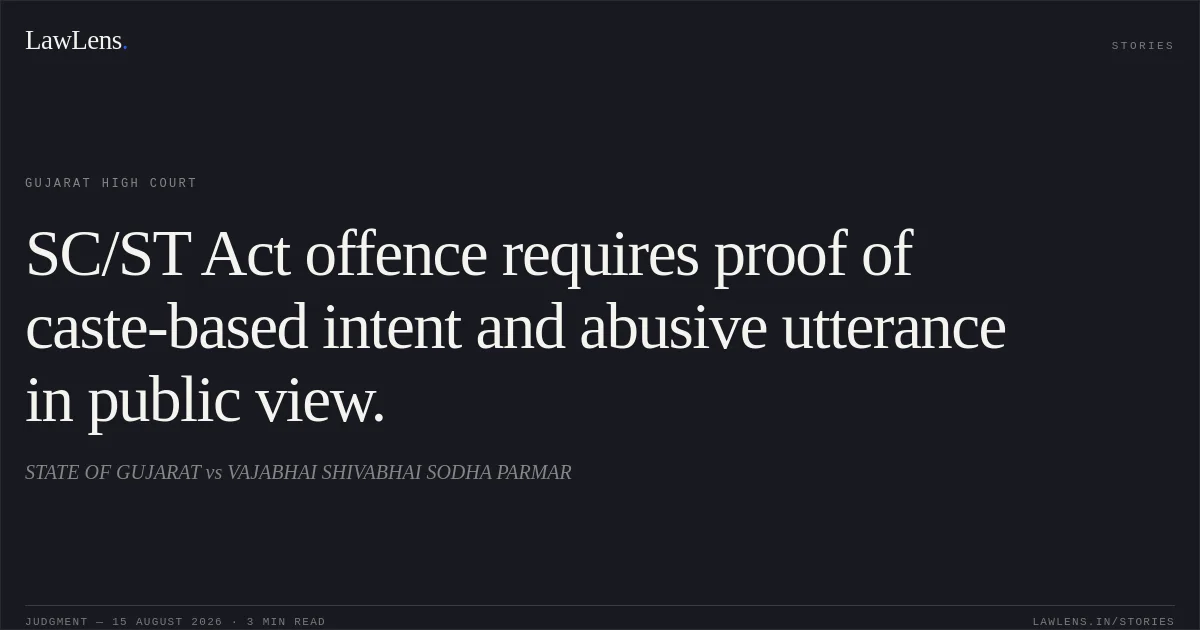
The complainant, Sunilbhai Danjibhai Vankar, alleged that the respondents, who owned adjoining agricultural land, had threatened the person cultivating his field and thereafter assaulted him on 13 June 2011. It was alleged that the respondents abused him using caste-related expressions, threatened to cut him into pieces if he approached the police, and thereby committed offences under Sections 143, 147, 149, 323, 504 and 506(2) of the IPC read with Section 3(1)(10) of the Scheduled Castes and Scheduled Tribes (Prevention of Atrocities) Act, 1989 (“Atrocities Act”).
Source reference: pp.2–4, paras.1–2.2Following investigation, a charge-sheet was filed and Special (SC/ST) Case No.22 of 2011 was tried before the Special Judge and 4th Additional Sessions Judge, Nadiad. The trial Court acquitted all the accused on 29 October 2012. The State preferred an appeal under Section 378(1)(3) of the Code of Criminal Procedure, 1973.
Source reference: p.1, para.1; p.4, para.2.2Issues
Whether the trial Court was justified in acquitting the respondents of the offences alleged against them.
Source reference: p.8, para.11Whether the trial Court properly appreciated the oral and documentary evidence led by the prosecution.
Source reference: p.8, para.11Whether the impugned judgment of acquittal suffered from illegality, irregularity, perversity, or any other infirmity warranting appellate interference.
Source reference: p.8, para.11Whether the prosecution established the ingredients of Section 3(1)(10) of the Atrocities Act, including intentional caste-based insult or humiliation in a public place or within public view.
Source reference: pp.11–12, paras.16–17Law Applied
The Court considered Sections 143, 147, 149, 323, 504 and 506(2) of the IPC, which concern unlawful assembly, rioting, liability for acts committed in prosecution of a common object, voluntarily causing hurt, intentional insult, and criminal intimidation, respectively; it also considered Section 3(1)(10) of the Atrocities Act concerning intentional insult or intimidation of a member of a Scheduled Caste or Scheduled Tribe in a place within public view.
Source reference: pp.1, 8, 11–12, paras.1, 12, 16–17On appeals against acquittal, the Court applied the principles in Chandrappa v. State of Karnataka, reaffirmed in Rajesh Prasad v. State of Bihar, Babu Sahebagouda Rudragoudar v. State of Karnataka and Ramesh v. State of Karnataka: an appellate court may reappreciate the evidence, but an acquittal carries a double presumption of innocence, and where two reasonable views are possible, the view favouring the accused should not be disturbed.
Source reference: pp.12–15, paras.18–21Relying on Shajan Skaria v. State of Kerala and Gunjan @ Girija Kumari v. State (NCT of Delhi), the Court held that Section 3(1)(10) requires proof of caste-based abusive or insulting conduct, an intention to humiliate the victim on that basis, and utterance in a public place or within public view.
Source reference: pp.11–12, para.17Reasoning
The Court found no basis to reverse the acquittal. The prosecution evidence disclosed an existing dispute concerning adjoining agricultural lands and a right of way, providing a background of hostility between the parties.
Source reference: pp.8–10, paras.12–13The complainant’s medical examination occurred on 15 June 2011, after the alleged incident and the registration of the FIR on 14 June 2011; the doctor noted only limited complaints and accepted that the injuries could have resulted from contact with a hard or blunt object.
Source reference: p.10, para.14The complainant’s mother was not an eyewitness and her evidence was based on what the complainant allegedly narrated to her.
Source reference: pp.10–11, para.15The Court also noted material contradictions regarding the precise role of Respondent No.1, the absence of independent eyewitnesses, and the lack of sufficiently credible evidence connecting all respondents with the alleged assault and threats.
Source reference: p.10, para.15; p.15, para.22Independently, the Atrocities Act charge failed because the alleged incident occurred in an agricultural field and the prosecution did not establish that it took place in public view or that the alleged abuses were uttered with the specific intention of humiliating the complainant on account of his caste.
Source reference: pp.11–12, paras.16–17Since the trial Court’s view was reasonably supported by the evidence and was neither perverse nor manifestly illegal, the appellate double-presumption principle required confirmation of the acquittal.
Source reference: pp.12–15, paras.18–23Holding
The High Court answered the issues in favour of the respondents. It held that the prosecution failed to prove the alleged IPC offences and the offence under Section 3(1)(10) of the Atrocities Act beyond reasonable doubt, and that the trial Court had correctly appreciated the evidence.
The State’s appeal was dismissed, the judgment and order of acquittal dated 29 October 2012 were confirmed, the bail bonds were cancelled, and the record and proceedings were directed to be returned to the trial Court.
Source reference: p.16, para.24Acts & Sections Cited
9 provisions across 3 statutes referred to in this judgment. Each provision opens on LawLens.
Code of Criminal Procedure, 19732
Indian Penal Code, 18606
Scheduled Castes and the Scheduled Tribes (Prevention of Atrocities) Act, 19891
Original Court PDF
STATE OF GUJARATvsVAJABHAI SHIVABHAI SODHA PARMAR
Click to open original judgment
Original judgment, available to read, download and summarize on LawLens.in