Facts
The Appellant, a government employee (Assistant Grade-III), was accused of circulating an audio recording via WhatsApp on 17.07.2025
Source reference: para 2-3The complainant, a local political office bearer, alleged that the audio contained obscene and caste-based slurs directed at a State Minister and a female MLA belonging to a Scheduled Tribe, thereby causing public resentment
Source reference: para 3The police registered an FIR and submitted a charge sheet based on the audio clip and a certificate under Section 63(4)(c) of the Bharatiya Sakshya Adhiniyam, 2023
Source reference: para 3The Appellant challenged the trial court’s order dated 10.10.2025, which framed charges under Section 296 of the Bharatiya Nyaya Sanhita (BNS), 2023, and Section 3(1)(h) of the Scheduled Castes and the Scheduled Tribes (Prevention of Atrocities) Act, 1989
Source reference: para 1Issues
1. Whether the complainant, who was not the direct target of the alleged slurs, falls under the definition of a "victim" and has the standing to initiate prosecution
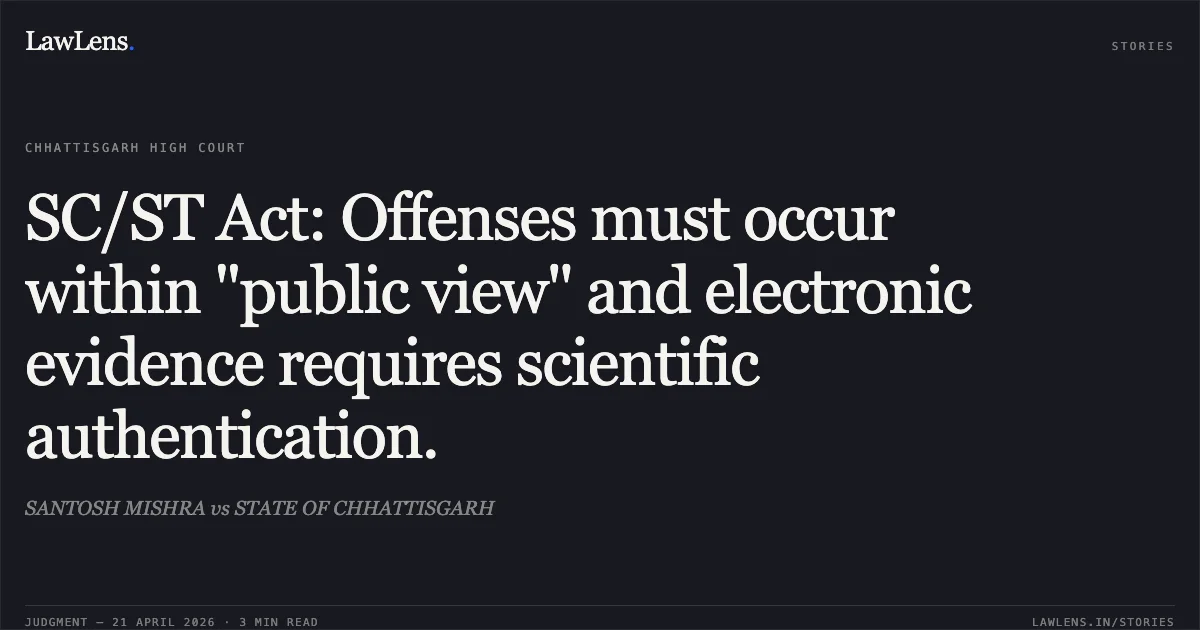
Source reference: para 9-112. Whether the alleged utterance and circulation of an audio clip constitute an offense in a "public place" or "within public view" as required by Section 296 BNS and Section 3(1)(h) of the SC/ST Act
Source reference: para 12-13, 173. Whether the absence of a voice sampling test, the non-seizure of the electronic device, and the lack of a transcript render the evidence insufficient for framing charges
Source reference: para 16, 19Law Applied
Section 2(ec) of the SC/ST Act, defining a "victim" as anyone who suffers harm due to an offense under the Act
Source reference: para 10Section 296 of the BNS regarding obscene acts or words in public
Source reference: para 12Section 3(1)(h) of the SC/ST Act regarding casteist abuse in any place "within public view"
Source reference: para 13The court relied on the "Hicklin Test" for obscenity as adopted in N.S. Madhanagopal v. K. Lalitha (2022), which requires a tendency to deprave or corrupt minds
Source reference: para 15The court further applied principles from Karuppudayar v. State (2025), which distinguishes a "public place" from a "place within public view," the latter requiring the presence of independent members of the public at the time of the incident
Source reference: para 18Reasoning
The court held that while the complainant could be considered a "victim" if the community felt aggrieved
Source reference: para 14Regarding the SC/ST Act and BNS charges, the court noted that the prosecution failed to identify a specific "public place" or "place within public view" where the words were uttered; no spot map (Nazri Naksha) was prepared, and the charges themselves lacked a specific location
Source reference: para 19Furthermore, the court observed critical investigative lapses: the Appellant’s mobile phone was not seized, no voice sampling or scientific comparison was conducted to prove the audio was his, and no transcript of the specific slurs used was available in the record
Source reference: para 16, 19The court distinguished the Kerala High Court’s ruling in Sooraj V. Sukumar, noting that in the present case, unlike a televised interview, there was no clear evidence of where or how the digital content reached the public to satisfy the "public view" requirement
Source reference: para 20-21Holding
The court answered the issues in the negative, holding that the essential ingredients of "public view" and the identity of the speaker remained unestablished
The court concluded that continuing the trial would be an abuse of the judicial process due to the lack of prima facie evidence
Source reference: para 22Consequently, the appeal was allowed, the trial court's order dated 10.10.2025 framing charges was set aside, and the Appellant was discharged from all offenses under Section 296 BNS and Section 3(1)(h) of the SC/ST Act
Source reference: para 22Acts & Sections Cited
5 provisions across 4 statutes referred to in this judgment. Each provision opens on LawLens.
Bharatiya Nyaya Sanhita, 20231
Bharatiya Sakshya Adhiniyam, 20231
Indian Penal Code, 18601
Original Court PDF
SANTOSH MISHRAvsSTATE OF CHHATTISGARH
Click to open original judgment
Original judgment, available to read, download and summarize on LawLens.in