Facts
The dispute concerned agricultural land originally belonging to Biju Gond and later recorded in the name of Dukhiya Bai, widow of Biju’s son Manher.
Source reference: no citationThe plaintiff, Amila Bai, was the daughter of another of Biju’s sons, Mahru; the defendant, Jagdish, was the son of Jahjeet, also a son of Biju.
Source reference: no citationAfter Dukhiya Bai’s death, Jagdish claimed the land under a Will and mutation entries; Amila challenged his title and sought a declaration and possession.
Source reference: no citationThe Trial Court dismissed her suit, finding her claim unproved.
Source reference: no citationThe First Appellate Court reversed in part and awarded her a one-half share, principally because Jagdish had not proved the Will.
Source reference: no citationJagdish’s legal representatives appealed under Section 100 of the Code of Civil Procedure.
Source reference: no citationThe High Court noted that the parties’ Gond tribal status was undisputed, that the Will had not been proved, and that other potential heirs had not been joined.
Source reference: paras. 3–9, 13–16, 25–28, 36–39Issues
Whether the First Appellate Court was justified in reversing the Trial Court’s judgment and awarding Amila a one-half share without determining the applicable rule of succession, the alleged custom, and the interests of other potential heirs
Source reference: p. 7 / paras. 16, 23–24, 34–42Whether Section 2(2) of the Hindu Succession Act, 1956 excluded its application to the parties as members of a Scheduled Tribe
Source reference: p. 7 / paras. 16, 29–32Law Applied
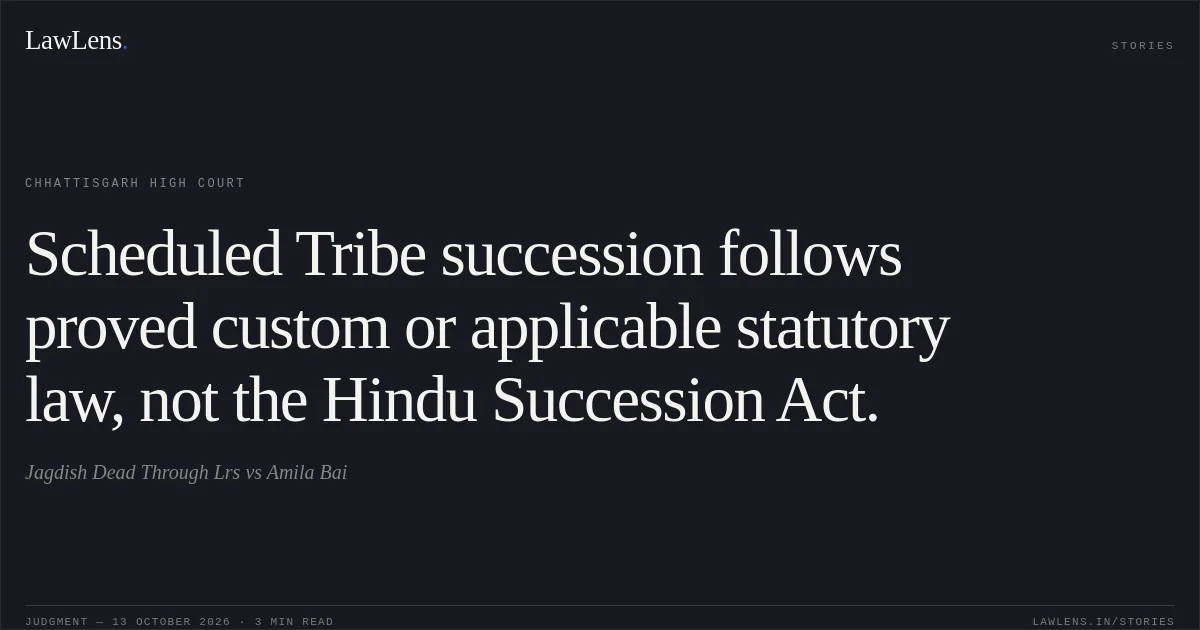
Section 2(2) of the Hindu Succession Act, 1956 provides that the Act does not apply to members of a Scheduled Tribe unless the Central Government directs otherwise by notification.
Source reference: para. 29The Court stated that succession among members of a Scheduled Tribe is governed by applicable customary law, which must be pleaded and proved; it also referred to Sections 5 and 6 of the Central Provinces Laws Act, 1875, concerning the applicable decision rule and justice, equity, and good conscience.
Source reference: paras. 30–34The Court relied on Madhu Kishwar v. State of Bihar, (1996) 5 SCC 125; Mst. Sarwango v. Mst. Urchmahin, AIR 2013 Chhattisgarh 98; Daduram v. Bhuri Bai, S.A. No. 270 of 2003 (6 February 2019); and Tirith Kumar v. Daduram, Civil Appeal No. 13516 of 2024 (19 December 2024), on succession and customary law among Scheduled Tribes.
Source reference: paras. 30–33It also cited Santosh Hazari v. Purushottam Tiwari, (2001) 3 SCC 179, and Azgar Barid v. Mazambi, (2022) 5 SCC 334, on the First Appellate Court’s duty to give reasoned findings and the potential legal significance of a perverse approach.
Source reference: para. 40Reasoning
Because the parties’ Gond tribal status was undisputed, the Hindu Succession Act did not govern their succession rights.
Source reference: paras. 25, 29–32The First Appellate Court therefore could not infer Amila’s entitlement to one-half of the land merely from Jagdish’s failure to prove the Will.
Source reference: paras. 34–39, 41–42Amila had to plead and establish a customary rule entitling her to succeed to property held by her paternal aunt by marriage, and the appellate court had to consider how the property devolved and whether other potential heirs had rights.
Source reference: paras. 34–39, 41–42The record indicated that other descendants of Biju existed and had not been joined; the First Appellate Court did not address these matters or adequately determine the legal basis for Amila’s share.
Source reference: paras. 34–39, 41–42Its failure to give reasoned findings on those material issues warranted intervention in second appeal.
Source reference: paras. 40–42Holding
The High Court answered both substantial questions of law in favour of the appellants.
It held that the Hindu Succession Act did not apply to the parties and that the First Appellate Court had erred in awarding Amila a one-half share without determining the applicable customary law and the rights of other potential heirs.
Source reference: paras. 32, 42–43The second appeal was allowed; the First Appellate Court’s judgment and decree were set aside, and the Trial Court’s dismissal of the suit was affirmed.
Source reference: paras. 43–45Acts & Sections Cited
2 provisions across 2 statutes referred to in this judgment. Each provision opens on LawLens.
Code of Civil Procedure, 19081
Hindu Succession Act, 19561
Original Court PDF
Jagdish Dead Through LrsvsAmila Bai
Click to open original judgment
Original judgment, available to read, download and summarize on LawLens.in