Facts
The petitioners, residents of Village Dodkachowra, were granted Patta for Abadi land in 2001 and have been conducting business there
Source reference: para. 2Disputes arose with Respondents Nos. 6-8 (private individuals) regarding land encroachment, leading to revenue proceedings where the Tehsildar Jashpur passed orders in favor of the petitioners on 08.01.2020 and 12.06.2020
Source reference: para. 2Respondent No. 2 (Chhattisgarh State Scheduled Tribes Commission) issued a notice dated 05.11.2020 (Annexure P/1) to the petitioners... based on a complaint (Annexure P/2) alleging that the petitioners had illegally occupied government land
Source reference: para. 1, 2, 3The petitioners challenged this notice via a Writ Petition, arguing it constituted "double jeopardy" as the Tehsildar was already seized of the matter
Source reference: para. 4Issues
Whether the notice issued by the Chhattisgarh State Scheduled Tribes Commission is maintainable and requires the petitioners to submit to its jurisdiction despite pending revenue proceedings.
Source reference: para. 4, 6Law Applied
The Court applied the principles of administrative law regarding the exhaustion of alternative remedies and the procedural powers of statutory commissions.
Source reference: para. 5It recognized the authority of the State Scheduled Tribes Commission to investigate complaints and issue notices to parties to present their defense.
Source reference: para. 5the court relied on the principle of Audi Alteram Partem, ensuring that the petitioners are granted a fair opportunity of hearing and the right to produce evidence before a statutory body prior to any adverse order being passed
Source reference: para. 6Reasoning
The Court observed that the Commission had issued a notice based on a formal complaint and that the petitioners had approached the High Court prematurely instead of responding to the statutory body
Source reference: para. 5The Court reasoned that the appropriate course of action was for the petitioners to file a detailed reply and submit relevant documents (including the Tehsildar’s reports) to the Commission
Source reference: para. 6By directing the Commission to consider "each and every aspect of the matter" and pass a reasoned order on merits, the Court ensured that the prior revenue findings would be brought to the Commission's attention through proper procedural channels
Source reference: para. 6Holding
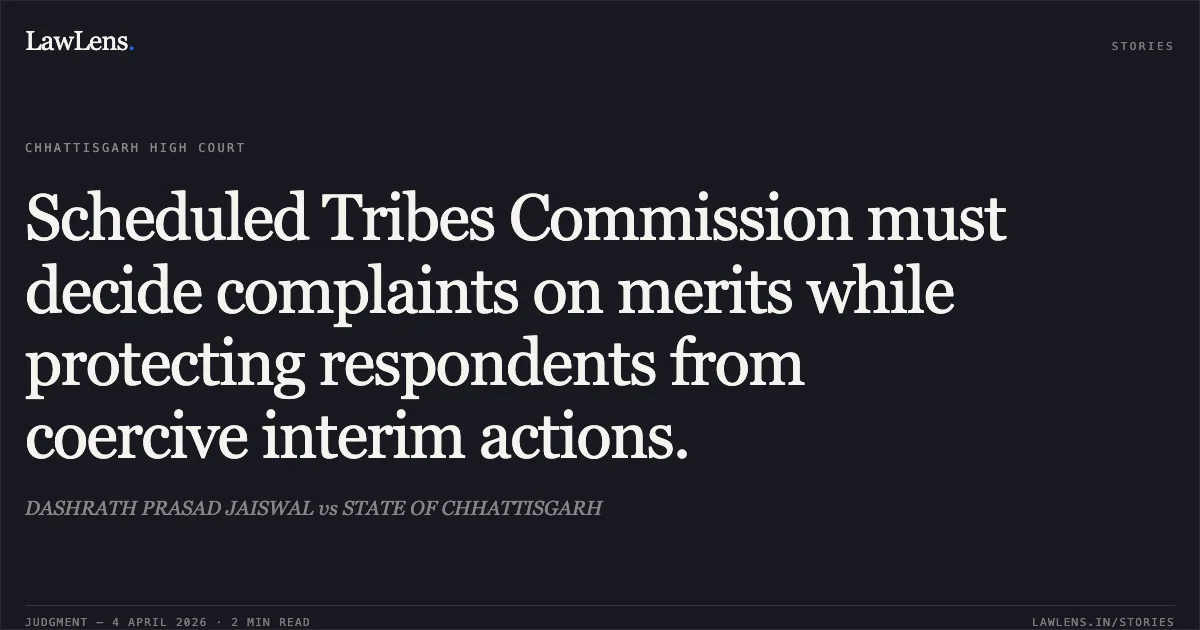
The High Court disposed of the Writ Petition without interfering with the impugned notice.
It directed the petitioners to appear before the Chhattisgarh State Scheduled Tribes Commission and file a detailed reply with supporting documents. The Commission was ordered to decide the case on its merits within 60 days from the date of production of the court order, ensuring a due opportunity of hearing.
Source reference: para. 6the Court granted interim relief by directing that no coercive steps be taken against the petitioners until the Commission concludes its proceedings
Source reference: para. 7-8Acts & Sections Cited
1 provisions across 1 statute referred to in this judgment. Each provision opens on LawLens.
Indian Penal Code, 18601
Original Court PDF
DASHRATH PRASAD JAISWALvsSTATE OF CHHATTISGARH
Click to open original judgment
Original judgment, available to read, download and summarize on LawLens.in


