Facts
The petitioners had worked as Supervisors under the Centrally sponsored Non-Formal Education Programme introduced in the erstwhile State of Bihar.
Source reference: paras. 5–6They were engaged during the 1980s through an advertised selection process and were paid fixed honoraria under the Scheme.
Source reference: paras. 5–6Pursuant to litigation before the Patna High Court, the State of Bihar formulated a scheme for absorption/regularisation of eligible Non-Formal Education Supervisors against posts of Primary Teachers or equivalent posts.
Source reference: paras. 7–8A final panel of 2,655 Supervisors, including the petitioners, was prepared; 676 of them belonged to territories that became part of Jharkhand after bifurcation on 15 November 2000.
Source reference: paras. 7–8By letter dated 23 December 2000, the Government of Bihar forwarded the names of those 676 Supervisors to the Government of Jharkhand for appropriate action.
Source reference: para. 8The petitioners contended that Bihar subsequently absorbed approximately 1,863 similarly situated Supervisors in Class III posts, whereas Jharkhand did not absorb the 676 Supervisors falling within its territory.
Source reference: para. 9Their earlier representations were rejected in 2003.
Source reference: para. 10In proceedings arising thereafter, this Court, by judgment dated 3 March 2021, quashed the rejection and directed fresh consideration after hearing the parties.
Source reference: para. 10Following a public notice and submission of representations, the competent authority again rejected the claim by order dated 16 December 2021.
Source reference: para. 10The present writ petitions challenged that order and sought absorption, regularisation and consequential benefits in reliance upon the Bihar scheme and the decisions in Bishundeo Choudhary v. State of Bihar, 1995 (1) PLJR 123, and M.J.C. No. 3442 of 1997.
Source reference: paras. 3–4Issues
1. Whether the petitioners acquired an enforceable right to absorption or regularisation in the regular service of the State of Jharkhand merely because their names appeared in the panel prepared under the Bihar scheme and judicial directions had been issued before bifurcation?
Source reference: paras. 26–312. Whether the State of Bihar’s subsequent absorption of similarly situated Supervisors created a right to equal treatment or compelled the State of Jharkhand to absorb the petitioners under Article 14 of the Constitution?
Source reference: paras. 32–373. Whether the order dated 16 December 2021 rejecting the petitioners’ claim was arbitrary or illegal, notwithstanding the earlier remand for fresh consideration?
Source reference: paras. 38–42Law Applied
The Court applied the principle that inclusion in a panel or participation in a proposed absorption scheme does not, by itself, confer an indefeasible right to appointment or regularisation, particularly where the concerned persons were not appointed against sanctioned posts in the regular establishment.
Source reference: paras. 29–31The Court relied upon Bishundeo Choudhary v. State of Bihar, 1995 (1) PLJR 123, and held that the Full Bench had merely noticed the Government scheme and had not adjudicated individual claims or issued an unconditional command for permanent appointment.
Source reference: para. 30The order dated 20 July 2000 in M.J.C. No. 3442 of 1997 required action in accordance with the scheme but did not guarantee appointment irrespective of sanctioned posts, service rules or the subsequent bifurcation of the State.
Source reference: para. 31Relying on L.P.A. No. 421 of 2017 and L.P.A. No. 649 of 2017, the Court held that Jharkhand retained the authority to independently decide claims for adjustment, absorption or regularisation and was not bound to replicate Bihar’s policy; employees engaged under a discontinued scheme had no enforceable right to regularisation.
Source reference: paras. 32–34The Court further applied the settled principle that a remand for reconsideration requires a fresh decision in accordance with law but does not mandate a favourable outcome.
Source reference: paras. 38–40Article 226 cannot be used to compel creation of posts or induction into a regular cadre dehors the prescribed recruitment process.
Source reference: paras. 37, 41Reasoning
The Court found that the petitioners’ engagement was under a time-bound, centrally sponsored scheme on an honorarium basis and not against substantive vacancies or sanctioned posts in the regular establishment.
Source reference: paras. 20–23, 36Although their names appeared in the panel and Bihar had forwarded the list of 676 Supervisors to Jharkhand, the panel represented only an eligibility or administrative exercise contemplated by the scheme; it did not create a vested right to appointment in Jharkhand.
Source reference: paras. 27–31The judicial directions issued before bifurcation were understood contextually as requiring implementation of the scheme, not as guaranteeing unconditional absorption.
Source reference: paras. 32–35Jharkhand’s separate constitutional and administrative status permitted it to independently determine whether absorption was permissible in light of its own posts, cadres, recruitment framework and policy.
Source reference: paras. 32–35The Court also rejected the Article 14 argument because Bihar and Jharkhand constituted separate State establishments and the petitioners were not holders of regular sanctioned posts.
Source reference: para. 35Since the earlier judgment had only required reconsideration, and the respondents had issued a public notice, received representations and passed a fresh order, the remand direction had been complied with.
Source reference: paras. 38–40Directing absorption would effectively require creation of posts or bypassing regular recruitment, which was impermissible under Article 226.
Source reference: paras. 36–37, 41Holding
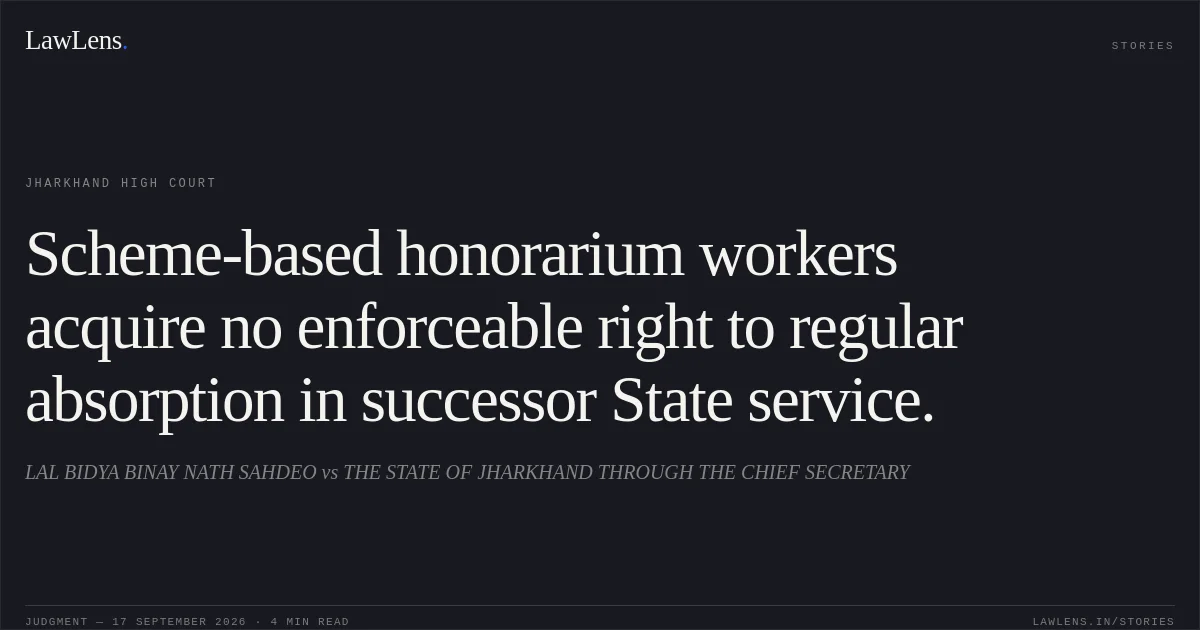
The Court held that the petitioners had no enforceable right to absorption or regularisation in the State of Jharkhand merely on the basis of the Bihar scheme, their inclusion in the panel, the pre-bifurcation judicial orders, or Bihar’s subsequent absorption of similarly situated persons.
It further held that the order dated 16 December 2021 was neither arbitrary nor illegal, as it followed fresh consideration pursuant to the earlier remand.
Source reference: paras. 38–42Both writ petitions were accordingly dismissed, the prayer for absorption into Class III or Class IV posts was refused, pending interlocutory applications were disposed of, and there was no order as to costs.
Source reference: para. 43Original Court PDF
LAL BIDYA BINAY NATH SAHDEOvsTHE STATE OF JHARKHAND THROUGH THE CHIEF SECRETARY
Click to open original judgment
Original judgment, available to read, download and summarize on LawLens.in