Facts
The proceedings concerned compliance with the Supreme Court’s directions in its judgment dated 30 January 2026 regarding menstrual hygiene facilities and related infrastructure in schools. The Court had directed all States and Union Territories to provide free oxo-biodegradable sanitary napkins complying with ASTM D-6954, functional gender-segregated toilets, washing facilities, sanitary-waste disposal systems, menstrual-health awareness, and periodic inspections by District Education Officers (“DEOs”).
Source reference: paras. 1–5; p. 1–5Pursuant to the Court’s order dated 25 May 2026, the Union of India filed an affidavit dated 31 August 2026 reporting progress by the States/UTs concerning toilets, sanitary products, menstrual hygiene management (“MHM”) corners, disposal systems, teacher sensitisation, and inspections. The Court found that although progress had been made, several State/UT reports contained inconsistent, illegible, incomplete, or purely statistical responses that did not establish actual compliance on the ground.
Source reference: paras. 2–7; p. 1–7Issues
Whether the earlier direction requiring oxo-biodegradable sanitary napkins complying with ASTM D-6954 should be modified in light of their potential environmental impact?
Source reference: paras. 5–12; p. 5–8Whether the compliance reports submitted by the Union of India and the States/UTs adequately demonstrated actual compliance with the Court’s directions concerning school toilets, water facilities, menstrual absorbents, disposal systems, MHM support, and awareness measures?
Source reference: paras. 13–20; p. 9–12Whether the States/UTs were required to adopt a more reliable and gap-oriented method of data collection and school inspection, including student feedback and identification of the reasons and timelines for unresolved deficiencies?
Source reference: paras. 14, 22–23; p. 9, 12–13Law Applied
The Court applied its earlier directions requiring schools to provide functional gender-segregated toilets, washing facilities, menstrual absorbents, sanitary-waste disposal mechanisms, and appropriate training and awareness measures, including the obligation of DEOs under the Court’s directions in paras. 173 and 174 of the main judgment.
Source reference: paras. 14, 20, 22; p. 9, 12Section 18 of the Right of Children to Free and Compulsory Education Act, 2009, read with Rule 16(a) of the RTE Rules, was referred to in relation to DEO notices and school inspections.
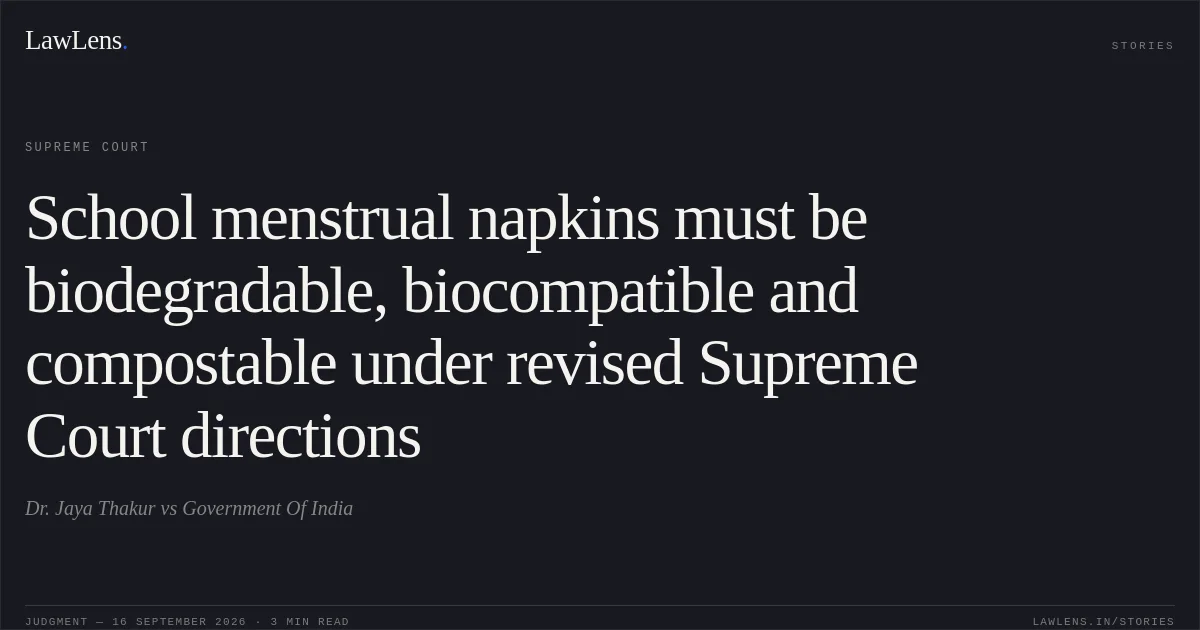
Source reference: para. 3; p. 4–5The Court also applied the environmental and health principle that menstrual absorbents supplied through public institutions must be safe, effective, biodegradable, biocompatible, and compostable. Accordingly, it modified the earlier specification of oxo-biodegradable napkins under ASTM D-6954 and directed compliance with the requirement of “biodegradable, biocompatible and compostable sanitary napkins” conforming to ISO 17088 read with IS 5405.
Source reference: paras. 6–12; p. 6–8Reasoning
The Court accepted that the States/UTs had made measurable progress, including construction of girls’ toilets, distribution of sanitary napkins, installation of vending machines, creation of MHM corners, provision of disposal systems, and conduct of awareness programmes. However, it held that the reported figures did not reliably establish compliance. Several States claimed saturation despite mismatches between the total number of schools and the number having accessible toilets, functional handwashing facilities, sanitary vending machines, sanitary products, or disposal mechanisms.
Source reference: paras. 8–18; p. 2–11The Court also held that inspection obligations required more than issuing directions: DEOs had to obtain anonymous student feedback, identify deficiencies, and ensure corrective action. On the material of sanitary napkins, the Court accepted the environmental concern that oxo-biodegradable products may merely disintegrate into smaller plastic particles under prevailing disposal conditions. It therefore considered biodegradable and compostable materials, including bamboo, jute, banana, starch, and corn-based materials, to be more consistent with public health and environmental protection.
Source reference: paras. 6–11, 14; p. 6–10Holding
The Court modified its earlier direction in para. 178(II)(i) of the main judgment: the requirement of “oxo-biodegradable sanitary napkins manufactured in compliance with ASTM D-6954” was replaced by a requirement for biodegradable, biocompatible, and compostable sanitary napkins complying with ISO 17088 read with IS 5405.
The States/UTs were directed to improve the reliability of future compliance reporting by conducting surprise inspections through teams of teachers under the supervision of DEOs, obtaining meaningful information regarding implementation, and incorporating anonymous student feedback. Future reports were required to identify actual gaps, their causes, and the time required to remedy them, particularly in relation to accessible and functional gender-segregated toilets, usable water connectivity, privacy, menstrual absorbents, disposal mechanisms, and maintenance. The interim application was disposed of, W.P. No. 987 of 2026 was disposed of in terms of the main judgment, and the matter was directed to be listed on 29 September 2026 for further progress.
Source reference: paras. 22–26; p. 12–13Acts & Sections Cited
1 provisions across 1 statute referred to in this judgment. Each provision opens on LawLens.
Right of Children to Free and Compulsory Education Act, 20091
Original Court PDF
Dr. Jaya ThakurvsGovernment Of India
Click to open original judgment
Original judgment, available to read, download and summarize on LawLens.in