Facts
The petitioners purchased a parcel of old tenure land (Survey No. 1305, etc.) in Village Rancharda, Gandhinagar, via a registered sale deed dated 20.02.2018
Source reference: p. 3, 4A promulgation entry (No. 10905) confirming their status was certified on 29.07.2020 and attained finality
Source reference: p. 3Previous proceedings under Section 84-C of the Tenancy Act against the predecessors were dropped in 2016
Source reference: p. 4Despite these facts, the District Collector, Gandhinagar, repeatedly rejected the petitioners' applications for Non-Agricultural (N.A.) permission (six orders between 2020 and 2025) on the grounds that the predecessors’ agricultural status was questionable and based on negative opinions from authorities
Source reference: p. 3, 4The petitioners challenged these rejections under Article 226 of the Constitution
Source reference: p. 2Issues
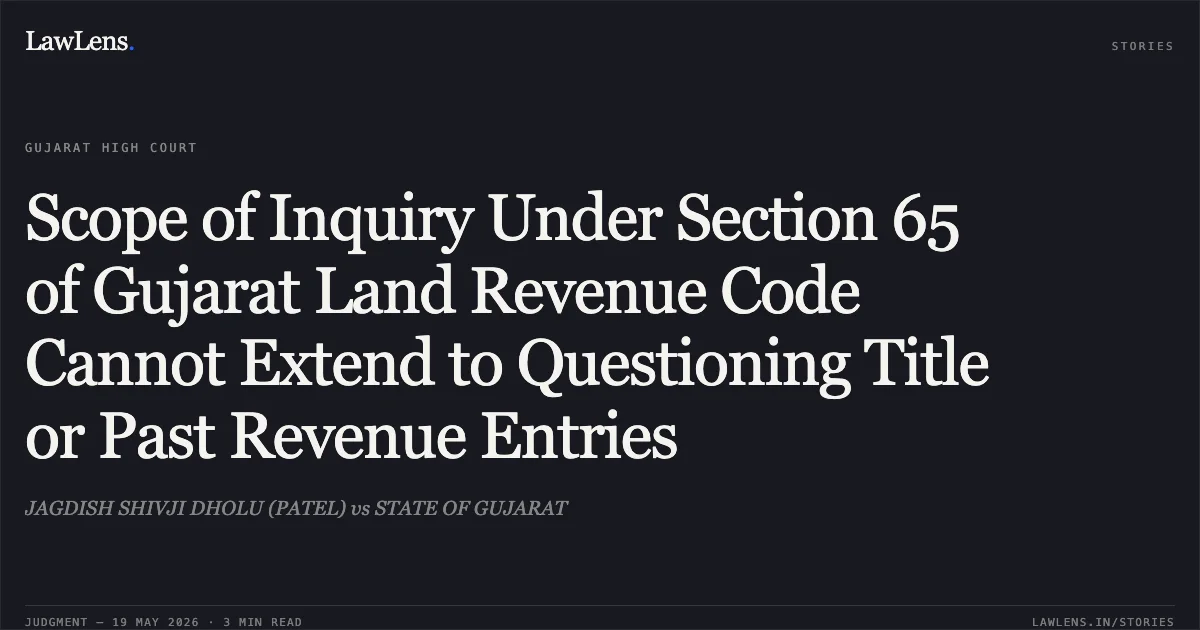
1. Whether the District Collector, while exercising jurisdiction under Section 65 of the Gujarat Land Revenue Code, can reject N.A. permission by inquiring into the title of the land or the agricultural status of predecessors-in-title.
Source reference: p. 5 / para. 82. Whether the repeated rejection of the N.A. application based on settled revenue entries and concluded tenancy proceedings was legally sustainable.
Source reference: p. 7 / para. 25Law Applied
Section 65 of the Gujarat Land Revenue Code, 1879, which governs the conversion of agricultural land for non-agricultural use
Source reference: p. 2The scope of inquiry under Section 65 is limited to verifying if the applicant is the "occupant" and "holder" of the land as defined by Sections 3(12) and 3(16) of the Code
Source reference: p. 8-9Tusharbhai Harjibhai Ghelani v. State of Gujarat [2019 (4) GLR 2578], which establishes that the Collector cannot resolve title disputes or "dig up graves" of old revenue entries during N.A. proceedings
Source reference: p. 5-7State of Gujarat v. Patel Raghav Natha [(1969) 2 SCC 187], affirming that revenue authorities should not decide serious questions of title
Source reference: p. 10Reasoning
The court found that the District Collector exceeded the jurisdictional limits of Section 65 by scrutinizing the validity of 30-year-old revenue entries and the historical agricultural status of the sellers
Source reference: p. 5, 7The court reasoned that since the petitioners are the current occupants via a registered sale deed (which has not been cancelled by a civil court) and the promulgation entry has attained finality, the Collector had no authority to reject the application based on "clouds" over the predecessor's title
Source reference: p. 8-9The court noted that the Collector ignored the fact that Section 84-C tenancy proceedings had already been dropped, and thus there was no legal basis to claim the status was in doubt
Source reference: p. 4-5By citing the Division Bench in LPA No. 1181 of 2025, the court emphasized that such "repetitive" and "baseless" rejections constitute a failure to apply the settled legal position
Source reference: p. 7-8Holding
The court held that the District Collector’s orders were "without jurisdiction" as they transgressed the limits of Section 65 by inquiring into title
The Court quashed and set aside the six impugned orders dated between 10.11.2020 and 17.07.2025. It directed that if the petitioners file a fresh application, the respondent authority must consider it strictly in accordance with the statutory mandate of Section 65 and the ratio in Tusharbhai Ghelani, focusing only on the occupancy of the applicant and the intended land use rather than historical title issues. The petition was partly allowed, and Rule was made absolute
Source reference: p. 11Acts & Sections Cited
3 provisions across 2 statutes referred to in this judgment. Linked provisions open on LawLens.
Bombay Land Revenue Code, 18792
Bombay Tenancy and Agricultural Lands Act, 19481
Original Court PDF
JAGDISH SHIVJI DHOLU (PATEL)vsSTATE OF GUJARAT
Click to open original judgment
Original judgment, available to read, download and summarize on LawLens.in