Facts
The Petitioner, a project management consultancy, entered into a contract dated 23.08.2012 with the Respondent for architectural and engineering services for a factory project
Source reference: p.2The contract outlined a consolidated fee of INR 31 Lakhs payable in seven stages
Source reference: p.2-3Clause 10 specified that the Petitioner’s obligations would continue for 12 months post-completion as per the official certificate
Source reference: p.2Although the Petitioner claimed the project had a 6-month completion timeline, it withdrew its Site Engineer on 07.06.2014 before completion, citing non-payment of dues
Source reference: p.4-5The Petitioner raised an invoice on 04.04.2014 for the full 100% contract value (INR 31 Lakhs)
Source reference: p.4, 15Following a Section 11 petition, a Sole Arbitrator was appointed who, on 27.09.2025, dismissed the Respondent’s counter-claims and partially allowed the Petitioner’s claims to the extent of INR 4,48,316/- with 18% interest
Source reference: p.1, 7The Petitioner challenged this award under Section 34 of the Arbitration and Conciliation Act, 1996, seeking a higher recovery
Source reference: p.7Issues
1. Whether the Petitioner completed the project in terms of Clause 10 of the Agreement
Source reference: p.6 / para. 2(xii)2. Whether the Petitioner was entitled to the full invoice amount of INR 17,41,480/- dated 04.04.2014
Source reference: p.6 / para. 2(xii)3. Whether the Petitioner was entitled to supplementary claims for design deviations and prolonged supervision
Source reference: p.17 / para. 19Law Applied
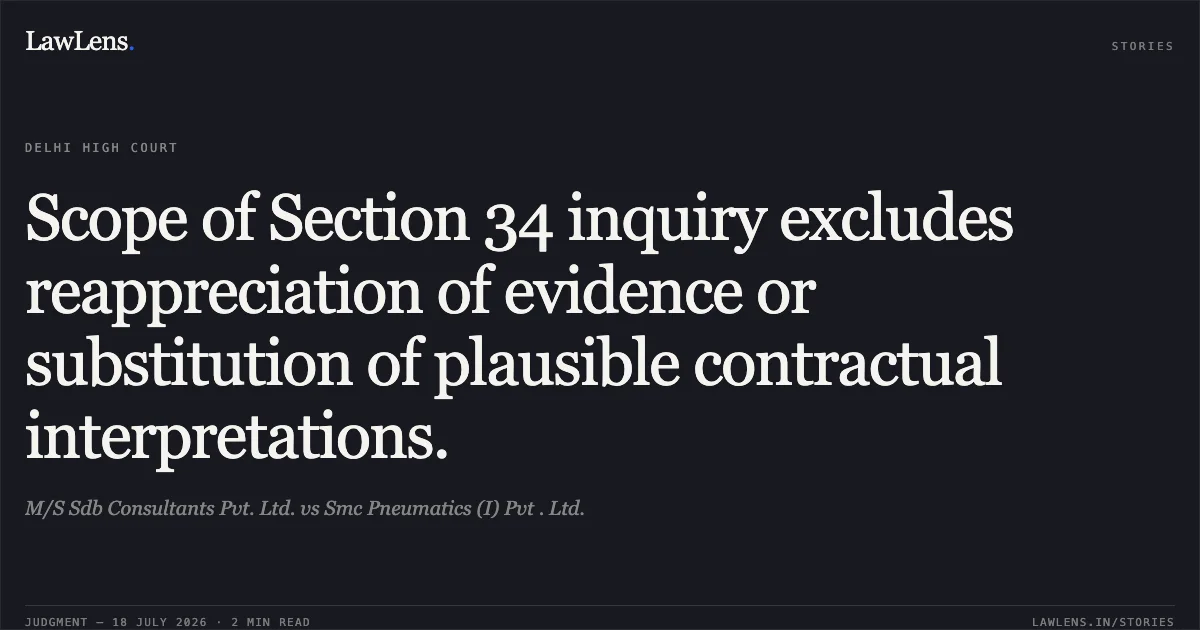
The Court applied Section 34 of the Arbitration and Conciliation Act, 1996, emphasizing that an award can only be set aside for "patent illegality" or violation of "public policy," which does not permit reappreciation of evidence or correction of mere errors of law
Source reference: p.8-10It applied the "Possible View" doctrine from MMTC Ltd. v. Vedanta Ltd. and Associate Builders v. DDA, holding that if an arbitrator’s interpretation is plausible, the court cannot intervene
Source reference: p.9, 11Sections 91 and 92 of the Indian Evidence Act, 1872, were applied to exclude oral evidence that contradicted the written terms of the contract regarding project timelines
Source reference: p.13Reasoning
The Court found that the Arbitrator correctly interpreted Clause 10, noting the absence of any written 6-month completion deadline; the Petitioner’s reliance on oral understandings was barred by the Evidence Act
Source reference: p.12-13Regarding the 100% payment claim, the Court upheld the Arbitrator’s finding that since the Petitioner admitted in its own pleadings and letters that the building was "far from complete" and it had withdrawn its staff prematurely, it was only entitled to payment for the four stages actually completed (INR 20,89,896/- minus payments already received)
Source reference: p.14, 16-17On the issue of supplementary bills for deviations, the Court agreed with the Arbitrator that while Clause 6 of the contract usually barred extra costs for deviations, it only applied to changes made before bidding; since changes occurred during construction, the Arbitrator’s nominal award of INR 1 Lakh for extra work was a reasoned and plausible determination based on the evidence
Source reference: p.18-19Holding
The Court dismissed the petition, holding that the Petitioner failed to establish any grounds of patent illegality or perversity
The Court affirmed the Arbitral Award, confirming the Petitioner's entitlement to only INR 4,48,316/- with interest at 18% p.a. from 20.07.2014
Source reference: p.1, 20The Court concluded that the Arbitrator had provided a well-structured adjudication within the confines of the contract and the evidence provided
Source reference: p.19-20Acts & Sections Cited
8 provisions across 1 statute referred to in this judgment. Each provision opens on LawLens.
Arbitration and Conciliation Act, 19968
Original Court PDF
M/S Sdb Consultants Pvt. Ltd.vsSmc Pneumatics (I) Pvt . Ltd.
Click to open original judgment
Original judgment, available to read, download and summarize on LawLens.in