Facts
Respondent No. 3 (Trust) executed a lease in 1917 and an assignment in 1932. Claiming the lease was terminated in 2016, the Trust obtained sanction from the Joint Charity Commissioner (JCC) under Section 36(1) of the Maharashtra Public Trusts Act on 24 May 2018 to grant a new lease to the Petitioner with an option to purchase reversionary rights.
Source reference: para. 2Following the execution of the lease and a conveyance deed, Respondent No. 2 (heir of the former assignee) challenged the sanction under Section 36(2).
Source reference: para. 3On 29 January 2020, the JCC revoked the sanction, citing non-disclosure of the 2016 termination notice, lack of transparency in advertisements regarding renewal rights, and inadequate valuation.
Source reference: para. 1, 4Issues
1. Whether the Joint Charity Commissioner exceeded his jurisdiction under Section 36(2) by revoking a sanction after the execution of conveyance in the absence of established fraud.
Source reference: para. 13, 162. Whether the non-disclosure of specific litigation documents or procedural irregularities in advertisements constitutes "fraud" or "concealment of material facts" sufficient to invalidate a completed transaction.
Source reference: para. 18, 22Law Applied
The court primarily applied Section 36 of the Maharashtra Public Trusts Act, 1950.
Source reference: para. 10Section 36(1) requires prior sanction for the alienation of trust property, emphasizing the "interest, benefit, or protection" of the trust.
Source reference: para. 11, 12Section 36(2) permits revocation only on grounds of fraud, misrepresentation, or concealment of material facts.
Source reference: para. 13Crucially, the Proviso to Section 36(2) mandates that once a conveyance is executed, a sanction can only be revoked on the ground that it was obtained by "fraud practiced upon the Charity Commissioner".
Source reference: para. 14, 16Reasoning
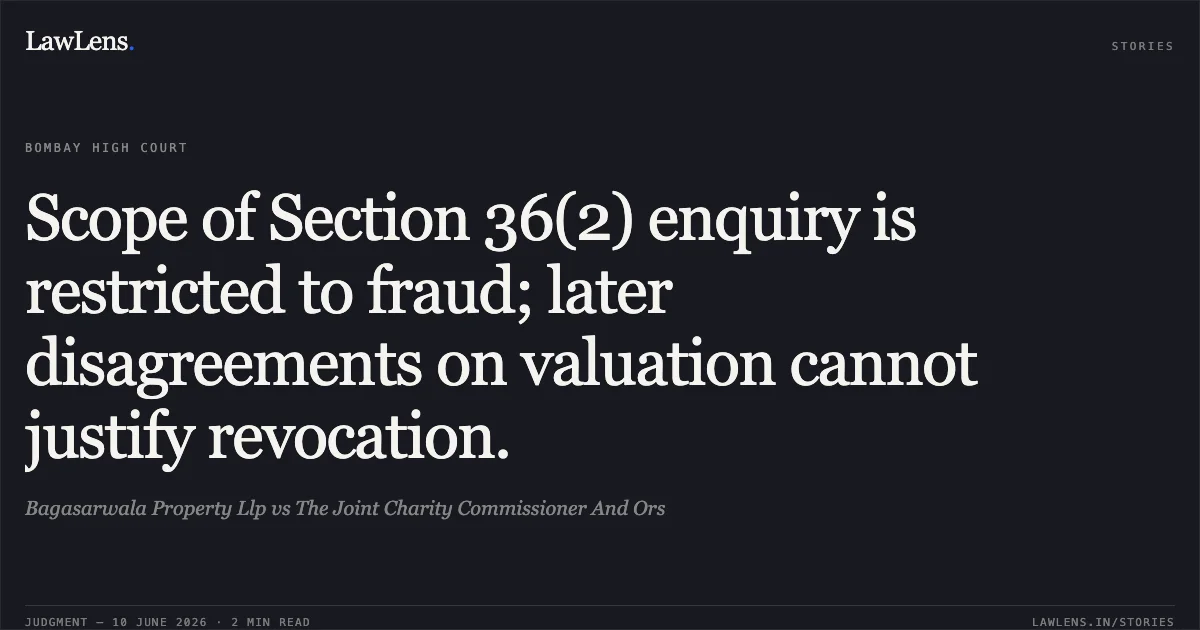
The Court reasoned that Section 36(2) does not grant appellate or merits-based review power; it is a narrow jurisdiction confined to establishing fraud.
Source reference: para. 13, 15Since the conveyance was already executed, the higher threshold of the Proviso applied.
Source reference: para. 16The Court found that "fraud" requires strict proof and intentional deception, which was absent here.
Source reference: para. 18The JCC was already aware of the property's encumbrances and disputes during the Section 36(1) stage, so the non-production of one specific notice did not constitute fraudulent concealment.
Source reference: para. 19, 25Furthermore, the JCC erred by using Section 36(2) to resolve tenancy and title disputes—issues that belong to civil courts—rather than focusing on whether the authority itself was defrauded.
Source reference: para. 21, 26Disagreements over valuation or the "prudence" of the transaction are matters for the sanction stage, not grounds for later revocation unless linked to fraud.
Source reference: para. 23, 27Holding
The Court allowed the Writ Petition and quashed the order dated 29 January 2020, restoring the original sanction of 24 May 2018.
Retrospective directions to return the consideration and restore trust records were set aside.
Source reference: para. 29(d)The Court held that the JCC traveled beyond his statutory jurisdiction by reassessing the merits of the transaction rather than proving fraud. All independent claims regarding title, tenancy, and ownership rights were kept open for agitation before appropriate forums. Stay on the judgment was refused.
Source reference: para. 28, 29(e)-(f), 30Acts & Sections Cited
1 provisions across 1 statute referred to in this judgment. Each provision opens on LawLens.
Maharashtra Public Trusts Act.1
Original Court PDF
Bagasarwala Property LlpvsThe Joint Charity Commissioner And Ors
Click to open original judgment
Original judgment, available to read, download and summarize on LawLens.in