Facts
The appellant, a registered Co-operative Society, entered into an agreement (2012-13) with the respondent for the procurement and transportation of wheat
Source reference: para. 2The appellant claimed it supplied 1,76,150 quintals but alleged that ₹32,85,617.84 remained unpaid, leading to a total claim of ₹37,68,453/-
Source reference: para. 2The appellant initiated arbitration before the Collector, Harda, who dismissed the claim on 13.02.2020, citing discrepancies in supply quantities and a failure by the appellant to provide cogent evidence despite multiple notices
Source reference: para. 3The appellant challenged this under Section 34 of the Arbitration and Conciliation Act, 1996, before the Principal District Judge, Harda, who dismissed the application on 30.06.2022, holding that the grounds raised requested an impermissible reappreciation of evidence
Source reference: para. 4The appellant subsequently filed this appeal under Section 37
Source reference: para. 1Issues
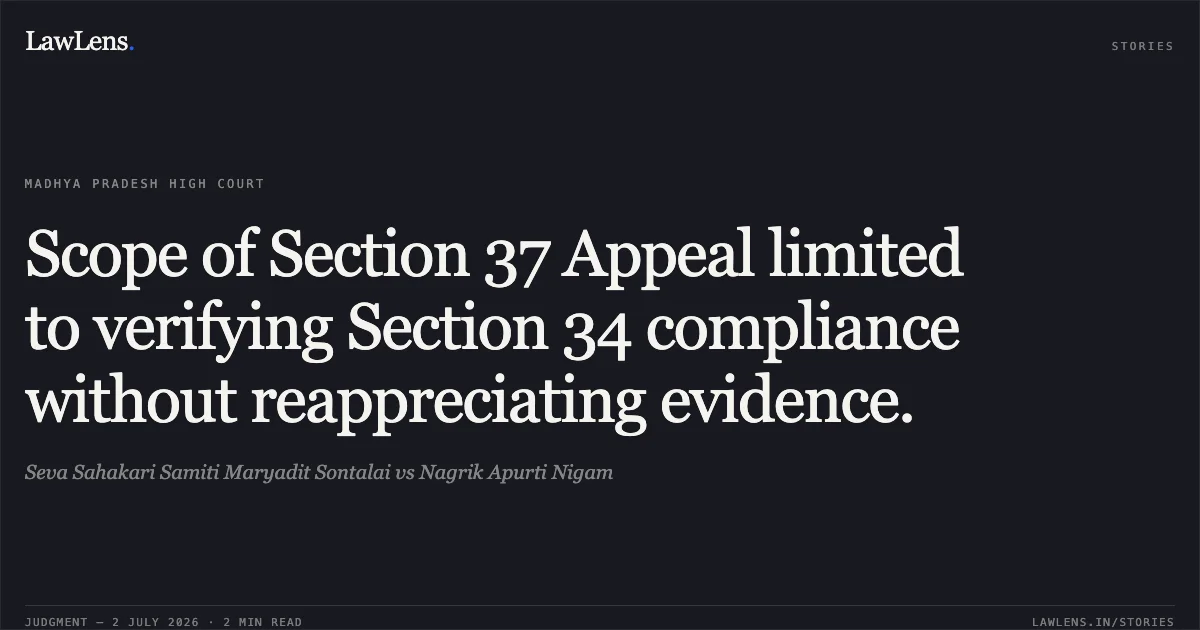
1. Whether the scope of an appeal under Section 37 of the Arbitration and Conciliation Act allows the Court to reappreciate evidence or substitute the Arbitrator's view on merits
Source reference: para. 6, 112. Whether the lower court’s refusal to set aside the award under Section 34 fell within the statutory parameters of the Act
Source reference: para. 12Law Applied
The Court primarily applied the Arbitration and Conciliation Act, 1996, specifically Section 34 (grounds for setting aside an award) and Section 37 (appellate jurisdiction)
Source reference: para. 1, 6It relied on Mcdermott International Inc v. Burn Standard Co. Ltd. (2006), establishing that judicial intervention is minimal and limited to fraud, bias, or violation of natural justice, and courts cannot correct arbitral errors
Source reference: para. 7It further cited MMTC Limited v. Vedanta Limited (2019) and Punjab State Civil Supplies Corp. v. Sanman Rice Mills (2024), which clarify that Section 37 jurisdiction cannot travel beyond Section 34 restrictions and is "more akin to superintendence" than a regular civil appeal
Source reference: para. 8, 11The "patent perversity" and "reasonable person" tests were applied via Dyna Technology Pvt. Ltd. v. Crompton Greaves Ltd. (2019) and Bharat Coking Coal Ltd. v. L.K. Ahuja (2001)
Source reference: para. 9, 10Reasoning
The Court reasoned that its jurisdiction under Section 37 is "extremely limited" and restricted to determining if the Section 34 court exceeded its authority
Source reference: para. 6, 11It noted that the Collector (Arbitrator) had applied his mind to the records of procurement, weighment, and correspondence, finding that the appellant failed to establish its entitlement due to discrepancies in supply acknowledgment
Source reference: para. 3, 9The Court observed that the appellant’s arguments essentially sought a merits-based reappraisal of facts, which is prohibited under the Act's scheme; as long as the Arbitrator's view is a "possible view," the court cannot interfere merely because an alternative interpretation exists
Source reference: para. 10, 11Since the appellant failed to prove any violation of public policy or fundamental policy of Indian law, the findings of the lower courts remained undisturbed
Source reference: para. 4, 12Holding
The Court answered the issues in the negative, holding that the appellate court has no authority to re-examine the merits of a dispute or the evidence presented before the Arbitral Tribunal
Finding that the orders of the Collector and the Principal District Judge were in consonance with the scheme of the Act and not against public policy, the High Court dismissed the Arbitration Appeal for being devoid of merit
Source reference: para. 12, 13Acts & Sections Cited
2 provisions across 1 statute referred to in this judgment. Each provision opens on LawLens.
Arbitration and Conciliation Act, 19962
Original Court PDF
Seva Sahakari Samiti Maryadit SontalaivsNagrik Apurti Nigam
Click to open original judgment
Original judgment, available to read, download and summarize on LawLens.in