Facts
The Rastogi brothers (Anil, Ajay, and Atul) were convicted by the Trial Court under Sections 148 and 302/149 of the IPC for murder and sentenced to life imprisonment
Source reference: para. 3On appeal, a Division Bench of the Allahabad High Court delivered split opinions: both Judges upheld the conviction of Anil and Ajay, but they disagreed regarding Atul; one Judge favored acquittal while the other favored conviction
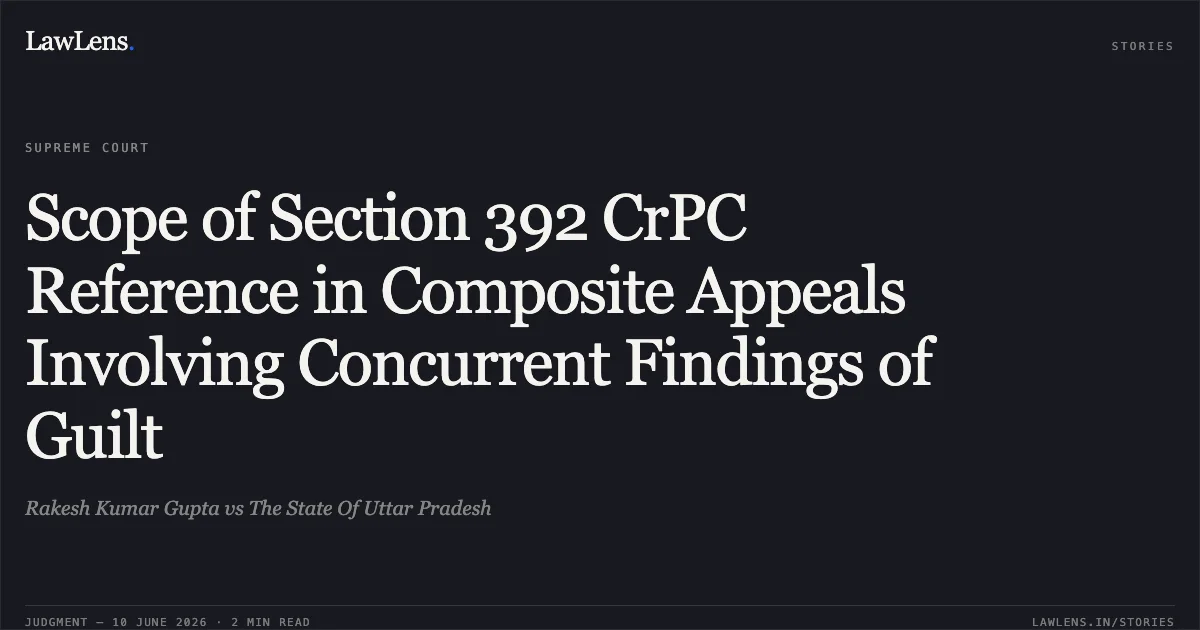
Source reference: para. 4Consequently, the matter was referred to a third (referee) Judge under Section 392 of the CrPC, 1973. The referee Judge not only acquitted Atul but also reversed the unanimous findings of the Division Bench regarding Anil and Ajay, acquitting them as well
Source reference: para. 4The Complainant and the State challenged this acquittal before the Supreme Court, arguing the referee Judge exceeded his jurisdiction
Source reference: paras. 5-6Issues
1. Whether a third Judge, upon a reference under Section 392 CrPC, is empowered to deliver an opinion at divergence with the unanimous conclusions reached by both Judges of the Division Bench regarding specific accused persons
Source reference: para. 8(ii)2. Whether the term "the appeal" in Section 392 CrPC is confined to the specific points of disagreement or encompasses the entire case, including matters where the Division Bench was ad idem
Source reference: para. 8(ii) / para. 313. Whether the precedent in Sajjan Singh v. State of Madhya Pradesh (1999) correctly interprets the scope of a referee Judge’s power under the 1973 Code
Source reference: para. 8(iii) / para. 41Law Applied
Section 392 of the Code of Criminal Procedure, 1973, which dictates the procedure when High Court Judges are equally divided in opinion.
Source reference: para. 12The Court analyzed the doctrine of stare decisis regarding Sajjan Singh v. State of M.P., which previously held that a third Judge must examine the whole case independently and is not bound by unanimous portions of the Division Bench's opinion.
Source reference: para. 13Section 374(2) regarding the individual right of appeal.
Source reference: para. 16The principles of judicial propriety and comity.
Source reference: para. 40Reasoning
The Court expressed "respectful disagreement" with the wide powers granted to referee Judges in Sajjan Singh.
Source reference: para. 41The Court reasoned that under Section 392, the use of the definite article "the" in "the appeal" is anaphoric, referring back to the specific "instance" of disagreement rather than reopening the entire trial.
Source reference: paras. 30-31The Court found that where multiple convicts file a composite appeal, they are effectively exercising individual statutory rights under Section 374; thus, if two Judges agree on the guilt of Accused A and B but differ only on Accused C, only Accused C’s "instance" should be laid before the third Judge.
Source reference: paras. 20, 27The Court highlighted that the Sajjan Singh approach creates anomalies: a referee Judge could theoretically reverse a unanimous acquittal of certain co-accused simply because there was a disagreement regarding one other person in a composite appeal, which violates Article 14 and judicial discipline.
Source reference: paras. 35-37Holding
The Supreme Court held that the interpretation in Sajjan Singh regarding the unbridled power of the third Judge requires reconsideration.
The Court referred the question of whether Sajjan Singh lays down the correct law to a larger Bench. The current appeals are stayed pending the opinion of the larger Bench.
Source reference: paras. 41-42Acts & Sections Cited
16 provisions across 3 statutes referred to in this judgment. Each provision opens on LawLens.
Indian Penal Code, 1860
Code of Criminal Procedure, 19736
Code of Civil Procedure, 19081
Original Court PDF
Rakesh Kumar GuptavsThe State Of Uttar Pradesh
Click to open original judgment
Original judgment, available to read, download and summarize on LawLens.in