Facts
The applicant, a visually impaired candidate (PwBD category), applied for the post of Assistant Section Officer (ASO) under Advertisement No. 02/2023.
Source reference: p. 2As of the application closing date (02.07.2023), she held a Bachelor’s degree (B.A.), though her Post-Graduate results were declared shortly after in July 2023.
Source reference: p. 5During the second-stage examination on 28.09.2024, she engaged her own scribe, who was a graduate.
Source reference: p. 5-6After successfully clearing the selection process, her candidature was cancelled via an impugned communication dated 07.05.2025.
Source reference: p. 2The respondent (DDA) contended that because the applicant was only a graduate on the "crucial date" (02.07.2023) and the scribe was also a graduate, the scribe did not meet the requirement of being "one step below" the candidate’s qualification.
Source reference: p. 4Issues
1. Whether the applicant satisfied the prescribed conditions for availing a scribe regarding the educational qualification of the scribe under Clause 2.11.6 of the recruitment notification.
Source reference: p. 5 / para 5.12. Whether the "crucial date" for assessing the qualification of the scribe and candidate for the purpose of the "one step below" rule is the application closing date or the date of the examination.
Source reference: p. 5 / para 5.1Law Applied
The Tribunal applied Clause 2.11.6 of the Recruitment Notification and DoPT guidelines, which mandate that if a PwBD candidate brings their own scribe, the scribe's qualification must be "one step below" that of the candidate.
Source reference: p. 7 / para 5.5It relied on the principle of "reasonable accommodation" under the Rights of Persons with Disabilities Act, 2016, as interpreted by the Supreme Court in Vikash Kumar v. UPSC and Arnab Roy v. Consortium of National Law Universities.
Source reference: p. 7-8 / para 5.6Furthermore, it considered the Bombay High Court's ruling in Rohit Vishnu Gaikwad v. State of Maharashtra, which emphasizes that while maintaining exam integrity, the "one step below" rule is a basic norm but not an inflexible formula that should defeat the purpose of reasonable accommodation.
Source reference: p. 8-9 / para 5.7Reasoning
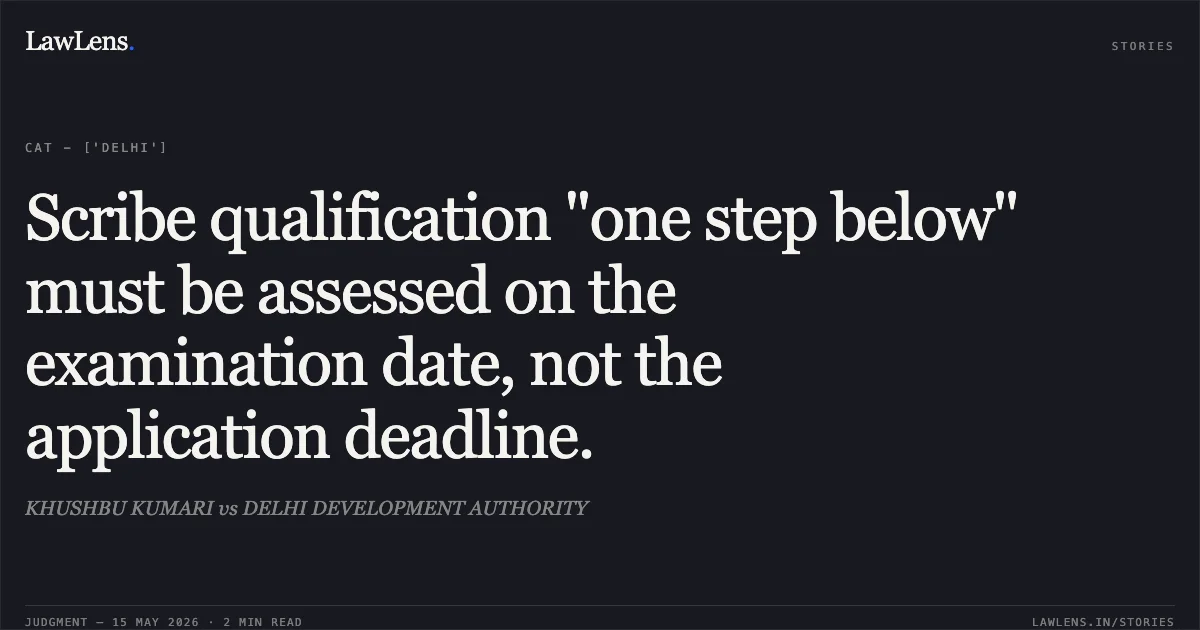
The Tribunal reasoned that the purpose of a scribe is to facilitate participation during the actual conduct of the exam, meaning the eligibility of the scribe must be determined relative to the candidate's status on the date of the examination, not the initial recruitment cut-off date.
Source reference: p. 12-13 / para 5.9-5.10On the date of the examination (28.09.2024), the applicant had already completed her Post-Graduation, making her graduate-level scribe "one step below" her current qualification.
Source reference: p. 5-6The Tribunal found that the DDA’s interpretation was "hyper-technical" and violated the spirit of the 2016 Act.
Source reference: p. 12 / para 5.9Since the applicant had disclosed all details and furnished the required undertaking without any misdeclaration or fraud, the respondents could not invalidate her selection after the process was complete.
Source reference: p. 13 / para 5.10Holding
The Tribunal held that the qualification of the scribe must be assessed with reference to the date of the examination.
It set aside the impugned communication dated 07.05.2025 and directed the DDA to appoint the applicant to the post of Assistant Section Officer based on her merit.
Source reference: p. 13 / para 6.1The applicant was granted consequential benefits, including seniority on a notional basis from the date similarly situated candidates were appointed, with actual financial benefits accruing from the date of joining.
Source reference: p. 13 / para 6.1The exercise must be completed within two months.
Source reference: p. 13 / para 6.2Original Court PDF
KHUSHBU KUMARIvsDELHI DEVELOPMENT AUTHORITY
Click to open original judgment
Original judgment, available to read, download and summarize on LawLens.in