01Facts
The petitioner, a salaried individual, filed his return for AY 2021–22 under Section 139(1) of the Income-tax Act, 1961, declaring total income of ₹8,87,790; the return was processed under Section 143(1) on 15 March 2022.
p. 3Based on information available on the Insight portal and material obtained during a search conducted on a third party on 7 September 2022, the Revenue alleged escapement of income of ₹11,85,000, representing a deduction claimed by the petitioner.
p. 3A notice under Section 148A(1) was issued on 31 March 2025, followed by an order under Section 148A(3) and a notice under Section 148 on 25 June 2025.
pp. 2–3The petitioner objected that the proceedings were time-barred and that, by virtue of Section 152(3), the pre-Finance (No. 2) Act, 2024 provisions applied because the reassessment was based on a search conducted between 1 April 2021 and 1 September 2024.
pp. 3–5The objections were rejected, leading to the present writ petition under Article 226 of the Constitution.
pp. 2–402Issues
i.Whether reassessment proceedings based on material discovered during a third-party search conducted on 7 September 2022 were required to be initiated under the pre-amendment provisions of Sections 147–151, by virtue of Section 152(3) of the Income-tax Act, 1961.
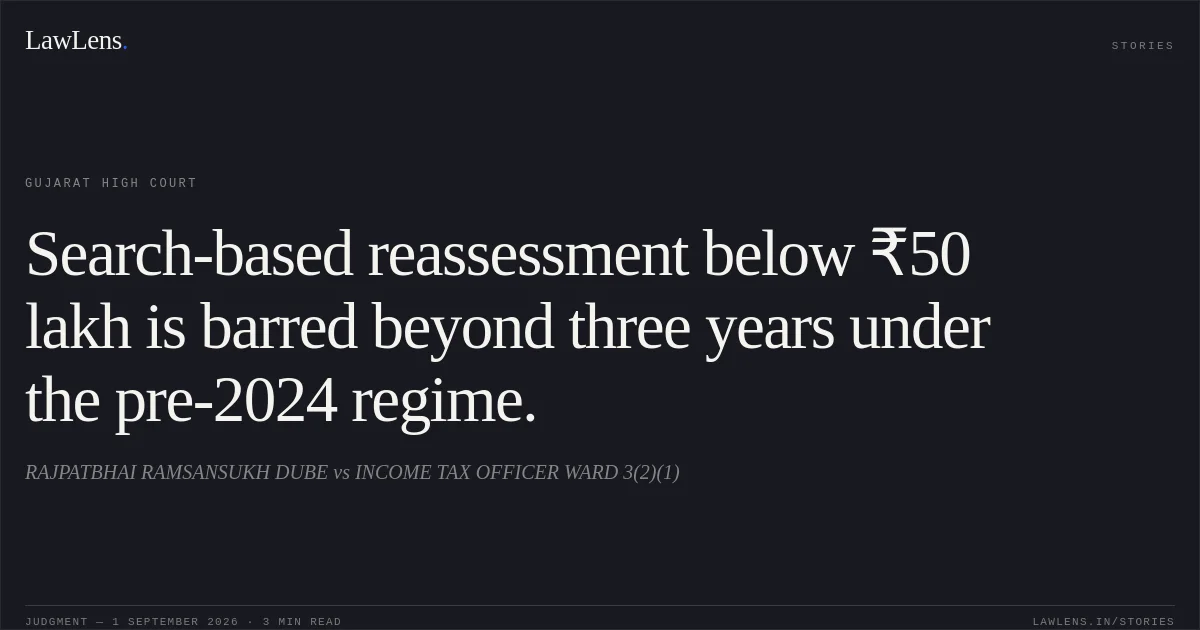
pp. 5–7ii.Whether the notice under Section 148 dated 25 June 2025 was barred by limitation under Section 149(1)(a), where the alleged escaped income was ₹11,85,000, below the statutory threshold of ₹50 lakh.
pp. 4–7iii.Whether the consequential notice under Section 148A(1), order under Section 148A(3), and notice under Section 148 were liable to be quashed.
p. 1003Law Applied
The Court applied Section 152(3) of the Income-tax Act, 1961, which provides that where a search under Section 132, requisition under Section 132A, or specified survey under Section 133A is conducted on or after 1 April 2021 but before 1 September 2024, Sections 147–151 apply as they stood immediately before the commencement of the Finance (No. 2) Act, 2024.
pp. 7–8Under the applicable pre-amendment Section 149(1), a notice under Section 148 could be issued beyond three years from the end of the relevant assessment year only where the escaped income represented in the prescribed form amounted to or was likely to amount to ₹50 lakh or more.
p. 8The Court relied on its earlier decision in Special Civil Application No. 15105 of 2025, decided on 15 June 2026, which held that Section 152(3) applies even where the assessee was not the person searched, if the reassessment proceedings were based on incriminating material found during the search.
pp. 7–10Provisions in the judgment · 15
Income Tax Act, 1961 14 provisions
Section 132Section 132ASection 133ASection 139Section 143Section 147Section 148Section 148ASection 149Section 150Section 151Section 152Section 153ASection 153CFinance Act, 2024 Section 149
04Reasoning
The Court found that the reassessment was expressly based on material emerging from a third-party search conducted on 7 September 2022, a date falling within the period specified in Section 152(3).
pp. 6–7Consequently, the pre-Finance (No. 2) Act, 2024 regime under Sections 147–151 governed the proceedings, and the Revenue was required to proceed under the old statutory framework rather than initiate proceedings under Section 148A of the amended regime.
p. 7Applying old Section 149(1), the Court held that the three-year limitation period for AY 2021–22 had expired, while the extended period was unavailable because the alleged escaped income of ₹11,85,000 was below ₹50 lakh.
pp. 6–9The Court considered its earlier decision directly applicable and rejected the Revenue’s position that Section 152(3) was confined to the searched person; the provision also applied to reassessment against another assessee where the proceedings originated from search material.
pp. 9–1005Holding
The Court answered the issues in favour of the petitioner.
It held that Section 152(3) required application of the pre-amendment provisions of Sections 147–151 and that the notice under Section 148 was issued beyond the permissible limitation period under Section 149 because the alleged escapement was below ₹50 lakh.
pp. 6–10Accordingly, the Court quashed and set aside the notice under Section 148A(1) dated 31 March 2025, the order under Section 148A(3) dated 25 June 2025, and the notice under Section 148 dated 25 June 2025.
p. 10The writ petition was allowed.
p. 10Original Court PDF
RAJPATBHAI RAMSANSUKH DUBEvsINCOME TAX OFFICER WARD 3(2)(1)
Click to open original judgment
Original judgment, available to read, download and summarize on LawLens.in