Facts
The respondent-workman claimed that he was appointed as a regular roj amdar by the petitioner on 11 November 1994 and worked continuously until his services were terminated on 31 December 2001 without justification.
Source reference: p.2After conciliation failed, the dispute was referred to the Labour Court, Junagadh, as Reference Case No. 187 of 2003.
Source reference: p.2The Labour Court partly allowed the reference on 19 May 2008 and directed reinstatement on the original post without back wages.
Source reference: p.2The petitioner contended that it was an Agricultural Produce Market Committee whose activities were seasonal, that the respondent was engaged as a daily-wage labourer only when work was available, that it was not an “industry,” and that the respondent had not completed 240 days of service in any relevant year.
Source reference: p.3The workman relied on attendance records showing service during 1994–2001 and on stock-register and market-fee records indicating that the petitioner had work and food-grain inflow throughout the relevant period.
Source reference: p.4Issues
Whether the petitioner’s activities constituted seasonal work or a seasonal industry, such that the respondent could be treated as engaged only intermittently or seasonally.
Source reference: pp.5–8Whether the respondent had established continuous service and completion of 240 days in the twelve months preceding termination, so as to attract the protections relating to retrenchment under the Industrial Disputes Act, 1947.
Source reference: pp.8–11Whether the Labour Court’s order directing reinstatement without back wages warranted interference under Article 226 of the Constitution.
Source reference: pp.11–12Law Applied
The Court applied Section 25B of the Industrial Disputes Act, 1947, under which a workman is deemed to be in continuous service if he has actually worked for 240 days during the preceding twelve calendar months.
Source reference: p.9The initial burden generally lies on the workman to prove completion of 240 days, but in cases involving daily-wage employment, the burden may shift when the workman enters the witness box and produces available documentary evidence, particularly where the employer possesses the best records such as muster rolls, wage registers and attendance registers; this principle was drawn from R.M. Yellatty v. Assistant Executive Engineer, as quoted in Director, Fisheries Terminal Division v. Bhikubhai Meghajibhai Chavda, 2009 (0) AIJEL-SC 47896.
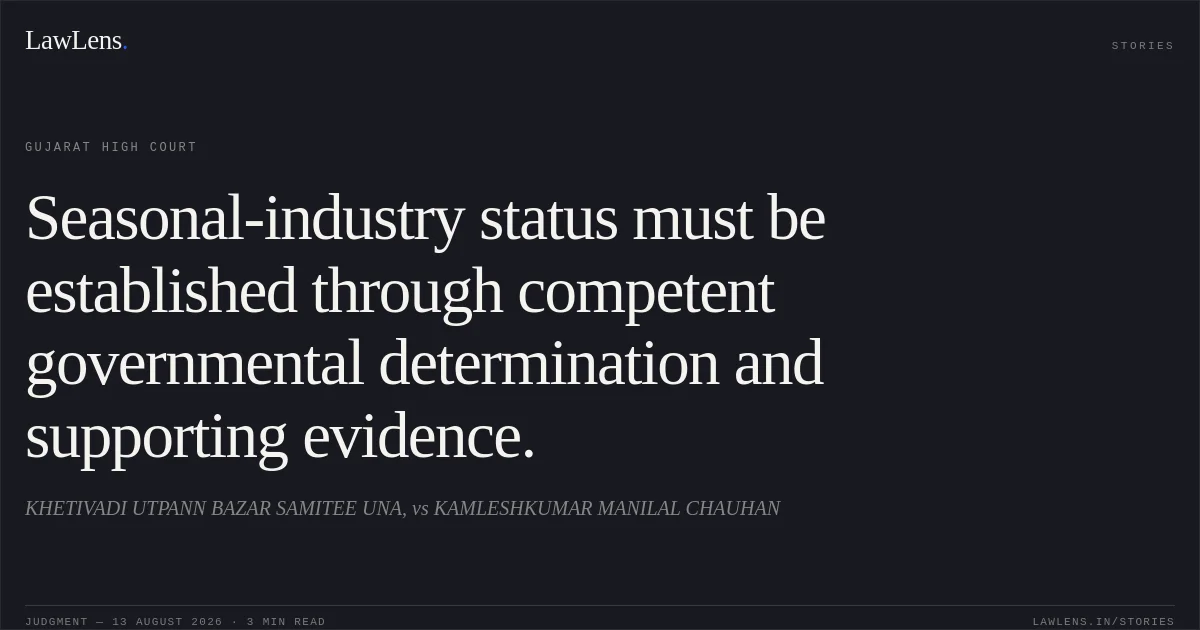
Source reference: pp.9–10The Court further relied on Director, Fisheries Terminal Division, holding that an assertion that an establishment is seasonal must be supported by appropriate governmental determination or other cogent evidence; mere assertion is insufficient.
Source reference: pp.8–9The Court also considered Ajnala Cooperative Sugar Mills Ltd. v. Sukhraj Singh, 2009 (17) SCC 326, but held that it did not assist the petitioner because that matter had been remanded for fresh consideration on its own facts.
Source reference: p.11Reasoning
The Court found that the petitioner’s claim of seasonal activity was unsupported by evidence.
Source reference: pp.5–7The stock register showed regular inward movement of food grains from October 1994 to September 2003, including during periods when the petitioner alleged that no work was available, while market-fee records demonstrated continuing commercial activity.
Source reference: pp.5–7The petitioner’s own evidence did not establish that the workman had been engaged only seasonally, and its witness admitted that the workman had worked from 1994 to 2001; significantly, the petitioner did not contend that the workman’s service had been interrupted during that period.
Source reference: p.6Applying the principles concerning continuous service and evidentiary burden, the Court held that the workman had produced sufficient attendance evidence and that the petitioner had failed to disprove continuous employment through reliable official records.
Source reference: pp.8–11Since the petitioner failed to establish that it was a seasonal industry or that the workman’s service was lawfully interrupted, the Labour Court’s factual findings were not perverse or legally untenable and did not warrant interference in writ jurisdiction.
Source reference: p.11Holding
The High Court answered the issues against the petitioner.
It held that the petitioner had not proved that its activities or the workman’s engagement were seasonal and had failed to establish a valid basis for denying the workman the benefit of continuous service and retrenchment protection.
Source reference: pp.7–11The petition was dismissed, the Labour Court’s award dated 19 May 2008 directing reinstatement on the original post without back wages was upheld, and any interim relief was vacated.
Source reference: p.12The petitioner was directed to comply with the award within four weeks from receipt of the order; no order as to costs was made.
Source reference: p.13Acts & Sections Cited
1 provisions across 1 statute referred to in this judgment. Linked provisions open on LawLens.
the APMC Act (alias, unresolved)1
Original Court PDF
KHETIVADI UTPANN BAZAR SAMITEE UNA,vsKAMLESHKUMAR MANILAL CHAUHAN
Click to open original judgment
Original judgment, available to read, download and summarize on LawLens.in