Facts
The suit land, Survey No. 665 at Village Timba, Taluka Satlasana, District Mehsana, was allotted by the Government in 1967 as new-tenure land to Sardarji Hathiji.
Source reference: paras. 4–4.4, 8–9; pp. 2–5, 10–13After his death in 1972, his widow Samuben and four daughters—the plaintiffs—were his Class-I legal heirs and became co-owners.
Source reference: paras. 4–4.4, 8–9; pp. 2–5, 10–13However, in 2003, the predecessor of the defendants, Takhaji Motiji, obtained Mutation Entry No. 1809 in his favour on the basis of Samuben’s statement and a pedigree that did not disclose the plaintiffs as heirs.
Source reference: paras. 4–4.4, 8–9; pp. 2–5, 10–13The defendants claimed that Samuben had sold the land to Karshanbhai Patel through a registered sale deed dated 22 April 1974, and that Takhaji subsequently obtained possession from Karshanbhai under an agreement dated 31 March 1987.
Source reference: paras. 4.2–4.3, 5, 6.1; pp. 3, 6–10Neither the alleged sale deed nor the sale agreement was produced in evidence, and Karshanbhai was not examined.
Source reference: paras. 4.2–4.3, 5, 6.1; pp. 3, 6–10The plaintiffs challenged the mutation entry and thereafter instituted Special Civil Suit No. 6 of 2018 on 5 March 2014, seeking declaration of their co-ownership and possession.
Source reference: paras. 2, 4.6–4.10; pp. 1, 4–5The Trial Court decreed the suit on 12 January 2023. The First Appellate Court dismissed the defendants’ appeal, Regular Civil Appeal No. 7 of 2023, on 17 July 2026 and confirmed the decree.
Source reference: paras. 2, 4.6–4.10; pp. 1, 4–5The defendants then preferred the present second appeal under Section 100 of the Code of Civil Procedure, 1908.
Source reference: no citationIssues
1. Whether the defendants established a valid transfer of title in favour of their predecessor through the alleged 1974 sale deed and 1987 sale agreement, despite not producing those documents or examining the alleged vendor?
Source reference: paras. 5.3, 6–7; pp. 7–102. Whether the plaintiffs, as the deceased owner’s Class-I legal heirs, retained co-ownership rights in the suit land notwithstanding the mutation of the defendants’ predecessor’s name in the revenue record?
Source reference: paras. 4.8, 8–10; pp. 5, 10–133. Whether the suit was barred by limitation, and whether the concurrent findings of the Courts below disclosed a substantial question of law warranting interference under Section 100 CPC?
Source reference: paras. 5.2, 11, 13–14; pp. 7, 14–17Law Applied
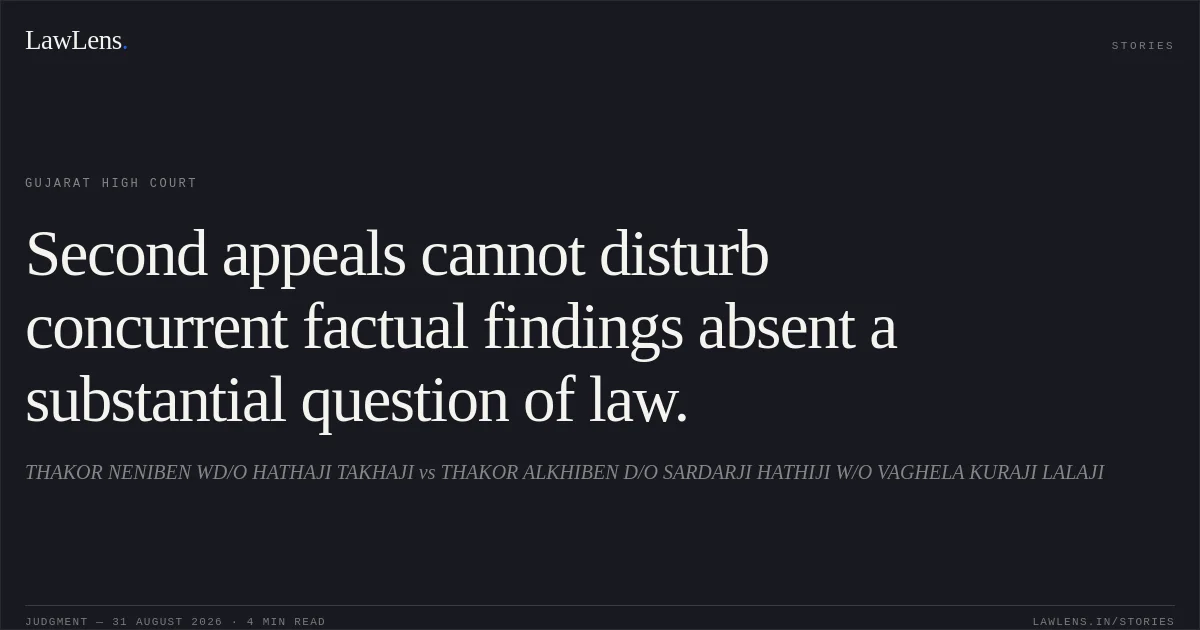
The Court applied Section 100 CPC, under which a second appeal lies only when a substantial question of law is involved; concurrent findings of fact ordinarily cannot be disturbed unless perverse, legally erroneous, based on inadmissible evidence, or unsupported by evidence.
Source reference: paras. 12–13; pp. 14–16It held that pleadings are not a substitute for proof and that title must be established through a valid registered document or lawful inheritance.
Source reference: paras. 7, 10; pp. 10, 13A revenue mutation entry is fiscal in character and does not confer title.
Source reference: para. 10; p. 13The Court further proceeded on the basis that the new-tenure land could not be transferred by the original owner or heirs without the requisite governmental/Collector permission.
Source reference: paras. 4.3, 6–6.1; pp. 3, 9–10For limitation, it relied on Articles 65 and 110 of the Limitation Act, 1963, holding that the plaintiffs’ suit filed within twelve years from the mutation entry dated 30 December 2003 was within time.
Source reference: para. 11; p. 14The Court relied on Russi Fisheries (P) Ltd. v. Bhavna Seth, 2026 SCC OnLine SC 555, and Jaichand (Dead) through LRs v. Sahnulal, 2024 SCC OnLine SC 3864, concerning the restricted scope of interference with factual findings in a second appeal.
Source reference: paras. 12–12.1; pp. 14–16Reasoning
The Court found that the defendants failed to prove either alleged transaction: the 1974 sale deed was not produced, the 1987 agreement was not proved, and the alleged vendor was not examined.
Source reference: paras. 6–7; pp. 9–10Since the suit land was new-tenure property, the alleged transfers were additionally incapable of conferring valid title without the required permission.
Source reference: para. 6.1; p. 10The evidence and admissions showed that Sardarji Hathiji’s widow and daughters were his legal heirs, whereas Takhaji was not shown to be a Class-I heir or otherwise legally entitled to inherit the land.
Source reference: paras. 8–9; pp. 10–13The mutation entry was therefore insufficient to establish ownership, particularly as it was based on an incorrect pedigree omitting the plaintiffs’ names.
Source reference: paras. 8.1, 10; pp. 11–13The suit was held to be within the applicable twelve-year limitation period calculated from the 2003 mutation entry.
Source reference: para. 11; p. 14As both lower Courts had reached concurrent factual findings supported by the record, and the appellants’ proposed questions did not constitute substantial questions of law, Section 100 CPC did not permit appellate interference.
Source reference: paras. 12–13; pp. 14–16Holding
The High Court held that the plaintiffs remained entitled to their lawful shares as the Class-I legal heirs and co-owners of the suit land; the defendants failed to establish any valid title through the alleged sale transactions or mutation entry.
The suit was not barred by limitation, and no substantial question of law arose for consideration under Section 100 CPC.
Source reference: paras. 10–14; pp. 13–17The second appeal was accordingly dismissed in limine.
Source reference: para. 14; p. 17The connected Civil Application for stay was disposed of as infructuous, with no order as to costs, and the decree was directed to be drawn accordingly.
Source reference: para. 14; p. 17Acts & Sections Cited
1 provisions across 1 statute referred to in this judgment. Each provision opens on LawLens.
Code of Civil Procedure, 19081
Original Court PDF
THAKOR NENIBEN WD/O HATHAJI TAKHAJIvsTHAKOR ALKHIBEN D/O SARDARJI HATHIJI W/O VAGHELA KURAJI LALAJI
Click to open original judgment
Original judgment, available to read, download and summarize on LawLens.in