Facts
Late Shri Pramod Kumar Bedharak, a Railway employee, died in harness on December 7, 2011.
Source reference: p.5Two women, Smt. Shakuntala Devi and Smt. Shimla Devi, both claimed to be his legally wedded wives and sought compassionate appointment and other terminal benefits.
Source reference: p.5, p.6Smt. Shimla Devi, the first wife, had married the deceased in 1978 and had an unmarried daughter and a married son.
Source reference: p.6Smt. Shakuntala Devi claimed her marriage to the deceased on May 2, 2005, after Smt. Shimla Devi allegedly deserted him.
Source reference: no citationSmt. Shakuntala Devi's name and her children's names were recorded in official Railway records during the deceased's lifetime.
Source reference: p.5The Railway Administration, facing rival claims, directed both women to obtain a succession certificate as a precondition for considering their claims, citing the need to avoid wrongful disbursement.
Source reference: p.5, p.7This directive led to these original applications challenging the insistence on a succession certificate and seeking the release of benefits.
Source reference: p.6Issues
1. Whether Smt. Shakuntala Devi is the legally wedded wife of the deceased employee, Late Shri Pramod Kumar Bedharak, entitled to family pension under the Railway Services (Pension) Rules, 1993.
Source reference: p.132. Whether the insistence by the Railway Administration on a succession certificate for disbursal of family pension and other retiral benefits to the claimants is legally sound.
Source reference: p.183. Whether children born from the second marriage are eligible for consideration for compassionate appointment.
Source reference: p.18Law Applied
The Tribunal primarily applied Rule 75(7)(i)(a) of the Railway Services (Pension) Rules, 1993, which addresses family pension payments to multiple widows, interpreting "widows" to mean legally wedded wives.
Source reference: p.12, p.16It relied on the Hindu Marriage Act, 1955, particularly the prohibition against bigamy, stating that a second marriage during the subsistence of a first marriage is void ab initio.
Source reference: p.14Precedents from the Hon’ble Supreme Court in *Rameshwari Devi v. State of Bihar & Others* (2000) 2 SCC 431, and the Hon’ble Allahabad High Court in *Chandra Kali v. State of U.P. & Others* (Writ ‘A’ No. 3288 of 2017), were crucial in establishing that a second marriage during the subsistence of a valid first marriage is void under Hindu law.
Source reference: p.14For compassionate appointment, the Tribunal considered the Railway Board Circular dated January 2, 1992, and the legal position established by the Hon’ble Calcutta High Court in *Smt. Namita Golder & Another v. Union of India & Others* (2010), holding that children of a second marriage are legitimate and thus eligible for consideration.
Source reference: p.17-18Reasoning
The Tribunal analyzed the marital status of Smt. Shakuntala Devi, finding no evidence that the first marriage between the deceased and Smt. Shimla Devi was ever legally dissolved through a competent court.
Source reference: p.13-14The argument of customary divorce based on desertion within the 'Shudra' community, relying on *M. Govindaraju v. K. Munisami Gounder* (AIR 1997 SC 10), was rejected as the custom in Karnataka could not be applied to the 'Shudra' community in Uttar Pradesh without specific evidence of its prevalence, which was not adduced.
Source reference: p.13-14Therefore, the Tribunal concluded that Smt. Shakuntala Devi's marriage was void *ab initio* under the Hindu Marriage Act, 1955, following the Supreme Court's pronouncement in *Rameshwari Devi*.
Source reference: p.14This meant that Smt. Shakuntala Devi was not a "legally wedded wife" and, consequently, not a "widow" under Rule 75(7) of the Railway Services (Pension) Rules, 1993.
Source reference: p.16-17The court distinguished *Smt. M. Samadhanam* as it involved a compromise and declaratory suit.
Source reference: p.15The insistence on a succession certificate for pension disbursement was deemed an abdication of the competent authority's duty, as the legal entitlement of the first wife was clear under service rules.
Source reference: p.18For compassionate appointment, while the second marriage was void, the children born from it were considered legitimate, and consistent with judicial precedents, their claim for compassionate appointment could not be denied solely on the ground of the second marriage's invalidity, provided they met other eligibility criteria.
Source reference: p.17-18Holding
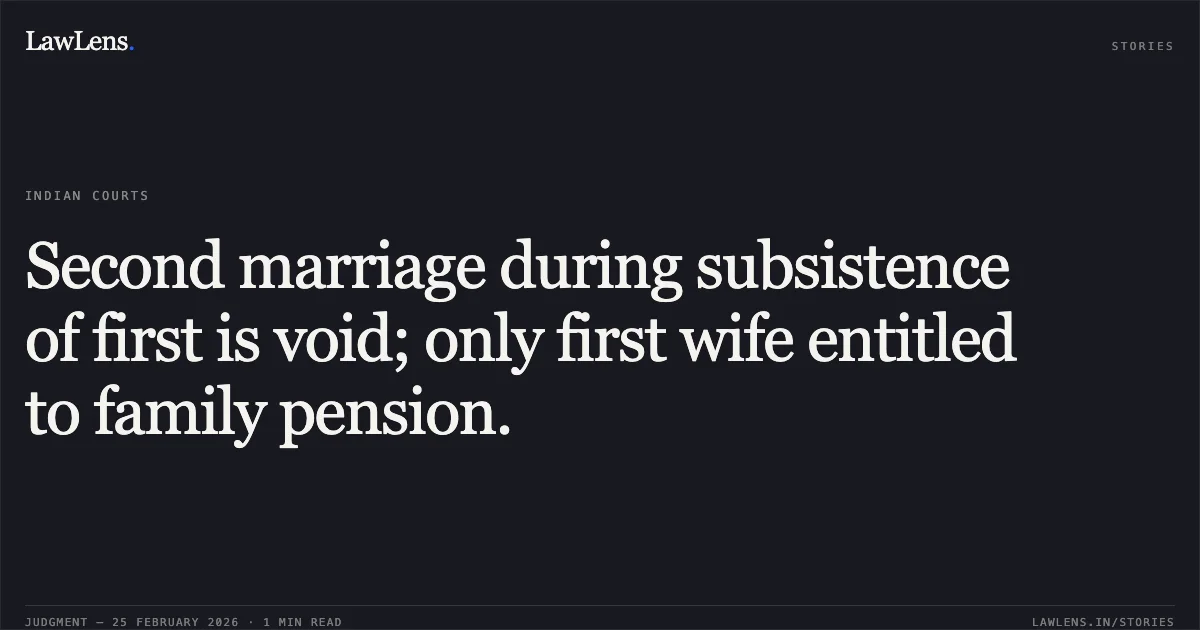
The Tribunal concluded that Smt. Shakuntala Devi’s marriage to Late Shri Pramod Kumar Bedharak was not a valid marriage under Hindu law, as Smt. Shimla Devi remained his legally wedded first wife.
Consequently, family pension is only admissible to Smt. Shimla Devi, the legally wedded first wife, and cannot be shared with Smt. Shakuntala Devi.
Source reference: p.17The impugned orders from the Railway Administration directing the claimants to obtain a succession certificate were quashed and set aside.
Source reference: p.18, p.19The respondents were directed to release the family pension in favor of Smt. Shimla Devi within three months.
Source reference: p.18, p.19Regarding compassionate appointment, the Tribunal held that children born from the second marriage are legitimate and eligible for consideration, and the respondents were directed to decide on compassionate appointment applications from both families based on applicable rules and a proper enquiry, without insisting on a succession certificate, within three months.
Source reference: p.18, p.19Acts & Sections Cited
4 provisions across 3 statutes referred to in this judgment. Each provision opens on LawLens.
Administrative Tribunals Act, 19852
Code of Criminal Procedure, 19731
Indian Penal Code, 18601
Original Court PDF
Smt. Shakuntala Devi W/o Late Pramod Kumar urf “Bedharak” v. Union of India through the General Manager, North Central Railway, Original Application No. 1485 of 2013 with Original Application No. 194 of 2013 and Original Application No. 1737 of 2012.
Click to open original judgment
Original judgment, available to read, download and summarize on LawLens.in