Facts
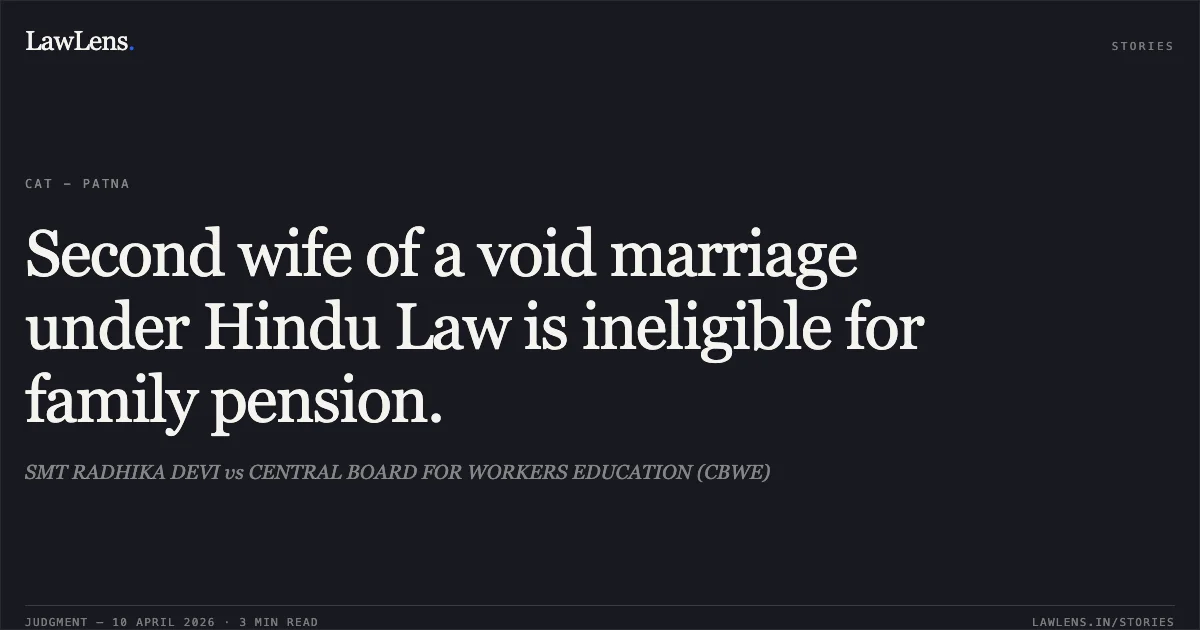
The applicant is the first legally wedded wife of late Lalan Jee Pathak, a former Regional Director in the Central Board of Worker Education, who died on December 14, 2019
Source reference: p. 2Prior to his death, the applicant had filed for maintenance and sought recording of her name in his service records
Source reference: p. 2After his demise, the Respondent department, vide order dated October 19, 2022, sanctioned 50% of the family pension to the applicant and 50% to Respondent No. 5, who claimed to be the second wife married to the deceased in 1971
Source reference: p. 3-4The Respondents justified this split citing Rule 50(6)(g) of the CCS (Pension) Rules, 2021
Source reference: p. 5-6The applicant challenged this order, seeking 100% family pension on the grounds that the second marriage was void under Hindu Law
Source reference: p. 3Issues
1. Whether the family pension of an employee who died in 2019 is governed by the CCS (Pension) Rules, 1972 or the CCS (Pension) Rules, 2021
Source reference: p. 72. Whether a second wife, whose marriage was solemnized during the subsistence of a valid first marriage under Hindu Law, is entitled to a share of the family pension
Source reference: p. 8-93. Whether the applicant is entitled to the full 100% family pension in the absence of eligible children from the second marriage
Source reference: p. 10-12Law Applied
The Tribunal applied Rule 87(2) of the CCS (Pension) Rules, 2021, which stipulates that cases where the employee died before the commencement of the 2021 Rules (December 20, 2021) are governed by the CCS (Pension) Rules, 1972
Source reference: p. 7It further relied on Sections 5(1), 11, and 17 of the Hindu Marriage Act, 1955, which render a second marriage during the lifetime of a spouse void
Source reference: p. 8The Tribunal also considered Rule 54(7)(a)(i) of the 1972 Rules regarding multiple widows and various precedents, including Dular i Devi v. State of Bihar, which established that a second wife of a Hindu employee is not entitled to family pension if the first marriage was subsisting
Source reference: p. 7, 9Reasoning
The Tribunal observed that since the employee died in 2019, the Respondents erred in applying the 2021 Rules; the case must be adjudicated under the 1972 Rules
Source reference: p. 7Under the Hindu Marriage Act, 1955, the marriage of Respondent No. 5 with the deceased was void as the applicant (the first wife) was alive and not divorced at the time
Source reference: p. 8-9Consequently, Respondent No. 5 cannot be recognized as a "widow" for the purposes of family pension
Source reference: p. 9While children from a void marriage are entitled to a share of the pension under Rule 54 of the 1972 Rules and relevant OMs, the record showed no evidence of eligible children from the second marriage
Source reference: p. 10-11The Tribunal noted that the Respondents failed to prove any legal divorce between the applicant and the deceased, and thus, the applicant remained the sole legally wedded wife entitled to the pensionary benefits
Source reference: p. 11-12Holding
The Tribunal held that Respondent No. 5 is not entitled to any share of the family pension
It directed the competent authority to ensure the payment of family pension to the applicant and any eligible children of the deceased strictly in accordance with Rule 54(6) of the CCS (Pension) Rules, 1972
Source reference: p. 12The Respondents were granted liberty to conduct a necessary inquiry regarding the eligibility of any children of the deceased
Source reference: p. 12The impugned order was set aside to the extent of the 50% grant to the second wife, and the authorities were ordered to pass fresh orders within six months
Source reference: p. 12The OA was disposed of with no order as to costs
Source reference: p. 12Acts & Sections Cited
5 provisions across 2 statutes referred to in this judgment. Each provision opens on LawLens.
Hindu Marriage Act, 19553
Indian Penal Code, 18602
Original Court PDF
SMT RADHIKA DEVIvsCENTRAL BOARD FOR WORKERS EDUCATION (CBWE)
Click to open original judgment
Original judgment, available to read, download and summarize on LawLens.in