Facts
The Appellant (husband) and Respondent (wife) were married in 1997 and have two children.
Source reference: p. 2-3In 2017, the husband filed for divorce under Section 13(1)(i-a) of the Hindu Marriage Act, alleging mental cruelty.
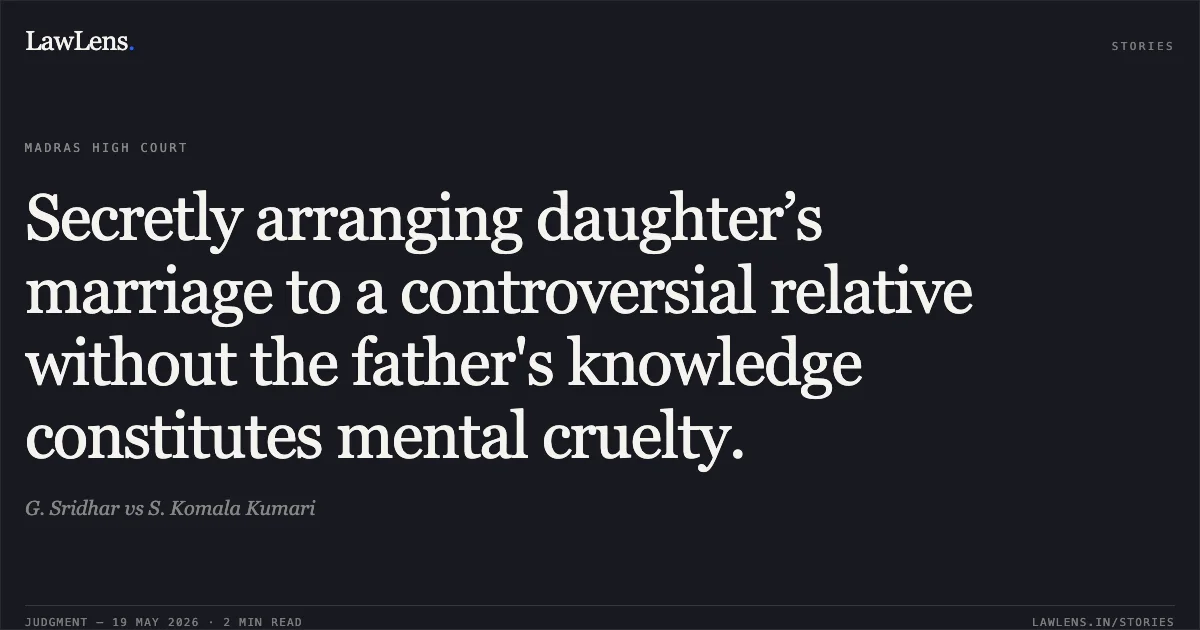
Source reference: p. 3The primary trigger was the wife surreptitiously taking their 18-year-old daughter to Bangalore to marry the wife’s brother—a 32-year-old divorcee with a criminal record—without the husband's knowledge or consent.
Source reference: p. 3, 10-11Substituted by this, the wife lodged police complaints against the husband, complained to his superior officers at the Greater Chennai Corporation, and broke open their flat to remove belongings.
Source reference: p. 4, 14The Family Court dismissed the husband's divorce petition and allowed the wife’s application for restitution of conjugal rights.
Source reference: p. 6Issues
1. Whether the act of the wife arranging the daughter’s marriage surreptitiously to a person of controversial background without informing the father constitutes mental cruelty.
Source reference: p. 11-122. Whether the wife’s subsequent conduct of lodging complaints with the husband’s employers and the police amounts to cruelty.
Source reference: p. 143. Whether the Trial Court erred in dismissing the divorce petition and granting restitution of conjugal rights.
Source reference: p. 19Law Applied
The Court applied Section 13(1)(i-a) of the Hindu Marriage Act, 1955, regarding divorce on the ground of cruelty.
Source reference: p. 8, 15-17It relied on the landmark precedent Samar Ghosh v. Jaya Ghosh (2007) 4 SCC 511, which established that mental cruelty is a state of mind causing deep anguish and frustration, evaluated by reviewing the married life as a whole.
Source reference: no citationThe Court also referenced Vishwanath Agrawal v. Sarla Vishwanath Agrawal (2012) 7 SCC 288, noting that cruelty has an inseparable nexus with human conduct and social milieu.
Source reference: p. 8It further observed that while "irretrievable breakdown of marriage" is not a statutory ground for High Courts, long separation and acts damaging reputation are factors in assessing cruelty.
Source reference: p. 8-9Reasoning
The Court reasoned that the husband, as a father, suffered irreparable mental agony due to the wife's "surreptitious" conduct regarding their daughter’s marriage.
Source reference: p. 12The court noted the husband was never informed of the wedding and only learned of it a week later.
Source reference: p. 12The court emphasized the husband's pain in seeing his daughter married at 18 to a significantly older divorcee with a history of police custody.
Source reference: p. 13The court found that the wife’s actions—lodging complaints with the husband's superior officers and the police—were calculated to damage his reputation and career, which fits the criteria for mental cruelty under the Samar Ghosh guidelines.
Source reference: p. 14, 18The Court noted that the wife had sold the matrimonial home and kept the surplus proceeds, effectively making the continuation of a shared household impossible.
Source reference: p. 18-19Holding
The High Court set aside the Family Court's orders. It held that the cumulative effect of the wife’s actions, specifically the secret marriage of the daughter and the humiliating complaints to the husband's employer, constituted grave mental cruelty.
The appeal was allowed: the husband was granted a decree of divorce, and the order for restitution of conjugal rights in favor of the wife was set aside.
Source reference: p. 19Acts & Sections Cited
2 provisions across 2 statutes referred to in this judgment. Each provision opens on LawLens.
Family Courts Act, 19841
Hindu Marriage Act, 19551
Original Court PDF
G. SridharvsS. Komala Kumari
Click to open original judgment
Original judgment, available to read, download and summarize on LawLens.in