Facts
The opposite parties pursued Title Suit No. 878 of 2018 for recovery of khas possession of the suit property against the petitioner, who had been inducted as a licensee by Tapan Kumar Ghosh, the original owner.
Source reference: p.3–4, paras. 12–13After Tapan Kumar Ghosh’s death, the opposite parties claimed succession through his sister, Pubali Bishnu Majumdar, who was subsequently substituted by the present opposite parties after her death.
Source reference: p.3–4, paras. 12–13The petitioner contested the suit and asserted ownership on the basis of a will allegedly executed by Tapan Kumar Ghosh; he also claimed to be the executor and legatee under that will.
Source reference: p.4, para. 13A probate proceeding, Misc. Case No. 175 of 2019(P), was instituted before the District Delegate, Barrackpore.
Source reference: p.4, para. 13The petitioner sought stay of the possession suit under Section 10 CPC pending disposal of the probate proceeding.
Source reference: p.4, para. 13By the time of the application, evidence in the possession suit had concluded and the matter had been fixed for arguments.
Source reference: p.4, para. 15The probate proceeding was dismissed for default on 18 March 2026, and only an application under Section 151 CPC for recall of that dismissal remained pending.
Source reference: p.4, para. 16The trial court rejected the petitioner’s application under Section 10 CPC, leading to the present Article 227 petition.
Source reference: p.1–2, paras. 1–5Issues
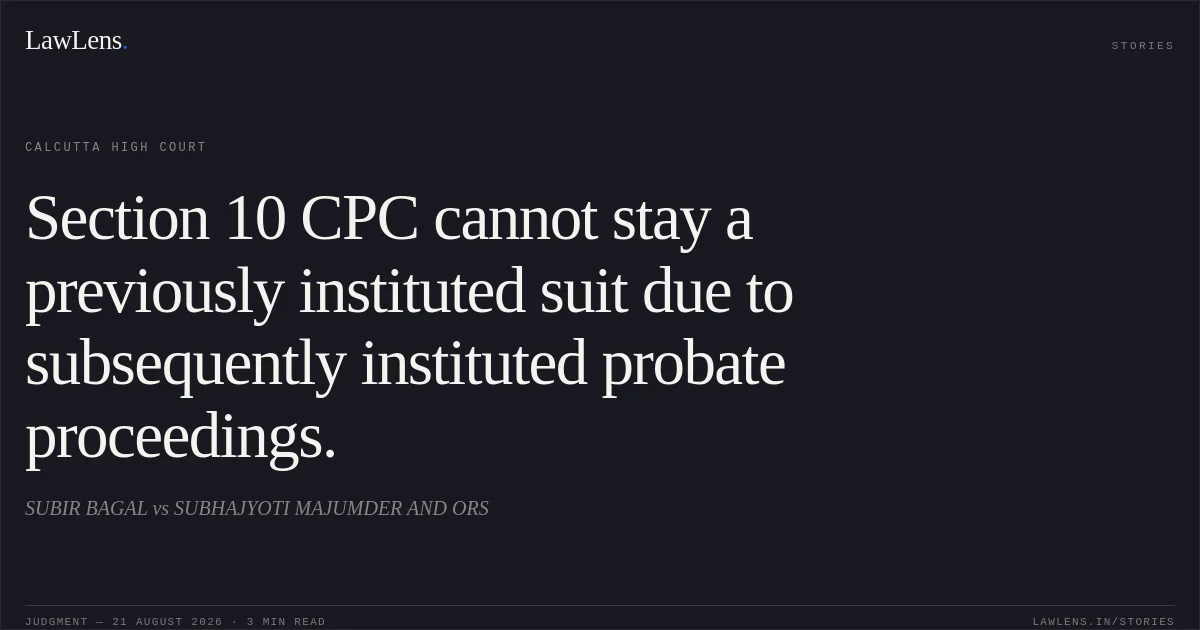
Whether Section 10 of the Code of Civil Procedure could be invoked to stay the previously instituted suit for recovery of khas possession on the ground of a subsequently instituted probate proceeding.
Source reference: p.5, paras. 21–23Whether, despite Section 10 being inapplicable, the High Court should exercise its inherent jurisdiction under Section 151 CPC to stay the possession suit until disposal or revival of the probate proceeding.
Source reference: p.6, paras. 24–30Whether the mere pendency of an application to recall the dismissal of the probate proceeding revived that proceeding or justified staying a suit already fixed for final arguments.
Source reference: p.6–7, paras. 27–30Law Applied
Section 10 CPC applies where a previously instituted suit involving the same matter directly and substantially in issue is pending; it operates as a bar against proceeding with the subsequently instituted suit and does not ordinarily authorise staying the previously instituted suit.
Source reference: p.5, paras. 21–23In cases outside Section 10, the court may, in exceptional circumstances, exercise inherent powers under Section 151 CPC to make orders necessary in the interests of justice.
Source reference: p.6, para. 24A probate court determines the validity and genuineness of the execution of a will concerning the properties covered by it, but does not adjudicate title to the property.
Source reference: p.6, para. 25In Indrajit Mukherjee v. Pradip Kumar Halder, the court permitted the possession suit to proceed up to the stage preceding arguments where the probate determination could affect the suit, while postponing final argument and adjudication.
Source reference: p.4–5, para. 18Nirmala Devi v. Arun Kumar Gupta and Balbir Singh Wasu v. Lakhbir Singh involved clubbing or transfer of overlapping title and probate proceedings, but were not authorities requiring stay of a previously instituted possession suit under Section 10 CPC.
Source reference: p.5, paras. 19–20; p.7–8, para. 34The court also considered Sri Binod Prasad v. Haridas Sen, Sri Supriya Saha v. Sushma Das, and Amrita v. Rakesh Kumar.
Source reference: p.2–3, paras. 7–9; p.7–8, paras. 31–35Reasoning
Section 10 CPC was held inapplicable because the possession suit was the previously instituted proceeding, whereas the probate case was subsequent; the petitioner was effectively seeking to stay the prior suit, which Section 10 does not contemplate.
Source reference: p.5, paras. 21–23Although the court recognised that a probate determination concerning the will might have some impact on the parties’ claims in the possession suit, any discretionary stay under Section 151 CPC had to be assessed in the factual context.
Source reference: p.6, paras. 24–26Here, the possession suit had already completed evidence and reached the stage of arguments, while the probate proceeding had been dismissed for default.
Source reference: p.6–7, paras. 27–30The pending recall application did not, by itself, revive the dismissed probate proceeding or establish its present legal existence.
Source reference: p.6–7, paras. 27–30Consequently, the limited procedural approach adopted in Indrajit Mukherjee did not warrant delaying the final adjudication of the possession suit in these circumstances.
Source reference: p.6–7, paras. 26–30Holding
The High Court held that Section 10 CPC did not apply because the petitioner sought to stay a previously instituted possession suit on the basis of a subsequent probate proceeding.
It further held that the dismissed probate proceeding, coupled only with a pending recall application, did not justify an inherent stay under Section 151 CPC.
Source reference: p.7–8, para. 36The trial court’s order rejecting the stay application was therefore upheld, and C.O. No. 2523 of 2026 was dismissed without any order as to costs.
Source reference: p.7–8, para. 36Acts & Sections Cited
2 provisions across 1 statute referred to in this judgment. Each provision opens on LawLens.
Code of Civil Procedure, 19082
Original Court PDF
SUBIR BAGALvsSUBHAJYOTI MAJUMDER AND ORS
Click to open original judgment
Original judgment, available to read, download and summarize on LawLens.in