Facts
The plaintiff sought specific performance of an agreement dated 22 March 2007 to purchase the suit property for ₹4,00,000, alleging payment of ₹3,00,000 as advance and readiness to pay the balance. The defendants admitted executing the agreement but contended that it was security for a loan: they said ₹2,80,000 was paid to discharge an existing Sundaram Finance debt, while the alleged remaining ₹20,000 was not paid.
Source reference: p. 2–5, 12The Trial Court decreed specific performance; the defendants’ first appeal was allowed and the Trial Court’s decree set aside. The defendants then brought this second appeal. The High Court dismissed the second appeal and confirmed the First Appellate Court’s judgment.
Source reference: p. 6, 12, 14Issues
1. Whether the findings concerning Ex.A1 were vitiated by failure to consider the oral and documentary evidence relevant to whether it was a sale agreement or security for a loan.
Source reference: p. 62. Whether the courts erred in applying Sections 91 and 92 of the Evidence Act without considering the proviso to Section 92 and the defendants’ evidence.
Source reference: p. 63. Whether the grant of specific performance was consistent with Sections 16 and 20 of the Specific Relief Act, having regard to the defendants’ case.
Source reference: p. 64. Whether the First Appellate Court independently considered the appeal in compliance with Order XLI Rule 31 CPC.
Source reference: p. 6Law Applied
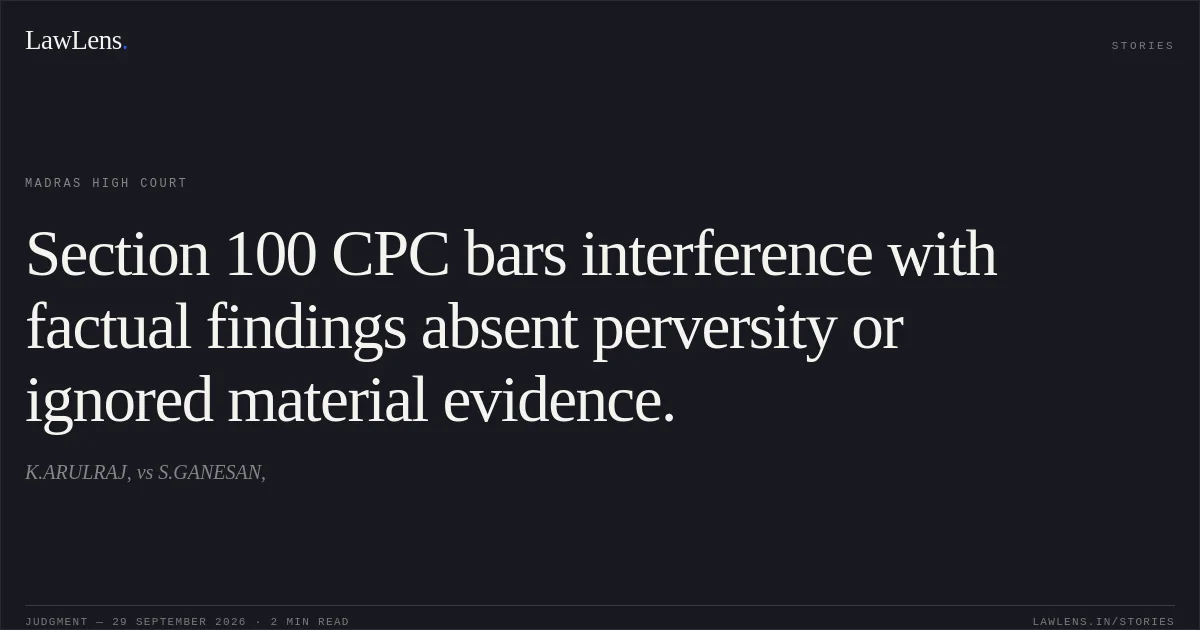
Under Section 100 CPC, a second appeal warrants interference only where a substantial question of law arises; a possible alternative view of the evidence is insufficient, absent perversity, a finding based on no evidence, or disregard of material evidence.
Source reference: para. 18–19The judgment identifies Sections 91 and 92 of the Evidence Act, Sections 16 and 20 of the Specific Relief Act, and Order XLI Rule 31 CPC as issues raised in the appeal, but does not set out or apply a separate doctrinal test under those provisions.
Source reference: p. 6It treats the contention that the written sale agreement was merely security for a loan as a factual plea to be established by the party asserting it.
Source reference: para. 16Reasoning
The Court held that the defendants had not shown that the findings were unsupported by evidence, perverse, or based on the omission of material evidence; the fact that another view might be possible did not justify intervention under Section 100 CPC.
Source reference: para. 16–19It also considered the agreement, the stipulated completion period, the parties’ conduct, and the plaintiff’s legal notice, noting that no reply had been sent disputing the agreement or alleging a loan transaction.
Source reference: para. 15, 17The Court did not separately analyse the statutory arguments under Sections 91–92 of the Evidence Act, Sections 16–20 of the Specific Relief Act, or Order XLI Rule 31 CPC.
Source reference: no citationThe reasoning contains an apparent inconsistency: it refers to concurrent findings in the plaintiff’s favour, although its procedural account states that the First Appellate Court allowed the defendants’ appeal and its final order confirms that appellate judgment.
Source reference: para. 3, 18–20Holding
The Court answered the substantial questions of law against the appellants.
The Court dismissed the second appeal, and confirmed the First Appellate Court’s judgment and decree, with no order as to costs.
Source reference: para. 19, p. 14Acts & Sections Cited
4 provisions across 3 statutes referred to in this judgment. Each provision opens on LawLens.
Code of Civil Procedure, 19081
Specific Relief Act, 19632
Negotiable Instruments Act, 18811
Original Court PDF
K.ARULRAJ,vsS.GANESAN,
Click to open original judgment
Original judgment, available to read, download and summarize on LawLens.in