Facts
The three appellants and the deceased, all coworkers from Bihar, resided together in a single rented room in Salakati, Assam.
Source reference: para. 19, 25On 02.10.2018, a co-tenant (PW14) witnessed a quarrel between the appellants and the deceased.
Source reference: para. 25Upon PW14's return from a brief absence, he discovered the deceased lying on the floor with a fatal stab wound.
Source reference: para. 25Other witnesses (PW1, PW2) testified that the appellants attempted to flee the scene but were apprehended by villagers.
Source reference: para. 12, 13, 17A knife was recovered from the vicinity of the room.
Source reference: para. 16, 28The medical report confirmed death due to hypovolemic shock from a homicidal stab injury.
Source reference: para. 23The Trial Court convicted the appellants under Section 302/34 of the IPC.
Source reference: para. 2The appellants challenged the conviction on the grounds that the case relied solely on circumstantial evidence with no proved motive or forensic linkage of the weapon.
Source reference: para. 7, 8Issues
Whether the prosecution established a complete chain of circumstantial evidence sufficient to prove the guilt of the accused beyond reasonable doubt?
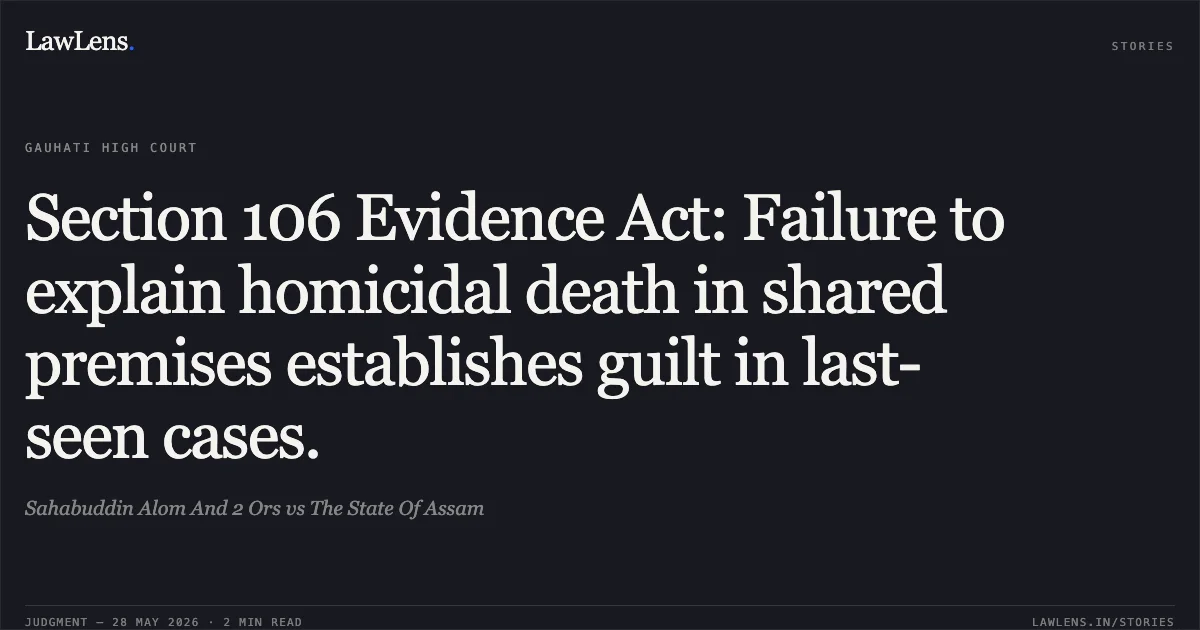
Source reference: para. 7, 30Whether the "Last Seen Theory" and the failure of the accused to provide an explanation under Section 106 of the Evidence Act support a conviction in a case of homicidal death occurring within a shared residence?
Source reference: para. 10, 31, 35Law Applied
The court applied Section 302/34 of the Indian Penal Code regarding murder and common intention and Section 415(2) of the Bharatiya Nagarik Suraksha Sanhita, 2023 for the appeal process.
Source reference: para. 2, 6Section 106 of the Evidence Act, which places the burden of proving facts especially within the knowledge of a person upon that person.
Source reference: para. 32The "Last Seen Theory" as explained in Ganpat Singh v. State of Madhya Pradesh, emphasizing the proximity of time between the last sighting and the death.
Source reference: para. 36Principle from Trimuk Maruti Kirkan v. State of Maharashtra, which mandates that inmates of a house must provide a cogent explanation for a murder committed in secrecy within that house.
Source reference: para. 35Reasoning
The Court found that the prosecution successfully established the foundational facts: the appellants and deceased shared a room, and the appellants were the only persons present during a quarrel immediately preceding the death.
Source reference: para. 30, 36The "Last Seen" interval was so minute—the time it took PW14 to freshen up at a tube-well—that the intervention of a third party was effectively ruled out.
Source reference: para. 34, 36Applying Section 106 of the Evidence Act, the Court reasoned that since the death occurred in a private shared space, the circumstances leading to the stabbing were "especially within the knowledge" of the appellants.
Source reference: para. 31, 33The Court dismissed the defense's argument regarding the lack of motive and forensic testing, noting that the appellants' attempt to flee (conduct under Section 8 of the Evidence Act) and their silence/failure to offer any explanation during their Section 313 Cr.PC examination reinforced the inference of guilt.
Source reference: para. 35, 37Holding
The Court held that the prosecution proved a complete chain of events without missing links, rendering the finding of guilt "irresistible".
The High Court dismissed the appeal, upheld the Judgment and Order dated 30.04.2025 passed by the Sessions Judge, Kokrajhar, and sustained the sentence of life imprisonment.
Source reference: para. 2, 38Acts & Sections Cited
4 provisions across 3 statutes referred to in this judgment. Each provision opens on LawLens.
Bharatiya Nagarik Suraksha Sanhita, 20231
Indian Penal Code, 18602
Code of Criminal Procedure, 19731
Original Court PDF
Sahabuddin Alom And 2 OrsvsThe State Of Assam
Click to open original judgment
Original judgment, available to read, download and summarize on LawLens.in