Facts
The Petitioner, a registered company, entered into an agreement with the Respondent on 19.06.2024 for services in specific zones.
Source reference: para. 1, 16Disputes arose, leading the Petitioner to file a writ petition (W.P.C. No. 10671 of 2025). The Respondent opposed the writ on the ground that an arbitration clause (Clause 14) existed in the agreement.
Source reference: para. 7, 13The Petitioner withdrew the writ with liberty to pursue arbitration, but despite a formal notice invoking arbitration dated 04.10.2025, the Respondent failed to appoint an arbitrator or reply.
Source reference: para. 14, 15During the present Section 11 proceedings, the Respondent repeatedly sought adjournments—citing the transfer of its Managing Director and the engagement of new counsel—while failing to pay previously imposed costs of Rs. 10,000/-.
Source reference: para. 2–6, 11Issues
1. Whether the Court should grant further adjournments to the Respondent to file a reply given the procedural history of delays.
Source reference: para. 8, 112. Whether an Arbitrator should be appointed under Section 11 of the Arbitration and Conciliation Act, 1996, based on the existence of an arbitration agreement.
Source reference: para. 10, 17Law Applied
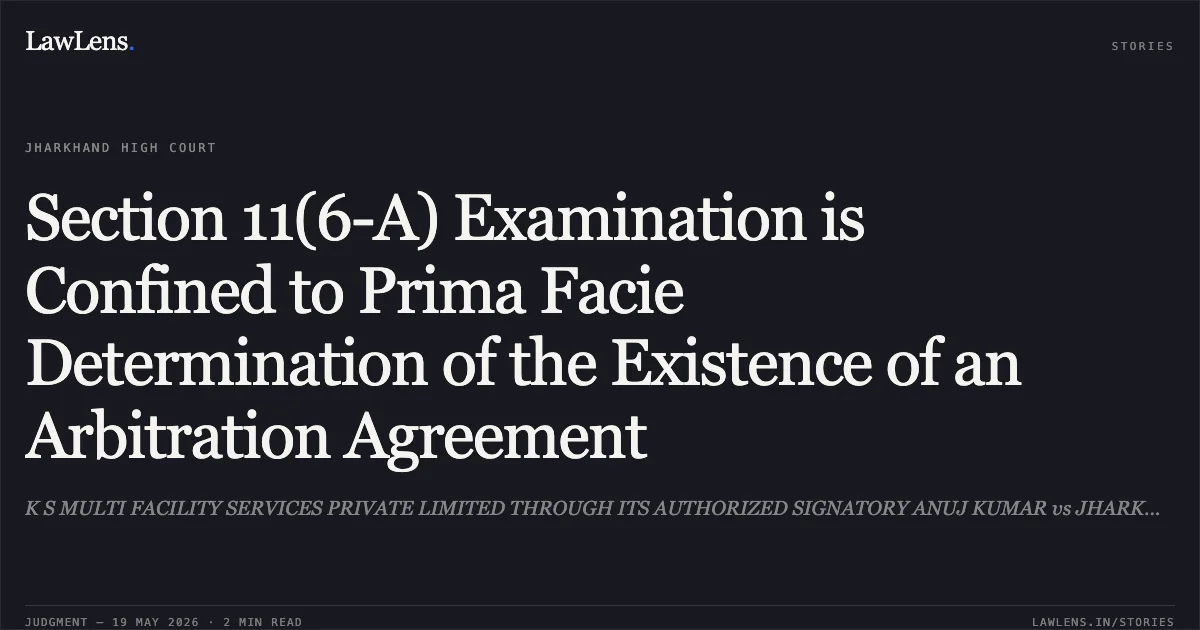
The Court applied Section 11(6) and 11(6-A) of the Arbitration and Conciliation Act, 1996, which confines the judicial role to the "examination of the existence" of an arbitration agreement.
Source reference: para. 10, 22The Court relied on the Supreme Court Constitution Bench decision in In Re: Interplay Between Arbitration Agreements under Arbitration and Conciliation Act, 1996 and Stamp Act, 1899 (2024) 6 SCC 1, which established that the court’s jurisdiction at the referral stage is limited to a prima facie determination of the existence of a written agreement, leaving substantive validity and jurisdictional issues to the Arbitral Tribunal under the doctrine of Competence-Competence (Section 16).
Source reference: para. 21, 24-27Reasoning
The Court observed that the Respondent’s repeated requests for adjournment were an "abuse of the process" intended to delay proceedings, especially since the Respondent had previously blocked the Petitioner’s writ petition by citing the same arbitration clause they now refuse to honor.
Source reference: para. 1, 17-18The Chief Justice noted that the Respondent failed to comply with cost orders or file a reply despite multiple opportunities; applying the prima facie standard, the Court found that the existence of the arbitration agreement was undisputed, as the Respondent had successfully used its existence as a defense in earlier litigation.
Source reference: para. 11, 19, 13, 17The Court reasoned that since Section 11(6-A) requires only a limited "examination" and not a "mini-trial" or "laborious inquiry," the appointment of an arbitrator cannot be delayed by frivolous procedural hurdles.
Source reference: para. 20, 26Holding
The Court dismissed the Respondent's interlocutory application for adjournment and allowed the Arbitration Application, finding that the existence of a written agreement was prima facie established.
The Court appointed Hon’ble Justice N.N. Tiwari (Retd.) as the sole Arbitrator, directed a declaration under Section 12(2), and ordered the proceedings to conclude expeditiously as per Section 29A, leaving all substantive contentions open for the Arbitrator’s adjudication.
Source reference: para. 29, 30-31, 32Acts & Sections Cited
11 provisions across 1 statute referred to in this judgment. Each provision opens on LawLens.
Arbitration and Conciliation Act, 1996
Original Court PDF
K S MULTI FACILITY SERVICES PRIVATE LIMITED THROUGH ITS AUTHORIZED SIGNATORY ANUJ KUMARvsJHARKHAND STATE BEVERAGE CORPORATION THROUGH ITS MANAGING DIRECTOR
Click to open original judgment
Original judgment, available to read, download and summarize on LawLens.in