Facts
The Applicant and the Respondent-Society entered into an Agreement dated 15 February 1996 for development of the Society’s property, followed by a Supplementary Agreement dated 16 April 2005.
Source reference: paras. 2, 7, 9The Society allegedly terminated the relevant Power of Attorney and Supplementary Agreement by an AGM Resolution dated 24 September 2017, communicated to the Applicant by letter dated 29 September 2018.
Source reference: paras. 2, 7, 9The Applicant contended that, notwithstanding the alleged termination, the parties engaged in discussions between 2021 and 2023 concerning redevelopment.
Source reference: paras. 3–6, 15–18The Applicant invoked the arbitration clause on 2 April 2026. The Society refused to agree to the appointment of an arbitrator by its reply dated 26 April 2026. The Applicant consequently filed the present Section 11(6) application on 6 May 2026.
Source reference: paras. 2, 5, 18, 25Issues
Whether the Applicant’s application under Section 11(6) of the Arbitration and Conciliation Act, 1996 was barred by limitation under Article 137 of the Limitation Act, 1963?
Source reference: paras. 8–9, 22–26, 37Whether the Applicant’s underlying contractual claims were so ex facie dead, stale or clearly time-barred that appointment of an arbitral tribunal ought to be refused at the referral stage?
Source reference: paras. 8, 14, 21, 29, 33–36Whether the disputed questions concerning termination, waiver, subsequent conduct, authority of the Society’s office-bearers and the survival of the Applicant’s development rights should be determined by the Court or left to the Arbitral Tribunal?
Source reference: paras. 17, 27, 31–34, 39Law Applied
The Court applied Section 11(6) of the Arbitration and Conciliation Act, 1996, concerning appointment of an arbitrator where a party fails or refuses to act in accordance with the arbitration agreement, read with Section 43 of the Act and Article 137 of the Limitation Act, 1963.
Source reference: paras. 10, 22–24, 37Relying on Vidya Drolia v. Durga Trading Corporation, (2021) 2 SCC 1, BSNL v. Nortel Networks India (P) Ltd., (2021) 5 SCC 738, Arif Azim Co. Ltd. v. Aptech Ltd., (2024) 5 SCC 313, SBI General Insurance Co. Ltd. v. Krish Spg., (2024) 12 SCC 1, and Aslam Ismail Khan Deshmukh v. ASAP Fluids (P) Ltd., (2025) 1 SCC 502, the Court held that the referral court’s enquiry is limited.
Source reference: paras. 10–13, 19–24, 28The Section 11 application is governed by a three-year limitation period commencing when a valid notice invoking arbitration is issued and the opposite party fails or refuses to comply with it; the referral court should not conduct an intricate evidentiary enquiry into whether the substantive claims are time-barred.
Source reference: paras. 10–13, 19–24, 28Refusal to refer is justified only where it is manifest and ex facie certain that the claim is dead, time-barred or non-arbitrable; disputed factual and legal questions must ordinarily be left to the Arbitral Tribunal.
Source reference: paras. 11, 13, 20, 28Reasoning
The Court distinguished limitation applicable to the underlying contractual claims from limitation applicable to the Section 11 application.
Source reference: paras. 22–26, 37For the latter purpose, the relevant starting point was the Applicant’s arbitration notice dated 2 April 2026 and the Society’s refusal dated 26 April 2026. Since the application was filed on 6 May 2026, it was within the three-year period under Article 137.
Source reference: paras. 22–26, 37Although the Society relied on the 2017 termination and its 2018 communication, the Applicant placed material showing subsequent discussions, meetings, architect quotations and correspondence between 2021 and 2024.
Source reference: paras. 15–18, 27, 31Whether that conduct amounted to waiver, acknowledgment, novation, restoration of rights or a fresh arrangement required examination of documents, authority, surrounding circumstances and evidence.
Source reference: paras. 15–18, 27, 31These were not matters capable of conclusive determination in a summary Section 11 proceeding. Since the Applicant’s claims were not manifestly dead and the parties’ competing positions disclosed a subsisting dispute, the Court declined to conduct a mini-trial and left all substantive limitation and contractual objections to the Arbitral Tribunal.
Source reference: paras. 21, 29, 32–36Holding
The Court rejected the Society’s objection that the Section 11(6) application was barred by limitation.
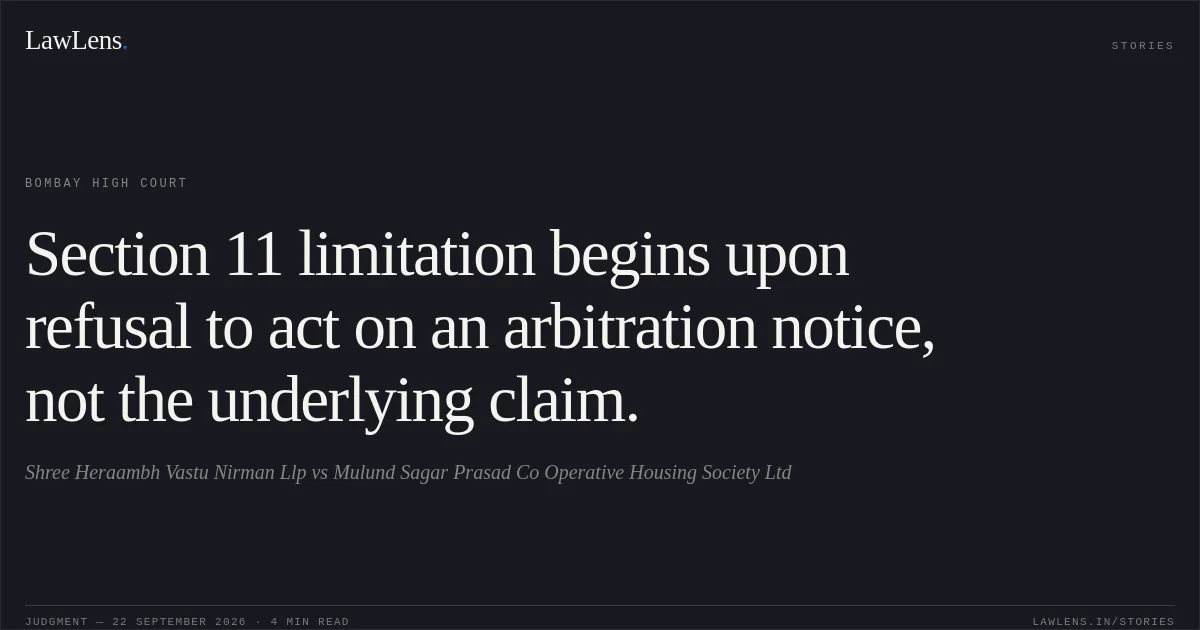
It held that the application was filed within limitation because the right to seek appointment arose upon the Society’s refusal to act on the arbitration notice, and not necessarily upon the alleged termination in 2017 or its communication in 2018.
Source reference: paras. 25–26, 37The Court expressly left open the merits of the Applicant’s claims and the Society’s defences, including limitation of the substantive claims, termination, waiver, abandonment, acquiescence, novation and the authority of the Society’s office-bearers.
Source reference: paras. 38–42Accordingly, Mr. Ashish Venugopal, Advocate, was appointed as the Sole Arbitrator to adjudicate disputes arising out of or relating to the Agreements dated 15 February 1996 and 16 April 2005, including claims and counterclaims.
Source reference: para. 43The parties were directed to comply with the disclosure, communication, procedural and cost directions set out in the order, with arbitral costs and fees to be borne equally in the first instance, subject to the final award on costs.
Source reference: para. 43Acts & Sections Cited
6 provisions across 2 statutes referred to in this judgment. Each provision opens on LawLens.
Arbitration and Conciliation Act, 19965
Limitation Act, 19631
Original Court PDF
Shree Heraambh Vastu Nirman LlpvsMulund Sagar Prasad Co Operative Housing Society Ltd
Click to open original judgment
Original judgment, available to read, download and summarize on LawLens.in