Facts
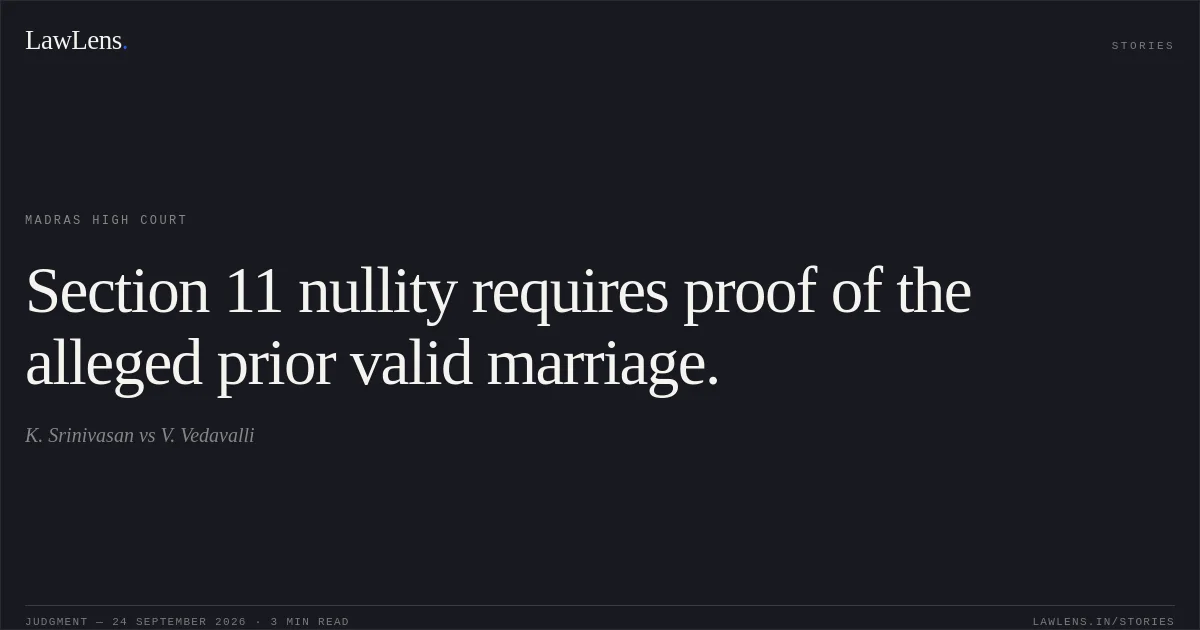
The appellant-husband filed H.M.O.P. No. 3053 of 2014 under Section 11 of the Hindu Marriage Act, 1955, seeking a declaration that his marriage with the respondent, solemnised on 14 June 2010, was null and void.
Source reference: pp.2–3, paras.2–4He alleged that he had previously married Revathy in 2005 and had children through her, and that he was compelled by his brother to marry the respondent despite the earlier marriage.
Source reference: pp.2–3, paras.2–4The respondent denied the allegations and asserted that her marriage with the appellant was solemnised according to Hindu rites and customs, followed by cohabitation and the birth of a daughter.
Source reference: pp.4–5, paras.5–6The Family Court dismissed the petition, holding that the appellant had failed to establish his case.
Source reference: p.6, para.7Issues
Whether the appellant proved that his alleged prior marriage with Revathy was valid and lawful, so as to render his subsequent marriage with the respondent void under Section 11 of the Hindu Marriage Act, 1955?
Source reference: p.5, para.6; p.7, para.11Whether the appellant was entitled to a declaration that his marriage with the respondent, solemnised on 14 June 2010, was null and void?
Source reference: p.5, para.6; p.10, para.14Law Applied
The Court applied Section 11 of the Hindu Marriage Act, 1955, under which a marriage is void if it contravenes the conditions prescribed in Section 5, including the prohibition against a subsisting prior marriage.
Source reference: p.2, para.2The party seeking such a declaration bears the burden of proving the existence, validity, and prior solemnisation of the alleged earlier marriage.
Source reference: pp.8–10, paras.12–14The Court also applied the evidentiary principle that documentary material must reliably establish the fact in issue and that unsupported or ambiguous documents are insufficient to prove a valid marriage.
Source reference: pp.8–10, paras.12–14Reasoning
The High Court held that the appellant failed to prove the alleged prior marriage with Revathy. He did not state the date of that marriage in his pleadings, although he specifically pleaded the date of his marriage with the respondent.
Source reference: pp.8–9, para.12The family card did not describe the relationship between the appellant, Revathy, and the child, while the child’s birth certificate contained deficiencies regarding the parents’ address and did not establish the solemnisation of a marriage.
Source reference: pp.8–9, para.12The Court further noted that the appellant had not examined Revathy, the most material witness; the marriage invitation and photographs were produced only after the original petition had been returned for compliance, creating doubt about their genuineness.
Source reference: p.9, para.13The appellant’s own evidence also indicated that the petition was filed because the respondent allegedly accepted Rs.4,00,000 and agreed to sever the relationship but later returned and complained against him, rather than solely because the marriage was legally void.
Source reference: pp.7–8, para.11Further, a 2012 document referred to the respondent as the appellant’s wife and did not mention any prior marriage, despite the appellant’s assertion that the marriage with her had been forced.
Source reference: p.9, para.12Since the appellant admitted the marriage with the respondent but failed to establish the prior valid marriage necessary to invoke Section 11, the statutory basis for declaring the subsequent marriage void was not proved.
Source reference: pp.9–10, paras.13–14Holding
The Court answered the issues against the appellant, holding that he had not proved the existence of a valid and lawful prior marriage with Revathy and was therefore not entitled to a declaration that his marriage with the respondent was null and void.
The High Court found no error in the Family Court’s dismissal of H.M.O.P. No. 3053 of 2014 and accordingly dismissed CMA No. 2522 of 2022 without costs.
Source reference: p.10, para.14Acts & Sections Cited
2 provisions across 2 statutes referred to in this judgment. Each provision opens on LawLens.
Family Courts Act, 19841
Hindu Marriage Act, 19551
Original Court PDF
K. SrinivasanvsV. Vedavalli
Click to open original judgment
Original judgment, available to read, download and summarize on LawLens.in