Facts
Madhubala Devi married appellant Ram Chandra Mandal on 12 May 1999. The prosecution alleged that, soon after marriage, her matrimonial family demanded a motorcycle and subjected her to cruelty for non-fulfilment of the demand. It was further alleged that her brother paid Rs.11,000 towards the demand and that, on 30 August 2001, Madhubala was killed by her in-laws and her body was disposed of without informing her parental family.
Source reference: p.2–3The FIR was registered under Sections 304B and 201/34 of the Indian Penal Code, and the appellants were charged before the Sessions Court.
Source reference: p.3The prosecution examined 12 witnesses. P.Ws.1, 2, 3 and 5 supported the allegation of dowry demand, while P.W.12 supported the allegation of demand and payment of Rs.11,000. However, several witnesses stated that they had heard that Madhubala died of snake bite, and P.W.6 supported that version. The defence also relied on the snake-bite explanation and examined two witnesses.
Source reference: p.3–4The Investigating Officer and the treating doctor were not examined.
Source reference: p.4The Fast Track Court convicted the appellants under Sections 304B and 201/34 IPC and sentenced them to rigorous imprisonment for seven years and three years, respectively, with the sentences to run concurrently. The appellants challenged the conviction and sentence before the High Court.
Source reference: p.1–2Issues
Whether the prosecution proved beyond reasonable doubt the essential ingredients of dowry death under Section 304B IPC, particularly that Madhubala was subjected to cruelty or harassment for, or in connection with, a dowry demand soon before her death?
Source reference: para. 8–12; p.4–6Whether the prosecution established that Madhubala’s death occurred otherwise than under normal circumstances and that the appellants caused the disappearance of evidence so as to sustain their conviction under Section 201/34 IPC?
Source reference: para. 13–15; p.6–7Whether the statutory presumption under Section 113B of the Indian Evidence Act could be invoked merely because the death occurred within seven years of marriage?
Source reference: para. 12, 14; p.5–7Law Applied
The Court applied Section 304B IPC, which requires proof that: (i) the woman’s death was caused by burns, bodily injury, or occurred otherwise than under normal circumstances; (ii) the death occurred within seven years of marriage; and (iii) soon before her death, she was subjected to cruelty or harassment by her husband or his relatives in connection with a demand for dowry.
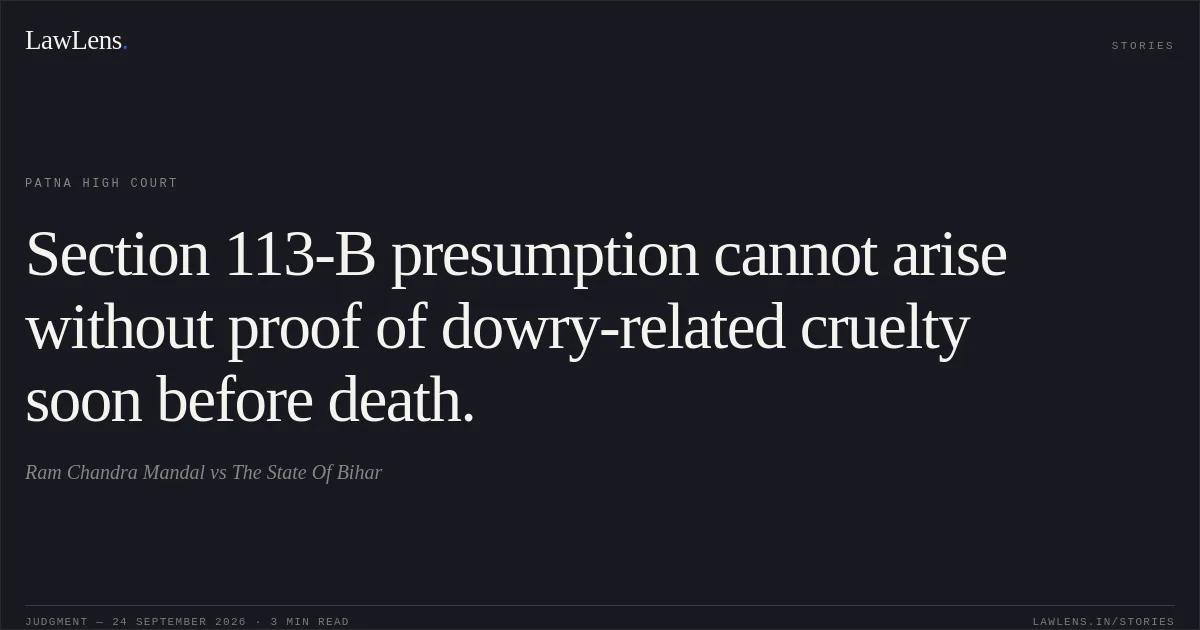
Source reference: para. 8, 11Section 113B of the Evidence Act permits a presumption of dowry death only after the prosecution first establishes these foundational facts, particularly dowry-related cruelty or harassment soon before death.
Source reference: para. 12, 14Section 201 IPC requires proof of the commission of an underlying offence and the accused’s intentional or knowing conduct in causing the disappearance of evidence.
Source reference: para. 15The Court also applied the principle that conviction must rest on reliable evidence proving the prosecution case beyond reasonable doubt.
Source reference: no citationReasoning
The Court accepted that Madhubala died within seven years of her marriage, thereby satisfying one ingredient of Section 304B IPC.
Source reference: para. 11However, it found that the evidence of dowry-related cruelty or harassment soon before death was inconsistent. Although P.Ws.1, 2, 3 and 12 referred to a motorcycle demand and payment of Rs.11,000, the informant, P.W.5, substantially resiled from the prosecution case during cross-examination.
Source reference: para. 12The evidence regarding the cause of death was also uncertain: several witnesses referred to a snake-bite death, the defence supported that explanation, and no treating doctor was examined to establish homicidal death.
Source reference: para. 13The non-examination of the Investigating Officer further weakened the prosecution’s case concerning the locked matrimonial house, alleged disposal of the body, and surrounding circumstances.
Source reference: para. 14Since the foundational facts required for Section 113B had not been proved, the presumption of dowry death could not arise.
Source reference: para. 15–16Similarly, absent reliable proof of the underlying offence and of deliberate disappearance of evidence, the conviction under Section 201/34 IPC could not be sustained.
Source reference: para. 15–16Holding
The High Court held that the prosecution failed to prove beyond reasonable doubt that Madhubala died a dowry death or that the appellants caused the disappearance of evidence.
The judgment of conviction dated 14 August 2018 and orders of sentence dated 17 and 18 August 2018 were set aside.
Source reference: para. 17The appellants were acquitted of all charges and discharged from liability under their bail bonds.
Source reference: para. 18–19Both appeals were accordingly allowed.
Source reference: para. 18–19Acts & Sections Cited
2 provisions across 1 statute referred to in this judgment. Each provision opens on LawLens.
Indian Penal Code, 18602
Original Court PDF
Ram Chandra MandalvsThe State Of Bihar
Click to open original judgment
Original judgment, available to read, download and summarize on LawLens.in