Facts
Sangita married the respondent-accused on 01 February 2000 and resided with him at Surat.
Source reference: pp. 2, 6–7; paras. 2.1–2.3, 8–9The prosecution alleged that the accused gambled, quarrelled with and physically and mentally harassed Sangita, suspected her inability to conceive, and insisted on a second marriage.
Source reference: pp. 2, 6–7; paras. 2.1–2.3, 8–9She allegedly complained about the ill-treatment to her parental family and, on 20 August 2006, telephonically requested that she be taken back after the accused had beaten and threatened her.
Source reference: pp. 2, 6–7; paras. 2.1–2.3, 8–9On 01 September 2006, she was found dead after allegedly committing suicide by hanging.
Source reference: pp. 2, 6–7; paras. 2.1–2.3, 8–9An accidental-death inquiry was initially registered under Section 174 CrPC; the FIR under Sections 498-A and 306 IPC was registered on the following day on the complaint of her father.
Source reference: pp. 2, 6–7; paras. 2.1–2.3, 8–9The Trial Court examined seven prosecution witnesses and acquitted the accused on 30 June 2008, holding that the charges were not proved beyond reasonable doubt.
Source reference: p. 3; para. 2.7The State appealed under Section 378(1) and (3) CrPC.
Source reference: p. 1; para. 1Issues
Whether the Trial Court committed an error in acquitting the respondent-accused.
Source reference: p. 5; para. 6Whether the Trial Court erred in law or fact while appreciating the prosecution evidence.
Source reference: p. 5; para. 6Whether the acquittal suffered from illegality or perversity warranting appellate interference.
Source reference: p. 5; para. 6Law Applied
The Court applied Section 498-A IPC, which criminalises cruelty by a husband or his relative, including wilful conduct likely to drive a woman to suicide or harassment connected with an unlawful demand.
Source reference: pp. 10–11; para. 17Section 306 IPC punishes abetment of suicide, while Section 107 IPC defines abetment through instigation, conspiracy, or intentional aid.
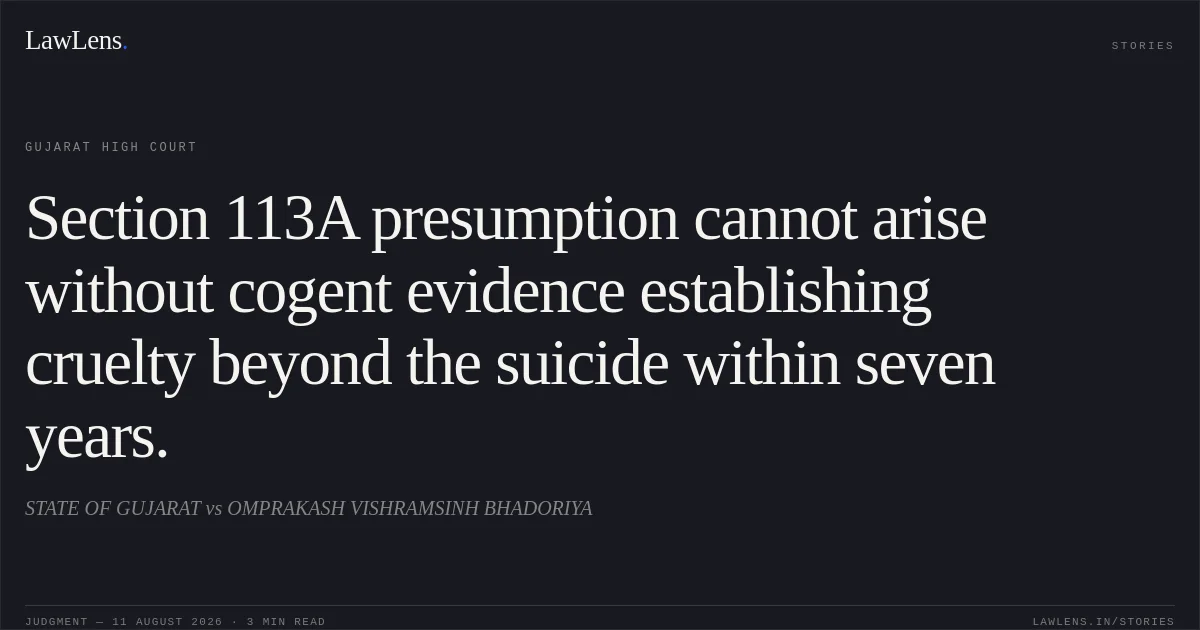
Source reference: p. 11; para. 17Under Section 113-A of the Evidence Act, the Court may presume abetment of suicide by a married woman within seven years of marriage only where it is first shown that the husband or relative subjected her to cruelty; the presumption is discretionary and requires foundational evidence.
Source reference: pp. 11–12; paras. 17–18In appeals against acquittal, an appellate court may fully reappreciate the evidence, but must account for the accused’s double presumption of innocence and should not interfere where two reasonable views are possible, absent perversity or manifest illegality.
Source reference: pp. 13–16; paras. 22–25The Court relied on Chandrappa v. State of Karnataka, (2007) 4 SCC 415; Rajesh Prasad v. State of Bihar, (2022) 3 SCC 471; Babu Sahebagouda Rudragoudar v. State of Karnataka, (2024) 8 SCC 149; and Ramesh v. State of Karnataka, (2024) 9 SCC 169.
Source reference: pp. 13–16; paras. 22–25Reasoning
The Court found that the prosecution failed to prove the essential factual foundation for Sections 498-A and 306 IPC.
Source reference: pp. 7–8; paras. 9–10Although the father alleged gambling, harassment, a demand for second marriage, and financial exploitation, his cross-examination established that he lacked personal knowledge of these matters and could not identify the specific nature or manner of the alleged cruelty.
Source reference: pp. 7–8; paras. 9–10The deceased’s brother and aunt likewise provided no reliable personal evidence of ill-treatment, while the neighbouring witnesses did not support the prosecution.
Source reference: p. 8; paras. 11–12, 15The medical and investigative evidence established the death but did not substantively connect the accused with cruelty, instigation, or intentional aid in the suicide.
Source reference: p. 8; para. 15The initial accidental-death inquiry also contained no contemporaneous allegation of cruelty or harassment.
Source reference: p. 6; para. 8Consequently, the statutory presumption under Section 113-A could not be invoked merely because the suicide occurred within approximately seven years of marriage; the prosecution had to first establish cruelty through cogent evidence.
Source reference: p. 9; paras. 13–14Applying the restrictive standard governing appeals against acquittal, the Court held that the Trial Court’s view was reasonable and neither perverse nor legally erroneous.
Source reference: pp. 12–16; paras. 19–25Holding
The High Court answered all issues against the State.
It held that the prosecution had not proved cruelty under Section 498-A IPC or abetment of suicide under Sections 306/107 IPC beyond reasonable doubt, and that Section 113-A of the Evidence Act was unavailable in the absence of foundational evidence.
Source reference: pp. 12, 16–17; paras. 19, 26–28The State’s appeal was dismissed, the Trial Court’s judgment of acquittal dated 30 June 2008 was confirmed, the bail bond was cancelled, and the record and proceedings were directed to be returned to the Trial Court.
Source reference: p. 17; para. 28Acts & Sections Cited
6 provisions across 2 statutes referred to in this judgment. Each provision opens on LawLens.
Code of Criminal Procedure, 19734
Indian Penal Code, 18602
Original Court PDF
STATE OF GUJARATvsOMPRAKASH VISHRAMSINH BHADORIYA
Click to open original judgment
Original judgment, available to read, download and summarize on LawLens.in