Facts
Manishaben married accused Ketankumar on 13 February 2005 and resided with him and his family. She died by hanging in the toilet of her matrimonial home on 15 April 2006, approximately one-and-a-half years after the marriage. Her brother alleged that the accused-husband and mother-in-law subjected her to continuous mental and physical cruelty, prevented her from attending a family marriage, and thereby abetted her suicide. An FIR was registered under Sections 498-A, 306 and 114 of the IPC. After investigation and trial in Sessions Case No. 77 of 2007, the Sessions Court, Surat, acquitted the accused on 13 March 2012. The State and the original complainant challenged the acquittal in the present appeals
Source reference: pp. 2–5, paras. 1.1–2.6The prosecution relied upon evidence of the deceased’s relatives, neighbours, police officers, the fire-brigade officer who broke open the toilet door, and the post-mortem report. The post-mortem recorded death by asphyxia due to ligature pressure, associated with head injury, and noted certain external abrasions and scratch marks. The defence contended that the death was suicidal, that the injuries were compatible with convulsive movements during hanging, and that the prosecution had failed to prove cruelty or abetment beyond reasonable doubt.
Source reference: pp. 21–23, paras. 6.1–6.8; pp. 27–30, para. 11Issues
Whether the Trial Court committed an error of law or fact in acquitting the accused of offences under Sections 498-A, 306 and 114 of the IPC
Source reference: p. 24, para. 7Whether the prosecution proved that the accused subjected Manishaben to “cruelty” within the meaning of Section 498-A of the IPC
Source reference: pp. 35–37, paras. 20–22Whether the evidence established the necessary instigation, intentional aid, or other conduct constituting abetment of suicide under Sections 107 and 306 of the IPC
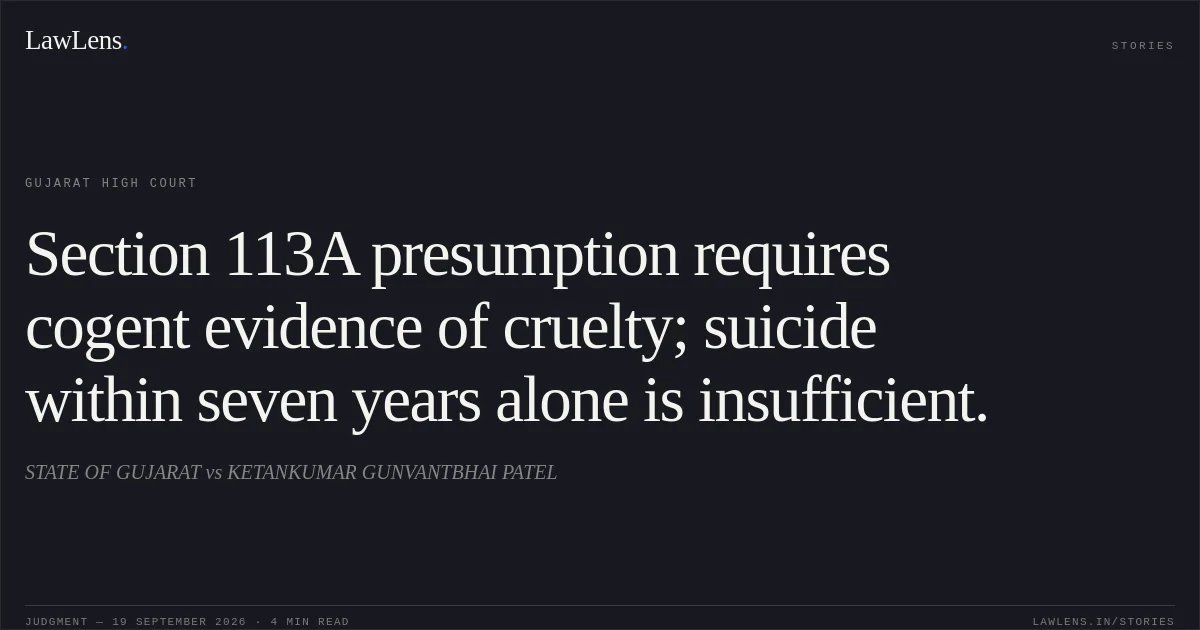
Source reference: pp. 35–37, paras. 20–22Whether the presumption under Section 113-A of the Indian Evidence Act could be invoked merely because the deceased committed suicide within seven years of marriage
Source reference: pp. 35–37, paras. 20–22Whether the appellate court ought to interfere with the acquittal in light of the principles governing appeals against acquittal
Source reference: pp. 38–41, paras. 25–28Law Applied
The Court applied Section 498-A IPC, which criminalises cruelty by a husband or his relative, including wilful conduct likely to drive a woman to suicide or cause grave injury, and harassment connected with an unlawful demand. Section 306 IPC requires proof that the accused abetted the suicide, while Section 107 IPC defines abetment through instigation, conspiracy, or intentional aid.
Source reference: pp. 35–36, para. 20Section 113-A of the Evidence Act permits, but does not mandate, a presumption of abetment where a married woman commits suicide within seven years of marriage and cruelty by the husband or his relative is first shown. The Court held that a foundational evidentiary basis of cruelty is necessary before the statutory presumption can arise. On appellate review of acquittals, the Court relied on Chandrappa v. State of Karnataka, Rajesh Prasad v. State of Bihar, Babu Sahebagouda Rudragoudar v. State of Karnataka and Ramesh v. State of Karnataka, reiterating that although an appellate court may reappreciate the evidence, the accused benefit from a reinforced or “double” presumption of innocence, and acquittal should not be disturbed where two reasonable views are possible.
Source reference: p. 36, para. 20; p. 37, para. 21; pp. 38–41, paras. 25–28Reasoning
The Court found that the prosecution failed to establish any specific, reliable, or continuous act of cruelty, harassment, instigation, or intentional aid by the accused. The complainant and the deceased’s parents admitted that they had not personally witnessed ill-treatment, that Manishaben had not complained to them of cruelty, and that the allegations concerning the husband’s alleged liquor habit were unsupported by their trial testimony. The alleged dispute concerning the deceased’s attendance at a family function, viewed in the context of the child’s medical condition, did not by itself amount to cruelty or conduct likely to drive her to suicide. The independent and neighbouring witnesses also failed to provide material evidence of harassment.
Source reference: pp. 31–34, paras. 12–18The medical evidence established hanging as the primary cause of death. Although the doctor stated that some injuries could be caused by assault, he also accepted that the head injury could result from convulsive movements during hanging and impact against a wall; the external injuries were not shown to be the cause of death or conclusively attributable to the accused. The Court therefore held that the medical evidence did not prove homicidal assault or cruelty. Since the prosecution failed to prove cruelty, the statutory presumption under Section 113-A could not be invoked. In the absence of proof of cruelty or a proximate act of instigation or intentional aid, the essential ingredients of Sections 107 and 306 IPC were also not established. Applying the heightened standard applicable to an appeal against acquittal, the Court found the Trial Court’s view reasonable and neither perverse nor illegal.
Source reference: pp. 26–30, paras. 10–11; pp. 34–37, paras. 18–22; pp. 38–41, paras. 25–30Holding
The High Court answered the issues against the State and the complainant. It held that the prosecution had failed to prove cruelty under Section 498-A IPC, abetment of suicide under Sections 107 and 306 IPC, or any basis for invoking the presumption under Section 113-A of the Evidence Act.
Both Criminal Appeal No. 731 of 2012 and Criminal Appeal No. 1359 of 2012 were dismissed. The acquittal dated 13 March 2012 passed by the Sessions Court, Surat, was confirmed; the bail bonds were cancelled, and the record and proceedings were directed to be returned to the Trial Court.
Source reference: p. 42, para. 31Acts & Sections Cited
7 provisions across 2 statutes referred to in this judgment. Each provision opens on LawLens.
Code of Criminal Procedure, 19733
Indian Penal Code, 18604
Original Court PDF
STATE OF GUJARATvsKETANKUMAR GUNVANTBHAI PATEL
Click to open original judgment
Original judgment, available to read, download and summarize on LawLens.in