Facts
Jagrutiben married respondent no. 1 about two years before her death and lived with her husband and in-laws.
Source reference: p.2, p.6The prosecution alleged that she had reported dowry-related harassment and cruelty to her family.
Source reference: p.2, p.6She died by suicide at her matrimonial home on 3 November 2012, three days after returning from a visit to her parental home.
Source reference: p.2, p.6The trial court acquitted the accused of offences under Sections 498A, 306 and 34 of the IPC.
Source reference: p.1The State appealed under Section 378 CrPC.
Source reference: p.1During the appeal, respondent no. 2 died and the appeal against her abated.
Source reference: p.2Issues
1. Whether the trial court rightly acquitted the respondents of the charges under Sections 498A, 306 and 34 IPC
Source reference: p.5, para. 102. Whether the trial court materially erred in appreciating the evidence, such that its acquittal was illegal, perverse or otherwise liable to be reversed
Source reference: p.5, p.11–12, paras 10, 16–18Law Applied
Sections 498A, 306 and 34 IPC governed the charged offences; Section 306 requires proof of abetment of suicide, assessed in light of Section 107 IPC.
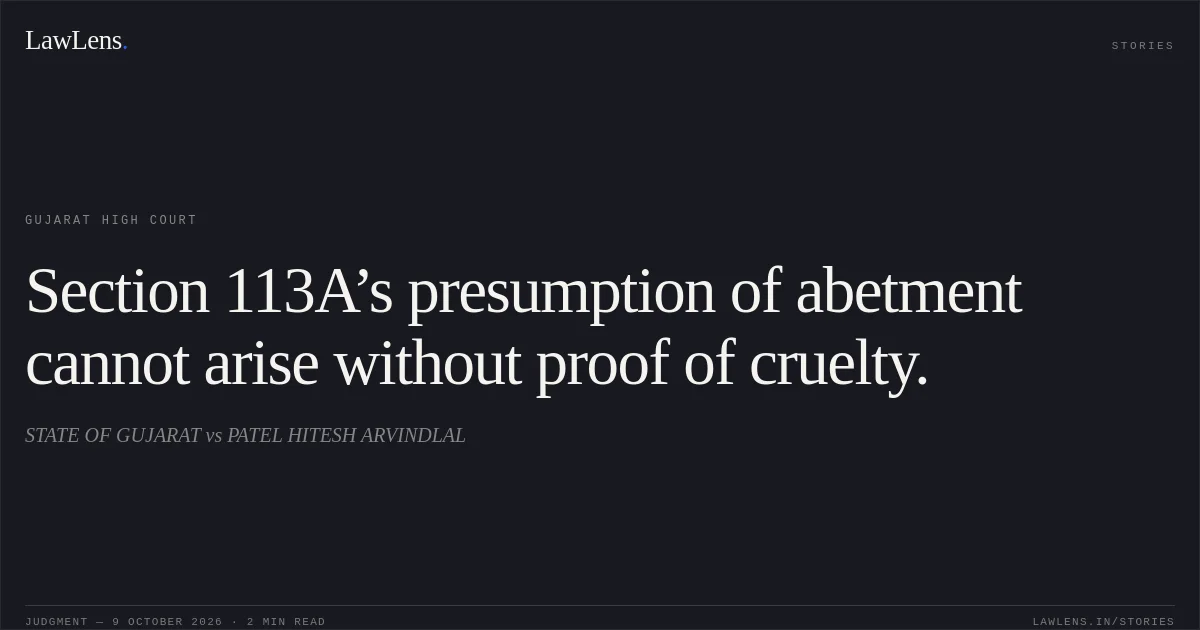
Source reference: p.8, para. 13Under Section 113A of the Evidence Act, a court may presume abetment where a married woman dies by suicide within seven years of marriage and cruelty by her husband or his relative is shown; the presumption is discretionary and depends on the circumstances.
Source reference: p.9–10, para. 14.1Section 113B concerns dowry death and requires proof of cruelty or harassment for, or in connection with, a dowry demand soon before death.
Source reference: p.9–10, para. 14.1For appeals against acquittal, the appellate court may reappraise the evidence, but must account for the reinforced presumption of innocence; where two reasonable views are possible, the acquittal should not be disturbed.
Source reference: p.11–14, paras 17–20applying Chandrappa v. State of Karnataka, (2007) 4 SCC 415, and other cited authorities
Source reference: p.11–14, paras 17–20Reasoning
The High Court found that the prosecution had not provided reliable particulars of any dowry demand or of when, how or in what circumstances the deceased allegedly reported ill-treatment to her family.
Source reference: p.6–7, paras 11–12The sole specific incident was an alleged slap by respondent no. 1, which the court considered insufficient, by itself, to establish cruelty or abetment; the account was also not reported to the investigating officer.
Source reference: p.6, p.8, para. 11–13The court further noted gaps in the investigation and the absence of evidence from witnesses in the deceased’s village.
Source reference: p.7–8, paras 12–13Since the foundational facts of cruelty or dowry-related harassment were not proved, the court held that the statutory presumptions could not assist the prosecution.
Source reference: p.8, para. 13Applying the principles governing appeals against acquittal, it found no perversity or manifest error warranting interference.
Source reference: p.8, p.11–14, paras 13, 16–20Holding
The High Court held that the prosecution had failed to prove the charges beyond reasonable doubt and that the trial court’s acquittal disclosed no error warranting appellate interference.
The State’s appeal was dismissed and the acquittal confirmed; the appeal against respondent no. 2 had abated following her death.
Source reference: p.2, p.15, paras 1.1, 23The bail bond was cancelled, and the record and proceedings were ordered to be returned to the trial court.
Source reference: p.2, p.15, paras 1.1, 23Acts & Sections Cited
5 provisions across 2 statutes referred to in this judgment. Each provision opens on LawLens.
Code of Criminal Procedure, 19732
Indian Penal Code, 18603
Original Court PDF
STATE OF GUJARATvsPATEL HITESH ARVINDLAL
Click to open original judgment
Original judgment, available to read, download and summarize on LawLens.in