Facts
Karpuri Devi, the wife of appellant Madan Kamat, was reported missing approximately three years after her marriage.
Source reference: para. 2–5Her relatives later located scattered skeletal remains near the Kamla River, which they identified as hers by reference to a key, taabeez and mala.
Source reference: para. 2–5The prosecution alleged dowry-related cruelty and charged the appellants under Sections 304B and 201 of the Indian Penal Code (IPC).
Source reference: para. 2–5The trial court convicted them and imposed concurrent sentences of eight years’ rigorous imprisonment under Section 304B and two years’ rigorous imprisonment under Section 201.
Source reference: para. 2–5The appellants challenged the conviction in these appeals under Section 374(2) of the Code of Criminal Procedure (CrPC).
Source reference: para. 2–5The High Court considered the evidence, including the medical evidence that the skeletal remains were female but that the cause of death could not be ascertained, and noted that the investigating officer was not examined.
Source reference: para. 17–23Issues
1. Whether the prosecution proved that the skeletal remains were those of Karpuri Devi and that her death occurred otherwise than under normal circumstances
Source reference: para. 25, 28–332. Whether the prosecution proved that the death occurred within seven years of marriage
Source reference: para. 26, 343. Whether the deceased was subjected, soon before her death, to cruelty or harassment for, or in connection with, a demand for dowry, so as to sustain a conviction under Section 304B IPC and invoke the presumption under Section 113B of the Indian Evidence Act
Source reference: para. 26, 35–37, 394. Whether the convictions under Sections 304B and 201 IPC could be sustained in light of the evidentiary deficiencies and the non-examination of the investigating officer
Source reference: para. 12, 38–40Law Applied
Section 304B IPC requires proof that a woman’s death was caused by burns or bodily injury, or occurred otherwise than under normal circumstances; that it occurred within seven years of marriage; and that soon before her death she was subjected by her husband or a relative to cruelty or harassment in connection with a dowry demand.
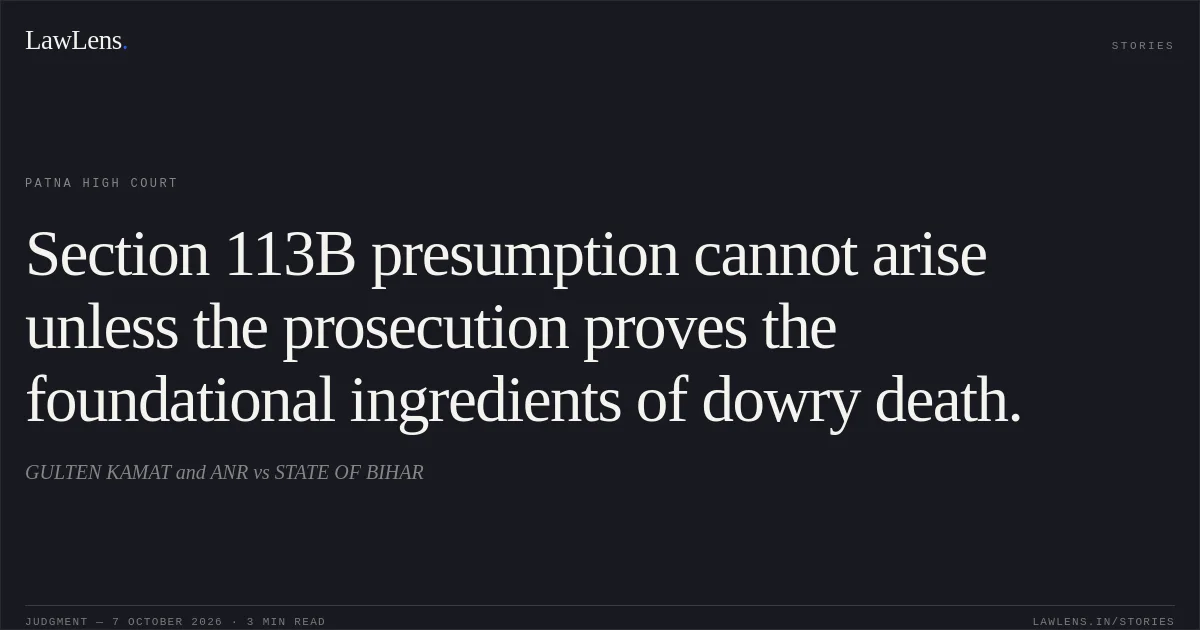
Source reference: para. 26Under Section 113B of the Indian Evidence Act, the presumption of dowry death arises only once the prosecution establishes that foundational requirement of dowry-related cruelty or harassment soon before death.
Source reference: para. 36The court relied on Shivaji Sahabrao Bobade v. State of Maharashtra for the principle that an omission to put a material circumstance to an accused under Section 313 CrPC does not automatically vitiate the trial, but prejudice must be considered.
Source reference: para. 31It also relied on S. Kaleeswaran v. State of T.N. for the caution that identification of decomposed remains, including through forensic techniques, requires reliable supporting evidence and may be unsafe as a sole basis for conviction.
Source reference: para. 32Munna Lal v. State of U.P. was cited for the proposition that non-examination of the investigating officer may create a material lacuna where the omission causes prejudice to the accused.
Source reference: para. 38Reasoning
The prosecution’s identification of the remains rested principally on articles said to have been found with the scattered skeleton; the medical evidence established only that the remains were female and did not establish the cause of death.
Source reference: para. 28–33The court found no reliable link between the deceased’s disappearance and the recovery, and noted inconsistencies about the recovery and police arrival, as well as the omission to put the identification circumstance to the appellants under Section 313 CrPC.
Source reference: para. 28–33The court also found that the witnesses could not provide cogent evidence of the marriage date, and that the evidence of dowry demand and cruelty was vague, inconsistent as to the amount demanded, and insufficient to establish harassment “soon before” death.
Source reference: para. 34–37Consequently, the statutory prerequisites for Section 304B and the Section 113B presumption were not established.
Source reference: para. 38–40The investigating officer’s absence further prejudiced the defence on material questions about the recovery and investigation.
Source reference: para. 38–40Holding
The High Court held that the prosecution had not proved the essential ingredients of Section 304B IPC beyond reasonable doubt; in particular, it had not established that the recovered remains were those of the deceased.
The trial court’s judgment of conviction and sentence under Sections 304B and 201 IPC was set aside, both appeals were allowed, and the appellants—who were on bail—were discharged from their bail bonds.
Source reference: para. 39–43Acts & Sections Cited
4 provisions across 2 statutes referred to in this judgment. Each provision opens on LawLens.
Code of Criminal Procedure, 19732
Indian Penal Code, 18602
Original Court PDF
GULTEN KAMAT and ANRvsSTATE OF BIHAR
Click to open original judgment
Original judgment, available to read, download and summarize on LawLens.in