Facts
The plaintiff claimed title to 5½ cents in Survey No. 119/8 under a sale deed dated 6 March 1985 and sought declaration and recovery of possession.
Source reference: p. 2–6, 9–10The defendant claimed a separate property in Survey No. 118 under a 1986 sale deed and disputed the identity of the plaintiff’s land.
Source reference: p. 2–6, 9–10In an earlier suit, the defendant obtained a decree concerning 1,410 sq. ft. but not the additional land claimed.
Source reference: p. 2–6, 9–10The trial court decreed the plaintiff’s suit, and the first appellate court affirmed.
Source reference: p. 2–6, 9–10The defendant appealed to the High Court.
Source reference: p. 2–6, 9–10Issues
Whether the suit was barred by limitation, including under Article 58 of the Limitation Act
Source reference: p. 6, 13Whether the courts below properly exercised their discretion under Section 34 of the Specific Relief Act, 1963, in granting declaratory relief
Source reference: p. 6, 13Whether the courts below could decree the suit on the basis of Exhibits A4 and A6, which the appellant challenged as inadmissible
Source reference: p. 6, 10–12Law Applied
Under Article 58 of the Limitation Act, a suit for a declaration must be brought within three years from when the right to sue first accrues; Article 65 governs recovery of possession based on title where the defendant’s possession is alleged to be adverse.
Source reference: p. 11–13Section 34 of the Specific Relief Act governs declaratory relief.
Source reference: p. 11–13The court also applied the evidentiary distinction between an objection that a document is inherently inadmissible—which may be raised even after it is marked—and an objection to the mode or sufficiency of proof, which should ordinarily be raised when the evidence is tendered.
Source reference: p. 11–13Relying on *Jagmail Singh v. Karamjit Singh*, *R.V.E. Venkatachala Gounder v. Arulmigu Viswesaraswami and V.P. Temple* and *Union of India v. Vasavi Cooperative Housing Society Ltd.*, the court reiterated that a plaintiff seeking declaration and possession must establish their own title; failure of the defendant’s title alone cannot entitle the plaintiff to relief.
Source reference: p. 11–13Reasoning
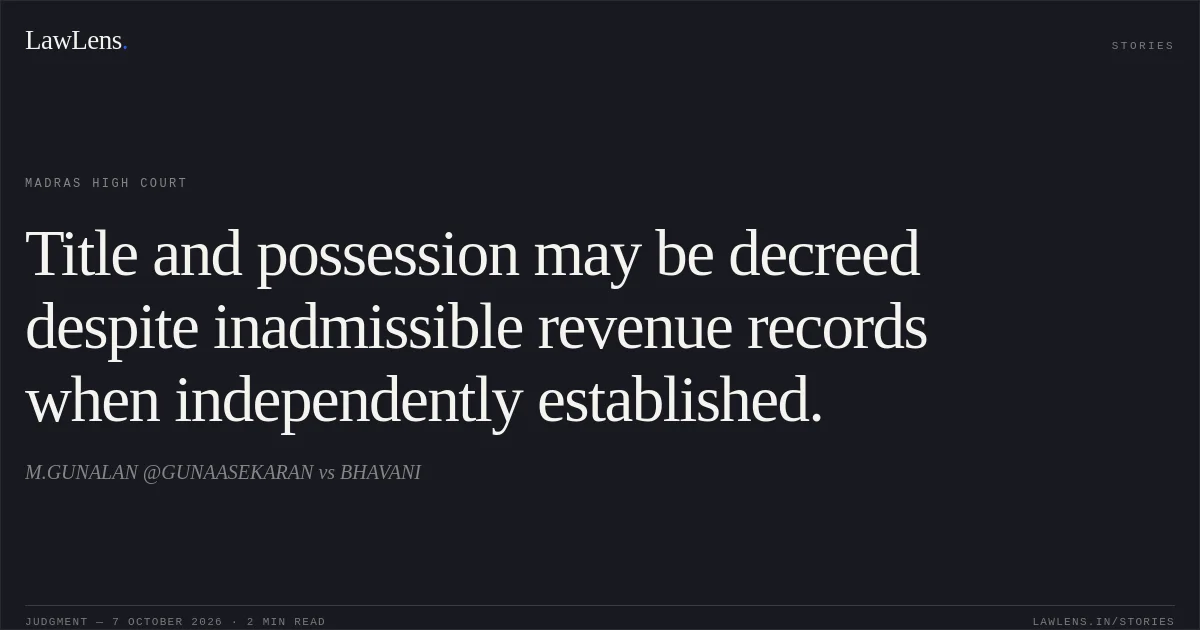
The court held that Exhibits A4 and A6, being photocopies of copies of Tahsildar communications, could not be relied on as secondary evidence; however, the plaintiff’s title did not depend on them.
Source reference: p. 9–13The plaintiff’s title deeds and the evidence identifying the land as Survey No. 119/8 were sufficient, while the defendant’s claim concerned Survey No. 118, for which he had already obtained a decree only to the extent of 1,410 sq. ft.
Source reference: p. 9–13The court therefore found the properties distinct and the plaintiff’s title established independently of the disputed exhibits.
Source reference: p. 9–13It rejected the limitation challenge, reasoning that the suit sought possession on the basis of title and was governed by Article 65, while also noting Article 58’s three-year period for declaratory relief.
Source reference: p. 9–13On that basis, it upheld the grant of declaration and possession under Section 34.
Source reference: p. 9–13Holding
The High Court answered the limitation and Section 34 questions against the appellant, but answered the challenge to Exhibits A4 and A6 in his favour.
It nevertheless held that the plaintiff had established title through other evidence and dismissed the second appeal, leaving the concurrent decrees for declaration and recovery of possession undisturbed.
Source reference: p. 13–14No costs were awarded.
Source reference: p. 13–14Acts & Sections Cited
4 provisions across 3 statutes referred to in this judgment. Each provision opens on LawLens.
Code of Civil Procedure, 19081
Limitation Act, 19632
Specific Relief Act, 19631
Original Court PDF
M.GUNALAN @GUNAASEKARANvsBHAVANI
Click to open original judgment
Original judgment, available to read, download and summarize on LawLens.in