Facts
Chandu Devi was married to the appellant in 2014.
Source reference: no citationHer mother alleged that, after the marriage, the appellant and his family demanded cash and a television and subjected Chandu Devi to cruelty and physical assault for non-fulfilment of the demand.
Source reference: no citationIt was further alleged that, on 27 November 2016, the appellant and his family burnt Chandu Devi and secretly disposed of her body.
Source reference: p. 2A case was registered under Sections 304B/34 and 201/34 of the Indian Penal Code.
Source reference: no citationThe trial court convicted the appellant under Sections 304B/34 and 201/34 IPC and sentenced him to ten years’ rigorous imprisonment and two years’ rigorous imprisonment with fine, respectively, with sentences to run concurrently.
Source reference: pp. 2–3The prosecution examined six witnesses, including the deceased’s relatives and the Investigating Officer, who seized certain burnt articles but did not examine independent neighbouring witnesses.
Source reference: p. 3The defence asserted that Chandu Devi had died from illness after childbirth and that there had been no dowry demand.
Source reference: p. 4Issues
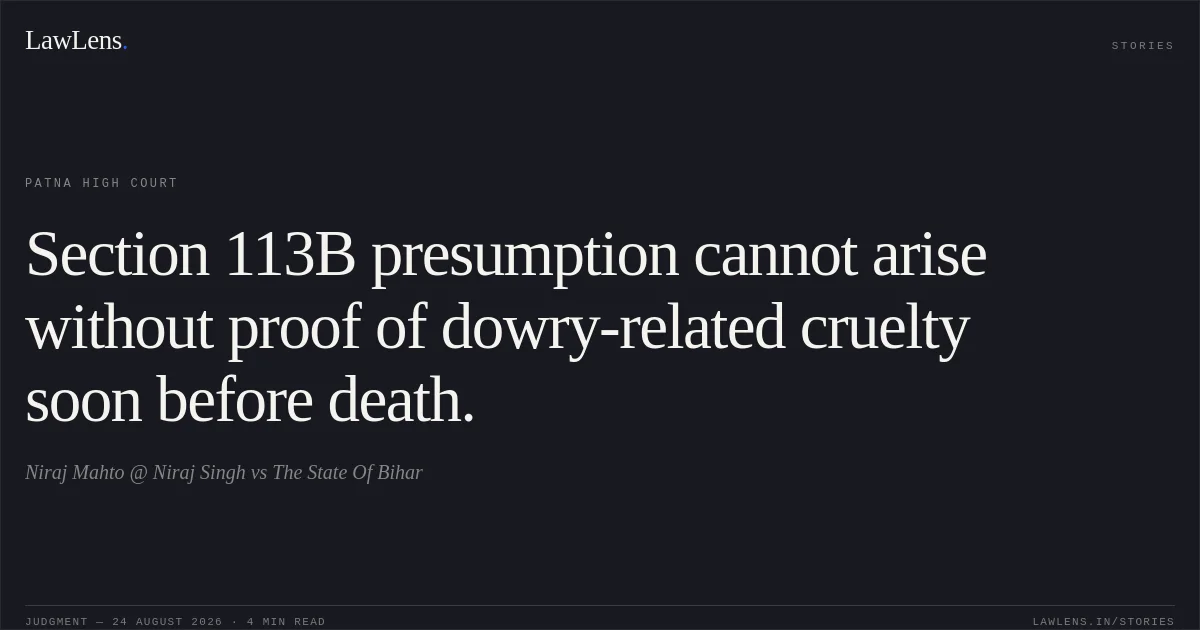
Whether the prosecution proved the essential ingredients of dowry death under Section 304B IPC, particularly that the deceased was subjected to cruelty or harassment for dowry “soon before her death,” so as to attract the presumption under Section 113B of the Evidence Act.
Source reference: pp. 4–5, 7–8Whether the conviction under Section 201/34 IPC was sustainable in the absence of evidence proving that the appellant caused evidence of an offence to disappear with the requisite knowledge and intent.
Source reference: pp. 5–6, 8–9Whether the appellant was entitled to acquittal on account of material gaps in the prosecution’s evidence and the resulting benefit of doubt.
Source reference: pp. 7–9Law Applied
The court applied Section 304B IPC, which requires proof that: (i) the woman’s death was caused by burns, bodily injury, or otherwise than under normal circumstances; (ii) the death occurred within seven years of marriage; and (iii) soon before her death, she was subjected to cruelty or harassment by the accused in connection with a dowry demand.
Source reference: pp. 4–5, 7–8Under Section 113B of the Indian Evidence Act, the presumption of dowry death arises only after the prosecution establishes these foundational facts; the presumption is rebuttable and the burden does not shift to the accused if those ingredients are not proved.
Source reference: p. 8For Section 201 IPC, the prosecution must prove that an offence was committed, that the accused knew or had reason to believe that it had been committed, and that, with the intention of screening the offender from legal punishment, the accused caused evidence to disappear or gave false information.
Source reference: pp. 5–6The court relied on Palvinder Kaur v. State of Punjab, 1953 SCR 94, for this principle.
Source reference: pp. 5–6The court also applied the rule that, in a case based on circumstantial evidence, the chain of circumstances must be complete and any reasonable alternative view must enure to the accused’s benefit.
Source reference: p. 9Reasoning
The court held that although the alleged death occurred within seven years of marriage and was asserted to be unnatural, the prosecution failed to establish the crucial requirement of dowry-related cruelty or harassment “soon before” the death.
Source reference: pp. 7–8The five material prosecution witnesses were relatives of the deceased and none had witnessed the occurrence.
Source reference: p. 7The court also noted the absence of the doctor, seizure-list witnesses, post-mortem report, and inquest report, as well as the Investigating Officer’s failure to examine independent neighbours.
Source reference: p. 7In these circumstances, the evidence did not establish the foundational facts necessary for invoking Section 113B of the Evidence Act; therefore, the burden never shifted to the appellant.
Source reference: p. 8The conviction under Section 201 IPC was likewise found unsustainable because the prosecution produced no adequate evidence that the appellant had caused evidence to disappear with the statutory knowledge and intention to screen an offender.
Source reference: pp. 8–9The finding was based only on suspicion, which could not substitute proof of the essential ingredients of the offence.
Source reference: pp. 8–9The resulting gaps in the circumstantial chain created a reasonable possibility of innocence, requiring the benefit of doubt to be granted to the appellant.
Source reference: p. 9Holding
The Patna High Court allowed the appeal and set aside the judgment of conviction dated 27 March 2018.
It held that the prosecution had failed to prove the offence under Section 304B IPC because dowry-related cruelty or harassment soon before death was not established, and had also failed to prove the charge under Section 201 IPC.
Source reference: pp. 8–9The order of sentence dated 3 April 2018 was set aside/modified, and the appellant was acquitted of all charges and discharged from the liability of his bail bond.
Source reference: pp. 9–10Acts & Sections Cited
4 provisions across 2 statutes referred to in this judgment. Linked provisions open on LawLens.
Indian Penal Code, 18603
Indian Evidence Act, 18721
Original Court PDF
Niraj Mahto @ Niraj SinghvsThe State Of Bihar
Click to open original judgment
Original judgment, available to read, download and summarize on LawLens.in