Facts
Pusha Kumari was married to respondent Sumit Kumar Pandit approximately two years before her death.
Source reference: paras. 4–5Her brother, Nitish Kumar, alleged that after the marriage, the respondents subjected her to cruelty and harassment for dowry, including demands for gold, a bed and ₹2 lakh.
Source reference: paras. 4–5On 12 June 2021, the informant was informed that Pusha had been killed at her matrimonial home.
Source reference: paras. 4–5The post-mortem indicated death by throttling.
Source reference: paras. 4–5An FIR was registered under Sections 304B/34 IPC, followed by charge-sheets against all four respondents; charges under Sections 304B and 498A read with Section 34 IPC were framed.
Source reference: paras. 4–5The prosecution examined seven witnesses, including family members of the deceased, the Investigating Officer, the doctor and an independent witness.
Source reference: paras. 6–7The defence examined two witnesses.
Source reference: paras. 6–7The Sessions Judge, Khagaria acquitted the respondents on 16 December 2024, finding inconsistencies in the alleged dowry demands, absence of proof of cruelty “soon before” the death, lack of specific attribution, and an incomplete chain of circumstantial evidence.
Source reference: paras. 6–7The State preferred the present appeal against acquittal under Section 378(1) and (3) CrPC/Section 419(1) and (3) BNSS.
Source reference: para. 2Issues
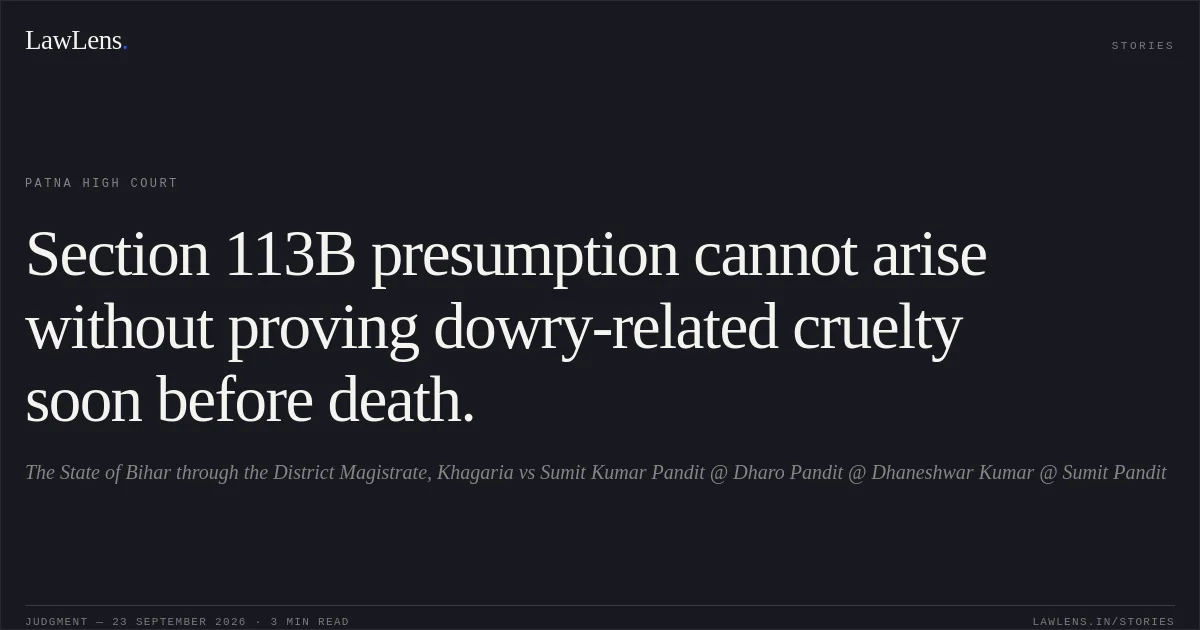
Whether the prosecution established the foundational ingredients of dowry death under Section 304B IPC, particularly cruelty or harassment for, or in connection with, a dowry demand “soon before” the deceased’s death, so as to invoke the presumption under Section 113B of the Evidence Act?
Source reference: paras. 11–15Whether the Trial Court’s acquittal was perverse, manifestly erroneous or otherwise warranted interference in an appeal against acquittal?
Source reference: paras. 26–30Law Applied
Section 304B IPC requires proof that a woman died otherwise than under normal circumstances within seven years of marriage and was subjected, soon before her death, to cruelty or harassment by her husband or his relative for, or in connection with, a dowry demand.
Source reference: para. 12Section 113B of the Evidence Act creates a mandatory presumption of dowry death only after these foundational facts, particularly dowry-related cruelty or harassment proximate to the death, are proved by the prosecution.
Source reference: paras. 13–15In Kaliyaperumal v. State of Tamil Nadu, (2004) 9 SCC 157, the Supreme Court identified the essential ingredients of Section 304B and the prerequisites for invoking Section 113B.
Source reference: para. 13Baijnath v. State of Madhya Pradesh, (2017) 1 SCC 101, establishes that the presumption cannot cure the prosecution’s failure to prove the foundational facts.
Source reference: para. 14Satbir Singh v. State of Haryana, (2021) 6 SCC 1, explains that “soon before” requires a proximate and live link between dowry-related cruelty and death.
Source reference: para. 19Under Chandrappa v. State of Karnataka, (2007) 4 SCC 415, an appellate court may reappreciate evidence in an appeal against acquittal, but must account for the strengthened presumption of innocence and should not interfere where the Trial Court’s view is reasonably possible.
Source reference: para. 27Reasoning
The Court held that the unnatural death within approximately two and a half years of marriage satisfied only some preliminary circumstances and did not, by itself, establish dowry death.
Source reference: para. 16Although PWs 1–4 alleged dowry demands, their accounts differed regarding the amount and nature of the demands—variously referring to cash, gold, a vehicle, a bed or a divan—and did not consistently identify which respondent made which demand.
Source reference: para. 17There was no prior complaint, independent corroboration of the alleged panchayat, or specific evidence of cruelty closely preceding the death.
Source reference: para. 18Consequently, the prosecution failed to establish the required proximate and live link between dowry-related cruelty and the death, and the presumption under Section 113B could not be invoked.
Source reference: paras. 19–21The medical evidence established throttling but did not identify the assailant; the source of information and the alleged involvement of the respondents also varied.
Source reference: paras. 22–25Evidence suggesting that Sumit and Sudhir were in Ludhiana further weakened the circumstantial case, which did not form a complete chain pointing unerringly to guilt.
Source reference: paras. 22–25The Trial Court’s view was therefore reasonably possible and was not perverse or manifestly erroneous.
Source reference: paras. 28–30Holding
The Court answered the issues against the State.
It held that the prosecution failed to prove the foundational ingredients of Section 304B IPC, particularly dowry-related cruelty or harassment soon before the death; therefore, the statutory presumption under Section 113B of the Evidence Act was unavailable.
Source reference: paras. 26, 30–31The Trial Court’s acquittal was found to be a lawful and reasonably possible view, with no perversity or manifest illegality warranting appellate interference.
Source reference: para. 30Accordingly, the government appeal was dismissed at the admission stage, and any pending applications were also disposed of.
Source reference: paras. 32–33Acts & Sections Cited
4 provisions across 3 statutes referred to in this judgment. Each provision opens on LawLens.
Code of Criminal Procedure, 19732
Bharatiya Nagarik Suraksha Sanhita, 20231
Indian Penal Code, 18601
Original Court PDF
The State of Bihar through the District Magistrate, KhagariavsSumit Kumar Pandit @ Dharo Pandit @ Dhaneshwar Kumar @ Sumit Pandit
Click to open original judgment
Original judgment, available to read, download and summarize on LawLens.in