Facts
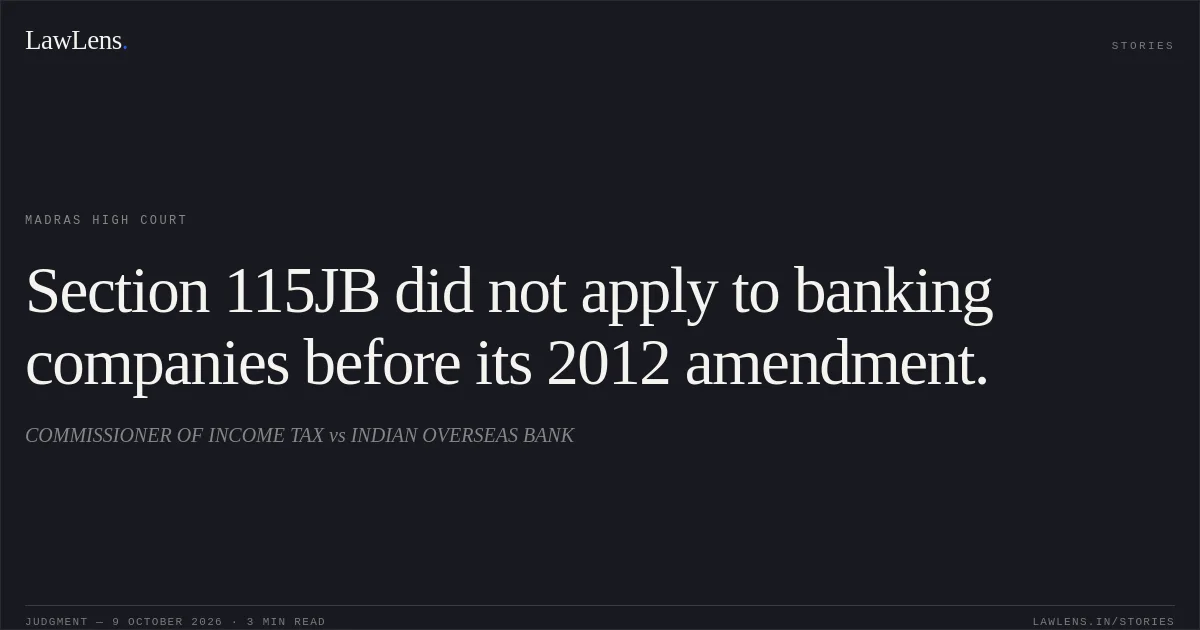
The Revenue appealed under Section 260A of the Income-tax Act, 1961 against ITAT orders concerning Indian Overseas Bank’s assessments for AY 2004–05 and AY 2005–06. The appeals raised questions concerning deductions for bad and doubtful debts under Sections 36(1)(vii) and 36(1)(viia), and whether Section 115JB applied to a banking company before its amendment by the Finance Act, 2012.
Source reference: p.1–3In the AY 2005–06 appeal, the CIT(A) had also accepted an alternative contention that provisions for bad debts and investments written off were deductible in computing book profits; the Tribunal did not consider the Revenue’s additional ground after holding that MAT did not apply to banks.
Source reference: p.9Issues
Whether the Bank was entitled to deductions for bad and doubtful debts under Sections 36(1)(vii) and 36(1)(viia), including where the relevant amount had been debited to a bad-debt reserve rather than written off as expenditure in the Profit and Loss Account.
Source reference: p.2Whether the Tribunal was right to remit the bad-debt issue to the Assessing Officer for fresh consideration in light of Catholic Syrian Bank Ltd. v. Commissioner of Income-tax.
Source reference: p.2Whether Section 115JB applied to a banking company governed by the Banking Regulation Act, 1949, before the Finance Act, 2012 amendment.
Source reference: p.2, p.5In T.C.(A) No. 159 of 2014, whether the provisions for bad debts and investments written off were deductible in computing book profits.
Source reference: p.9–10Law Applied
Section 36(1)(vii) allows deduction for bad debts actually written off, while Section 36(1)(viia) separately permits scheduled commercial banks a deduction for qualifying provisions relating to rural advances; the proviso to Section 36(1)(vii) prevents double deduction by limiting the write-off deduction in the circumstances it covers.
Source reference: p.3–5The Supreme Court in Catholic Syrian Bank Ltd. v. Commissioner of Income-tax, (2012) 343 ITR 270, held that the two deductions are distinct, subject to the statutory limitation against double deduction.
Source reference: p.3–5On Section 115JB, the Court applied its earlier decision in Commissioner of Income Tax v. Indian Overseas Bank and the Karnataka High Court’s decision in Commissioner of Income Tax v. Karnataka Bank Ltd., (2022) 142 taxmann.com 64, in concluding that banking companies were outside MAT before the Finance Act, 2012 amendment specifically addressed their application.
Source reference: p.6–8The alternative book-profit issue was raised by reference to Commissioner of Income Tax v. HCL Comnet Systems and Services Ltd., (2008) 305 ITR 409 (SC), but was not decided.
Source reference: p.9Reasoning
The Court treated the first two questions as governed by Catholic Syrian Bank and, following that authority and its decision in Commissioner of Income Tax v. Karur Vysya Bank Ltd., resolved them for the Bank.
Source reference: p.3–5On Section 115JB, it relied on its prior ruling concerning Indian Overseas Bank, which followed the Karnataka High Court’s reasoning, and held that the MAT provision did not apply to banking companies before the 2012 amendment.
Source reference: p.6–8Because that ruling disposed of the MAT question in T.C.(A) No. 159 of 2014, the Court found it unnecessary to decide the Revenue’s additional challenge concerning the deductibility of provisions in computing book profits.
Source reference: p.10Holding
The Court answered the bad-debt questions and the Section 115JB question in favour of the Bank and against the Revenue.
It left the alternative book-profit issue unanswered as academic.
Source reference: p.10All three tax case appeals were dismissed, with no order as to costs; the connected miscellaneous petitions were closed.
Source reference: p.10Acts & Sections Cited
7 provisions across 1 statute referred to in this judgment. Linked provisions open on LawLens.
Income Tax Act, 19617
Original Court PDF
COMMISSIONER OF INCOME TAXvsINDIAN OVERSEAS BANK
Click to open original judgment
Original judgment, available to read, download and summarize on LawLens.in