Facts
The parties married on 20.02.2008 according to Hindu rites and customs; no child was born from the marriage. The respondent filed a complaint under Section 498A IPC and subsequently instituted proceedings under Section 9 of the Hindu Marriage Act, 1955 (“HMA”) for restitution of conjugal rights.
Source reference: pp. 1–3The Section 9 petition was decreed in her favour on 17.09.2013. Despite the decree, the parties did not resume cohabitation. The respondent initiated execution proceedings, but the appellant refused to join her; the execution petition was later withdrawn owing to her financial constraints.
Source reference: pp. 11–14On 22.04.2016, the appellant filed a petition under Sections 13(1A) and 13(1)(ib) HMA seeking divorce on the grounds of non-restitution of conjugal rights and desertion. The Family Court dismissed the petition on 02.05.2018, finding that the appellant was taking advantage of his own wrong. The appellant challenged that dismissal before the High Court.
Source reference: paras. 1–4Issues
Whether the appellant could challenge the validity of the marriage on the ground that he was under the influence of a sedative when the marriage ceremonies were performed, despite the validity issue having been decided against him in the Section 9 proceedings.
Source reference: paras. 11–14Whether proof of non-restitution of conjugal rights for the statutory period under Section 13(1A)(ii) HMA automatically entitled the appellant to a decree of divorce, or whether relief could be refused under Section 23(1)(a) HMA on the ground that he was taking advantage of his own wrong.
Source reference: paras. 19–24Whether the respondent’s alleged failure to resume cohabitation constituted desertion or otherwise disentitled the appellant from relief under Sections 13(1A) and 13(1)(ib) HMA.
Source reference: paras. 25–37Whether the appellant’s payment of maintenance and the alleged irretrievable breakdown of the marriage justified granting a decree of divorce.
Source reference: paras. 38–39Law Applied
The Court applied Sections 5 and 11 HMA, which prescribe the conditions of a valid Hindu marriage and the consequences of their contravention; the appellant’s allegation of being under the influence of a sedative, at most, attracted Section 12(1)(c) HMA concerning a voidable marriage based on vitiated consent, subject to the statutory limitation for seeking annulment.
Source reference: paras. 12–14Section 13(1A)(ii) HMA permits either spouse to seek divorce where there has been no restitution of conjugal rights for at least one year after a decree under Section 9, but that right remains subject to Section 23(1)(a), which requires the Court to refuse relief where the petitioner is taking advantage of his or her own wrong.
Source reference: paras. 17–22In Hirachand Srinivas Managaonkar v. Sunanda, (2001) 4 SCC 125, the Supreme Court held that Section 23 applies to petitions under Section 13(1A) and that proof of the requisite period of non-cohabitation does not make divorce compulsory.
Source reference: para. 23T. Srinivasan v. T. Varalakshmi, (1998) 3 SCC 112, establishes that refusal by a spouse to permit the other to resume cohabitation constitutes misconduct or “wrong” under Section 23(1)(a).
Source reference: para. 32The Court also distinguished Smt. Saroj Rani v. Sudarshan Kumar Chadha, (1984) 4 SCC 90, and reiterated that irretrievable breakdown of marriage, by itself, is not a statutory ground for divorce.
Source reference: paras. 36, 39Reasoning
The Court held that the appellant’s challenge to the marriage was untenable because the alleged sedation did not render the marriage void under Sections 5 and 11 HMA; at most, it could have supported annulment under Section 12(1)(c), which the appellant did not timely pursue. Moreover, the validity of the marriage had already been adjudicated against him in the Section 9 proceedings and had attained finality.
Source reference: paras. 11–14Although the decree under Section 9 and the requisite period of non-restitution prima facie attracted Section 13(1A)(ii), the appellant admitted that he made no effort to reconcile or bring the respondent back. The respondent, in contrast, expressed continued willingness to resume cohabitation, offered to withdraw the pending litigation, and attempted to execute the restitution decree.
Source reference: paras. 25–35The appellant’s refusal even in the execution proceedings, together with his continued denial of the marriage, demonstrated that he had frustrated the possibility of cohabitation and was seeking to benefit from his own misconduct.
Source reference: paras. 25–35Payment of maintenance merely discharged a statutory or court-imposed obligation and did not negate the appellant’s wrongful conduct. Nor could the Court grant divorce solely on the basis of prolonged separation or alleged irretrievable breakdown, particularly when the respondent remained willing to live with him.
Source reference: paras. 38–39Holding
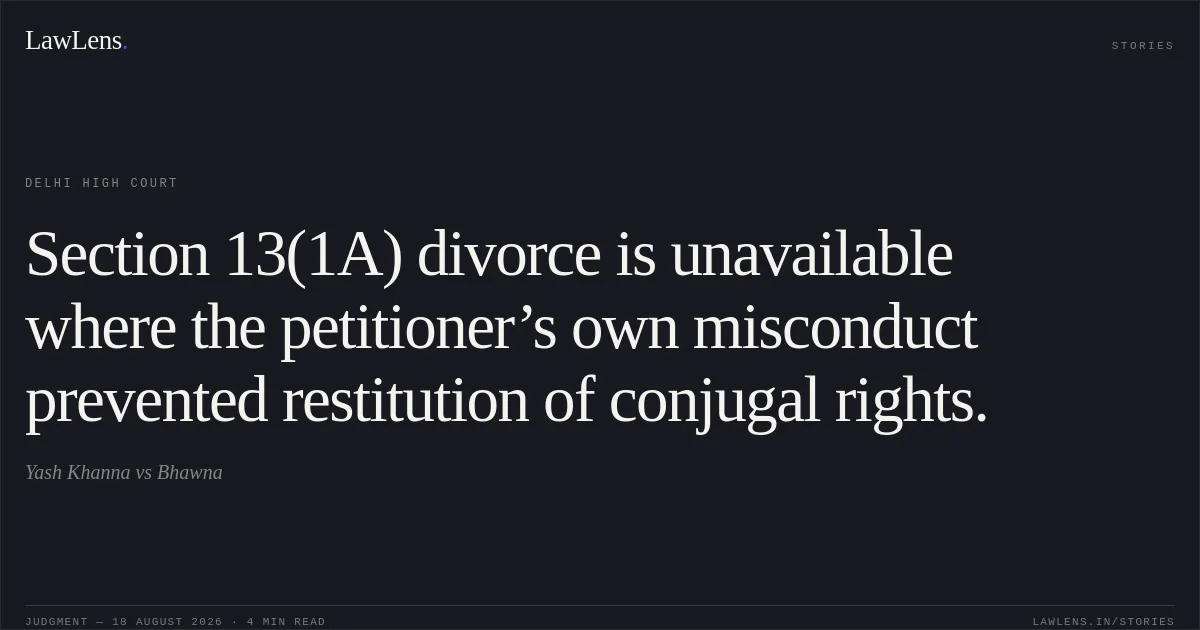
The High Court answered the issues against the appellant. It held that he was not entitled to challenge the marriage as void, that Section 13(1A) does not confer an absolute right to divorce, and that his refusal to resume or facilitate cohabitation amounted to taking advantage of his own wrong under Section 23(1)(a) HMA.
The plea of desertion also failed, as the evidence did not establish that the respondent had unjustifiably withdrawn from the appellant; rather, the appellant’s conduct prevented reunion.
Source reference: paras. 33–37Finding no perversity, illegality, or infirmity in the Family Court’s judgment, the Court dismissed the appeal and disposed of the pending applications, if any.
Source reference: paras. 40–41Acts & Sections Cited
7 provisions across 2 statutes referred to in this judgment. Each provision opens on LawLens.
Family Courts Act, 19841
Hindu Marriage Act, 19556
Original Court PDF
Yash KhannavsBhawna
Click to open original judgment
Original judgment, available to read, download and summarize on LawLens.in