Facts
The petitioner and respondent were married on 23.03.2023 at Shivpuri according to Hindu rites. They began living separately on 26.06.2023 due to serious differences and incompatibility, and stated that reconciliation and resumption of cohabitation were no longer possible.
Source reference: paras. 2–5; pp. 1–2The parties jointly instituted proceedings for divorce by mutual consent under Section 13-B of the Hindu Marriage Act, 1955, before the Family Court, Gwalior. Their First Motion statements were recorded on 11.07.2026. They thereafter jointly applied for waiver of the six-month cooling-off period under Section 13-B(2), but the Second Additional Principal Judge, Family Court, Gwalior rejected the application by order dated 11.08.2026 in H.M.A. Case No. 874/2026. The petitioner challenged that order under Article 227 of the Constitution.
Source reference: paras. 2–5; pp. 1–2Issues
Whether the six-month waiting period prescribed under Section 13-B(2) of the Hindu Marriage Act is mandatory or directory and capable of being waived by the Court.
Source reference: paras. 5–7; pp. 2–4Whether the Family Court erred in rejecting the parties’ joint application for waiver despite their prolonged separation, failed reconciliation efforts, and mutual decision to dissolve the marriage.
Source reference: para. 8; p. 5Law Applied
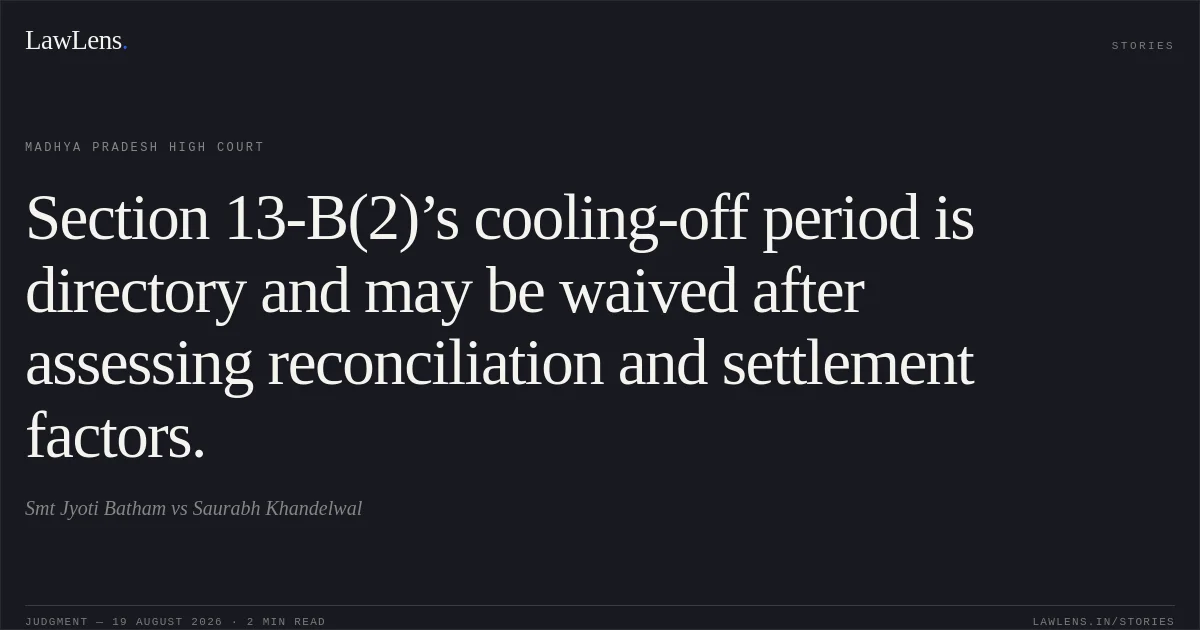
Section 13-B(2) of the Hindu Marriage Act prescribes a six-month period between the First and Second Motions for divorce by mutual consent; however, as held in Amardeep Singh v. Harveen Kaur, (2017) 8 SCC 746, the period is directory and may be waived where the Court is satisfied that the parties have already undergone the requisite separation, reconciliation efforts have failed, their disputes have been genuinely settled, and continued waiting would prolong their agony.
Source reference: paras. 6–7; pp. 2–4The Supreme Court in Amit Kumar v. Suman Beniwal, 2021 SCC OnLine SC 1270, clarified that the factors in Amardeep Singh are not mandatory preconditions and that the Court may consider, among other factors, the duration of the marriage, the period of cohabitation and separation, pending litigation, the possibility of reconciliation, the existence of children, and the voluntariness and completeness of the settlement.
Source reference: paras. 6–7; pp. 2–4Reasoning
The High Court found that the parties had lived separately for more than three years, had jointly stated that reconciliation was impossible, had already recorded their First Motion statements, and had consciously chosen divorce by mutual consent.
Source reference: para. 8; p. 5Applying Amardeep Singh and Amit Kumar, the Court held that insistence on the statutory waiting period would serve no useful purpose and would merely prolong the parties’ matrimonial agony. The Family Court had failed to consider the discretionary nature of Section 13-B(2) and the applicable Supreme Court principles while rejecting the waiver application.
Source reference: para. 8; p. 5Holding
The High Court allowed the miscellaneous petition and set aside the Family Court’s order dated 11.08.2026. It held that the period under Section 13-B(2) is discretionary, not mandatory.
The High Court directed the concerned Family Court to decide the parties’ application under Section 13-B expeditiously in light of Amit Kumar v. Suman Beniwal. The High Court did not itself grant the divorce or expressly waive the period, but remitted the waiver application for prompt reconsideration.
Source reference: paras. 9–10; pp. 5–6Acts & Sections Cited
2 provisions across 2 statutes referred to in this judgment. Each provision opens on LawLens.
Hindu Marriage Act, 19551
Family Courts Act, 19841
Original Court PDF
Smt Jyoti BathamvsSaurabh Khandelwal
Click to open original judgment
Original judgment, available to read, download and summarize on LawLens.in