Facts
The appellant, the original complainant in a cheque-dishonour prosecution, filed an appeal under Section 378 of the Code of Criminal Procedure, 1973 (CrPC), alternatively invoking Section 419 of the Bharatiya Nagarik Suraksha Sanhita, 2023 (BNSS), challenging the judgment dated 22 November 2024 by which the Trial Court acquitted the accused of the offence under Section 138 of the Negotiable Instruments Act, 1881 (NI Act).
Source reference: p.1, para.1During the hearing, the accused and the State submitted that, in view of Celestium Financial v. A. Gnanasekaran, the complainant in a Section 138 prosecution is a “victim” and must pursue an appeal under the proviso to Section 372 CrPC before the immediately superior court, namely, the Sessions Court.
Source reference: p.2, paras.3–4The Additional Public Prosecutor informed the Court that the decision in Celestium Financial was pending consideration before the Supreme Court in Special Leave to Appeal (Crl.) No. 12350 of 2024 and that the issue had been referred for authoritative determination.
Source reference: p.2, para.6Issues
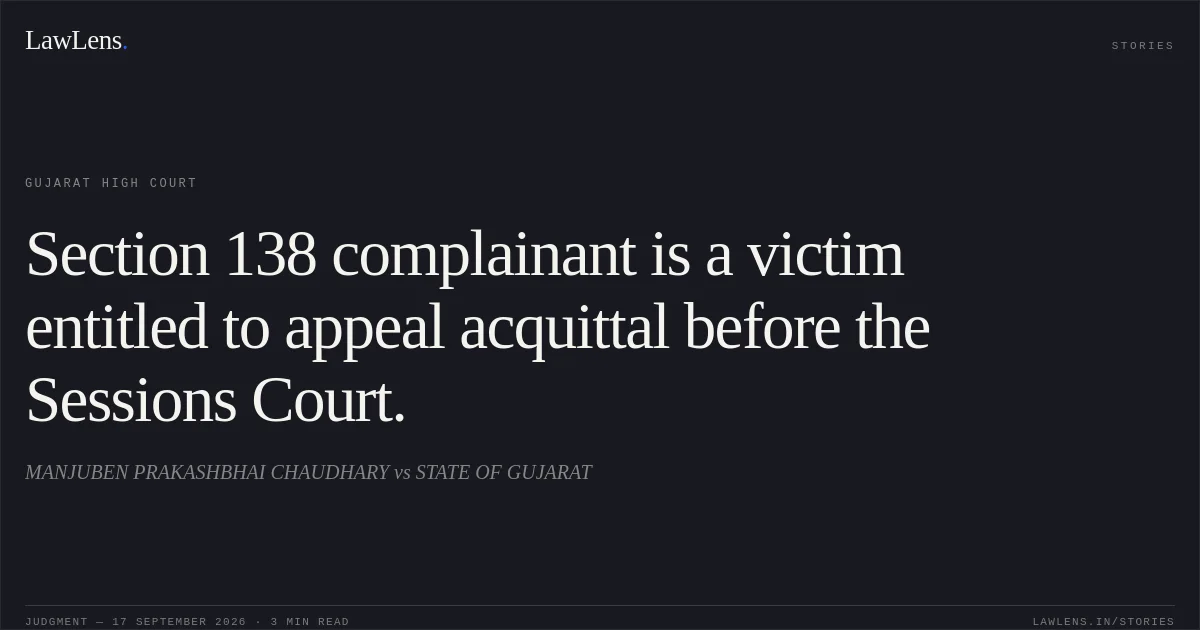
Whether the complainant in a prosecution under Section 138 of the NI Act is a “victim” entitled to appeal against acquittal under the proviso to Section 372 CrPC, or the corresponding provision of the BNSS, without proceeding under Section 378 CrPC.
Source reference: p.2, paras.3–4; p.3, paras.7.8–7.9Whether the appeal filed before the High Court was required to be transferred to the concerned Sessions Court for consideration as an appeal under the proviso to Section 372 CrPC / Section 413 BNSS.
Source reference: p.5, para.8Law Applied
The Court applied Sections 378 and 372 CrPC, and the corresponding provisions under the BNSS, together with Section 138 of the NI Act.
Source reference: no citationRelying on Celestium Financial v. A. Gnanasekaran, the Court held that the complainant/payee or holder of a dishonoured cheque is also the victim of the deemed offence under Section 138 of the NI Act and may appeal against acquittal under the proviso to Section 372 CrPC; such an appeal lies before the court immediately superior to the trial court, ordinarily the Sessions Court, and is not subject to the special-leave requirement under Section 378(4) CrPC.
Source reference: pp.3–5, para.7The Court also relied on Shivsinh Ganpatsinh Solanki v. State of Gujarat and Thakar Hariprasad Dalsukhram v. State of Gujarat, 2026 SCC OnLine Guj 569, for the procedure concerning transfer of such appeals.
Source reference: pp.2, 5, paras.4, 8Reasoning
The Court did not examine the merits of the acquittal.
Source reference: no citationIt accepted the legal position stated in Celestium Financial that, in a Section 138 NI Act prosecution, the complainant and victim are ordinarily the same person because the complainant suffers the direct injury from dishonour of the cheque.
Source reference: pp.3–5, para.7Accordingly, the appellant’s challenge to the acquittal was required to be treated as a victim’s appeal under the proviso to Section 372 CrPC / Section 413 BNSS and presented before the Sessions Court, which is immediately superior in hierarchy to the Magistrate’s Court.
Source reference: p.5, para.8Although the State pointed out that the issue was pending before a larger Bench of the Supreme Court, the High Court proceeded in accordance with the prevailing decisions and transferred the matter without adjudicating its merits.
Source reference: pp.2, 5–6, paras.6, 8–9Holding
The High Court disposed of the appeal by directing the Registry to transfer it to the concerned Sessions Court.
The Sessions Court was directed to treat and number the matter as an appeal under the proviso to Section 372 CrPC / Section 413 BNSS and issue notice to the parties.
Source reference: p.5, para.8The complete record, including the certified copy of the impugned judgment and the record and proceedings, was directed to be transmitted forthwith.
Source reference: p.5, para.8The Sessions Court was further requested to decide the matter expeditiously, and the High Court expressly clarified that it had not considered the merits of the acquittal.
Source reference: p.6, para.9Acts & Sections Cited
9 provisions across 3 statutes referred to in this judgment. Each provision opens on LawLens.
Code of Criminal Procedure, 19735
Bharatiya Nagarik Suraksha Sanhita, 20232
Negotiable Instruments Act, 18812
Original Court PDF
MANJUBEN PRAKASHBHAI CHAUDHARYvsSTATE OF GUJARAT
Click to open original judgment
Original judgment, available to read, download and summarize on LawLens.in