Facts
The Appellant (Complainant) entered into a contract with Respondent Nos. 1 and 2 (Accused) for the supply of 40,000 MT of iron ore
Source reference: p. 3The Appellant paid a demand draft of ₹35,00,000 as a deposit to be adjusted against the last delivery
Source reference: p. 3-4A cheque dated 24.05.2004 for the same amount, allegedly held as security, was presented by the Appellant and subsequently dishonored on 02.06.2004
Source reference: p. 5The Appellant claimed the Respondents breached the contract by supplying inferior quality ore (below 62% iron content)
Source reference: p. 3-4However, the Respondents contended that the cheque was a blank security cheque and that no enforceable debt existed at the time of presentation
Source reference: p. 8While the JMFC, Panaji originally convicted the Respondents on 11.09.2014, the Sessions Judge, North Goa, set aside the conviction on 30.09.2015
Source reference: p. 2The Appellant challenged this acquittal in the High Court of Bombay at Goa
Source reference: p. 3Issues
1. Whether there existed a legally enforceable debt or liability under Section 138 of the Negotiable Instruments Act at the time the cheque was presented for encashment
Source reference: p. 5 / para. 92. Whether the Appellant established the foundational facts necessary to invoke the statutory presumptions under Sections 118 and 139 of the Negotiable Instruments Act
Source reference: p. 6 / para. 11Law Applied
The court applied Section 138 of the Negotiable Instruments Act, 1881, regarding the dishonor of cheques for discharge of debt or liability
Source reference: p. 2It relied on the statutory presumptions under Sections 118 (presumption as to negotiable instruments) and 139 (presumption in favor of holder) of the N.I. Act
Source reference: p. 4, 6Regarding the standards for reversing an acquittal, the court followed principles from C. Antony v. Raghavan Nair, K. Prakashan v. P. K. Surendran, and State of Goa v. Sanjay Thakran, which dictate that an appellate court should not interfere with an acquittal if the trial court’s view is a "possible view" and the presumption of innocence is strengthened by the acquittal
Source reference: p. 9-10Reasoning
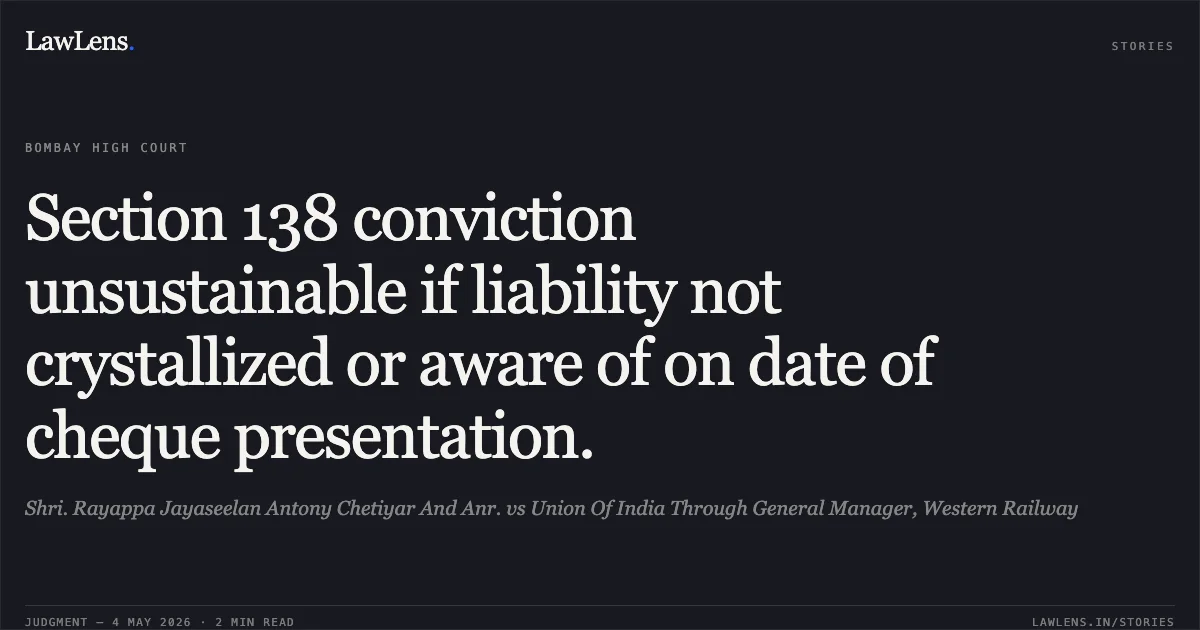
The court found that as of 24.05.2004 (date of presentation), the Appellant had no objective basis to claim a debt because the official analysis report from S.K. Mitra Pvt. Ltd.—the only binding analyst per the contract—was dated 09.07.2004
Source reference: p. 6, 11Consequently, the Appellant was unaware if the ore was "inferior" at the time of deposit, meaning no liability had crystallized
Source reference: p. 13Furthermore, the court noted significant discrepancies between the Appellant’s 138 complaint and a separate cheating complaint filed against one Pandurang alias Bhai Naik regarding how the cheque was obtained
Source reference: p. 7This variance undermined the "foundational facts" required to trigger the Section 139 presumption
Source reference: p. 12The court also observed that since the Respondents had supplied some ore (1393.10 MT), the dispute was a matter of contract price adjustment or arbitration (Clause 12), rather than a clear-cut liquidated debt enforceable via criminal proceedings
Source reference: p. 11-12Holding
The High Court held that the legal liability was not established at the time of the cheque's presentation and the Respondents successfully rebutted the statutory presumptions via preponderance of probabilities
The Appeal was dismissed, and the acquittal of Respondent Nos. 1 and 2 was upheld
Source reference: p. 14Acts & Sections Cited
4 provisions across 2 statutes referred to in this judgment. Each provision opens on LawLens.
Negotiable Instruments Act, 18813
Code of Criminal Procedure, 19731
Original Court PDF
Shri. Rayappa Jayaseelan Antony Chetiyar And Anr.vsUnion Of India Through General Manager, Western Railway
Click to open original judgment
Original judgment, available to read, download and summarize on LawLens.in