Facts
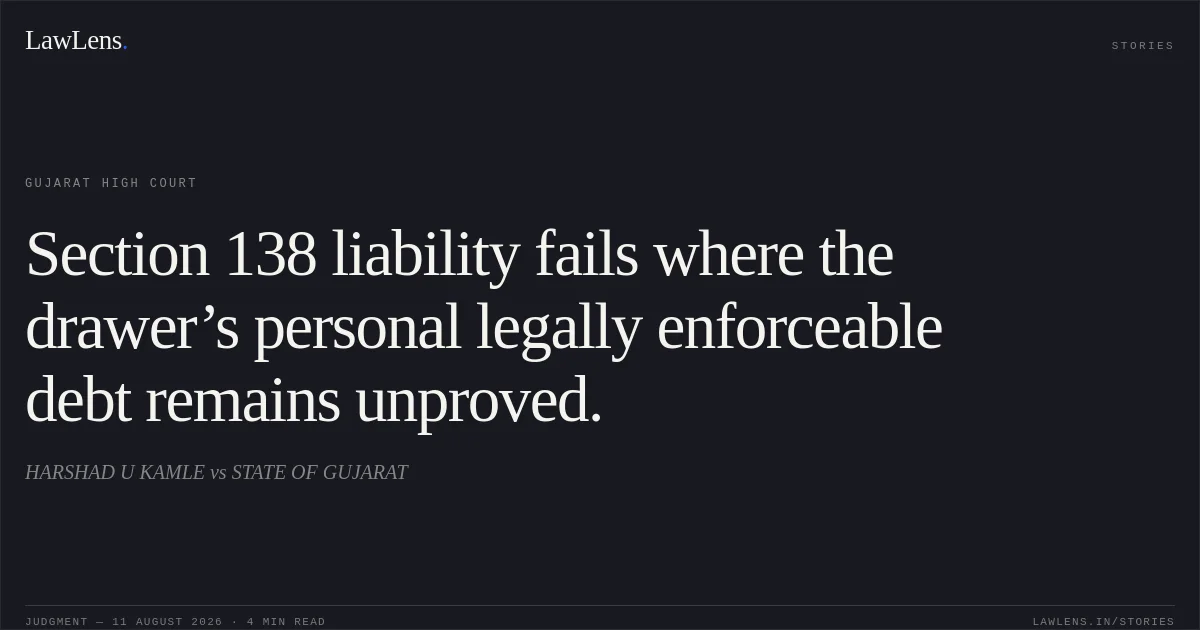
Respondent No. 2 was associated with Tapasvi Charitable Trust, which operated a de-addiction centre from premises owned by the appellant. The appellant alleged that respondent No. 2 had incurred or personally acknowledged liabilities comprising loans of ₹50,000, ₹2,00,000 and ₹50,000 advanced by him, ₹2,00,000 advanced by his wife, and ₹1,50,000 towards rent. He claimed that respondent No. 2 executed documents acknowledging the liability and issued a personal cheque dated 1 June 2006 for ₹6,50,000, which was dishonoured for insufficiency of funds. After service of the statutory notice and failure to pay, the appellant filed a complaint under Section 138 of the Negotiable Instruments Act, 1881 (“NI Act”).
Source reference: pp. 2–4, paras. 2.1–2.6The Trial Court convicted respondent No. 2 under Section 138 of the NI Act and directed her to undergo three months’ simple imprisonment, pay a fine of ₹1,000, and pay ₹6,50,000 to the appellant. In appeal, the Principal Sessions Judge reversed the conviction and acquitted her, holding, inter alia, that the liabilities related to the Trust and were not established as respondent No. 2’s personal legally enforceable liabilities. The complainant challenged the acquittal before the Gujarat High Court under Section 378 of the Code of Criminal Procedure, 1973.
Source reference: pp. 4–5, paras. 2.9–2.11; pp. 26–32, paras. 13–23; p. 1, para. 1Issues
Whether the First Appellate Court was justified in reversing the Trial Court’s judgment of conviction and acquitting respondent No. 2?
Source reference: p. 21, para. 6Whether the First Appellate Court’s judgment suffered from illegality, perversity, or failure to appreciate the Trial Court’s reasoning and the evidence on record?
Source reference: p. 21, para. 6Whether the cheque represented a legally enforceable debt or other liability personally owed by respondent No. 2 to the appellant, notwithstanding that the underlying liabilities arose from the affairs of the Trust?
Source reference: pp. 26–36, paras. 13–31Whether the statutory presumptions under Sections 118(a) and 139 of the NI Act stood rebutted by the defence raised by respondent No. 2?
Source reference: pp. 18–20, para. 5.14; pp. 37–40, paras. 33–35Law Applied
The Court applied Section 138 of the NI Act, under which dishonour of a cheque constitutes an offence only when the cheque was issued towards a legally enforceable debt or other liability and the statutory notice and payment requirements are satisfied.
Source reference: pp. 32–33, para. 24Sections 118(a) and 139 create rebuttable presumptions that the negotiable instrument was issued for consideration and that the cheque was received for discharge of a debt or liability; the accused may rebut these presumptions on a preponderance of probabilities and need not necessarily enter the witness box.
Source reference: pp. 18–20, para. 5.14; pp. 37–40, paras. 33–35Relying on Rangappa v. Sri Mohan, Basalingappa v. Mudibasappa, Kamala S. v. Vidhyadharan M.J., and Babubhai Ambalal Patel v. State of Gujarat, the Court held that a probable defence emerging from the complainant’s evidence and cross-examination can shift the evidentiary burden back to the complainant.
Source reference: pp. 19–20, para. 5.15; pp. 37–40, paras. 33–35The Court also recognised, with reference to Bijoy Kumar Moni v. Paresh Manna, that Section 138 may apply where the drawer assumes responsibility for another person’s legally enforceable liability, provided such an arrangement is established.
Source reference: p. 36, para. 29In an appeal against acquittal, the appellate court may reappreciate the evidence, but must respect the double presumption of innocence and should not interfere where two reasonable views are possible, absent perversity or manifest illegality; this principle was drawn from Chandrappa v. State of Karnataka, Dattatraya v. Sharanappa, Rajco Steel Enterprises v. Kavita Saraff, and Ramesh v. State of Karnataka.
Source reference: pp. 41–45, paras. 37–43Reasoning
The Court found that the documentary evidence, particularly the Memorandum of Understanding at Exhibit 21, showed that from 1 February 2005 the newly inducted trustees had assumed responsibility for the Trust’s administration, rent, and specified financial liabilities.
Source reference: pp. 22–26, paras. 7–12The rent receipts identified the Trust as the tenant and recorded payments made by Dr. Vijay Kumar Patel, indicating that the rent liability was attributable to the Trust and its managing trustees rather than personally to respondent No. 2.
Source reference: pp. 26–30, paras. 15–21The appellant also failed to satisfactorily establish the alleged ₹2,00,000 loan advanced by his wife because she was neither examined nor was supporting financial or accounting evidence produced; the appellant’s assertion that the relevant records had been stolen was unsupported by production of the alleged FIR.
Source reference: pp. 31, 34–35, paras. 22, 26–28These circumstances constituted a probable defence sufficient to rebut the presumptions under Sections 118(a) and 139 of the NI Act.
Source reference: pp. 31–36, paras. 23–31Although a drawer may incur liability by expressly assuming another person’s debt, the Court held that the alleged personal assumption of liability by respondent No. 2 was not proved with sufficient credibility.
Source reference: pp. 31–36, paras. 23–31The Trial Court had overlooked material contradictions, the Trust-related nature of the liabilities, the rent receipts, the non-examination of the appellant’s wife, and the absence of corroborative financial records.
Source reference: pp. 31–36, paras. 23–31Since the First Appellate Court had undertaken a detailed and reasonable appreciation of the evidence, its acquittal could not be characterised as perverse or manifestly illegal.
Source reference: pp. 40–45, paras. 36–45Holding
The High Court answered the issues against the appellant. It held that the appellant failed to establish beyond reasonable doubt that the cheque represented a legally enforceable personal debt or liability of respondent No. 2.
The First Appellate Court had lawfully rebutted the statutory presumptions on the basis of a probable defence and had not committed any perversity or manifest error in reversing the conviction.
Source reference: pp. 40–45, paras. 36–45Accordingly, the appeal under Section 378 CrPC was dismissed, the order of acquittal passed by the First Appellate Court was confirmed, the bail bond was cancelled, and the record and proceedings were directed to be returned to the concerned appellate court.
Source reference: p. 46, para. 46Acts & Sections Cited
9 provisions across 2 statutes referred to in this judgment. Each provision opens on LawLens.
Code of Criminal Procedure, 19735
Negotiable Instruments Act, 18814
Original Court PDF
HARSHAD U KAMLEvsSTATE OF GUJARAT
Click to open original judgment
Original judgment, available to read, download and summarize on LawLens.in