Facts
The appellant/complainant alleged that the respondent obtained a loan of ₹1,15,000 on 23 April 1999 and, towards partial discharge of the liability, issued account-payee cheque No. 166246 for ₹50,000, after allegedly repaying ₹21,000.
Source reference: para. 3The cheque was presented on 11 October 1999 and dishonoured on 15 October 1999 with the endorsement “Not Arranged For”.
Source reference: para. 4The complainant issued a statutory notice, received by the respondent on 26 October 1999, calling upon her to make payment; the respondent replied denying liability and did not pay.
Source reference: para. 4The Trial Court acquitted the respondent in the complaint under Section 138 of the Negotiable Instruments Act, 1881, principally because the notice did not specifically mention the amount payable under the dishonoured cheque.
Source reference: paras. 1–2, 6The complainant challenged the acquittal in the present appeal.
Source reference: para. 7Issues
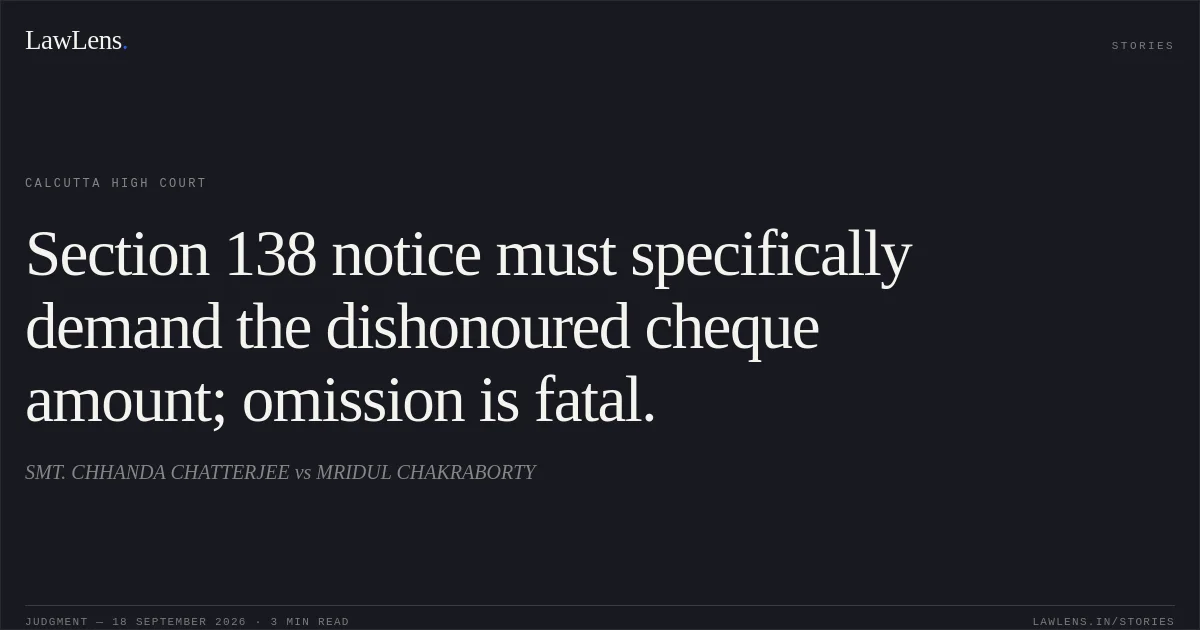
Whether a statutory demand notice under proviso (b) to Section 138 of the Negotiable Instruments Act is valid when it refers to the dishonoured cheque and demands payment but does not specifically state the cheque amount of ₹50,000.
Source reference: paras. 25–27Whether the omission to mention the precise cheque amount is a curable or technical defect, or whether it constitutes non-compliance with a mandatory statutory condition precedent to prosecution under Section 138.
Source reference: paras. 29–35Whether the Trial Court’s acquittal warranted appellate interference.
Source reference: paras. 36–38Law Applied
Section 138 of the Negotiable Instruments Act, 1881, particularly proviso (b), requires the payee or holder in due course to issue a written notice demanding payment of the “said amount of money,” meaning the amount covered by the dishonoured cheque.
Source reference: para. 27In Central Bank of India v. Saxons Farms, (1999) 8 SCC 221, the Supreme Court held that no particular form of notice is prescribed, but the notice must be written, timely, and contain a demand for payment of the cheque amount.
Source reference: paras. 11–12, 32In Kaveri Plastics v. Mahdoom Bawa Bahrudeen Noorul, 2025 SCC OnLine SC 2019, the Supreme Court reiterated that demanding payment of the amount covered by the dishonoured cheque is a principal ingredient of an offence under Section 138; a notice must specify the same amount for which the cheque was issued, although additional claims such as legal or notice charges may also be included.
Source reference: para. 28Non-compliance with this requirement invalidates the foundation for proceedings under Section 138.
Source reference: paras. 29, 34–35Reasoning
The Court found that the cheque was for ₹50,000 and that Exhibit-3 was the statutory notice, but the notice did not state or demand payment of that precise amount.
Source reference: paras. 23–26, 30Although the notice identified the dishonour and demanded payment generally, such reference was insufficient because the drawer had to be informed with reasonable certainty of the exact monetary liability whose payment would avoid penal consequences.
Source reference: para. 31The Court distinguished the principle in Central Bank of India that no particular format is necessary: flexibility as to form does not dispense with the substantive requirement of demanding the cheque amount.
Source reference: paras. 32–33The defect could not be cured by evidence concerning the debt, issuance of the cheque, or dishonour, since the validity of the notice had to be determined from its own contents.
Source reference: para. 34Accordingly, the statutory condition under proviso (b) to Section 138 remained unfulfilled.
Source reference: para. 35Holding
The Court held that Exhibit-3 was invalid because it did not demand payment of the ₹50,000 covered by the dishonoured cheque.
The omission constituted non-compliance with a mandatory requirement of proviso (b) to Section 138 and defeated the prosecution under that provision.
Source reference: paras. 35–36Finding no perversity or legal infirmity in the Trial Court’s decision, the High Court dismissed the appeal and affirmed the judgment and order of acquittal dated 17 April 2001.
Source reference: paras. 37–39A copy of the judgment was directed to be transmitted to the Trial Court along with the records.
Source reference: para. 40Acts & Sections Cited
1 provisions across 1 statute referred to in this judgment. Each provision opens on LawLens.
Negotiable Instruments Act, 18811
Original Court PDF
SMT. CHHANDA CHATTERJEEvsMRIDUL CHAKRABORTY
Click to open original judgment
Original judgment, available to read, download and summarize on LawLens.in