Facts
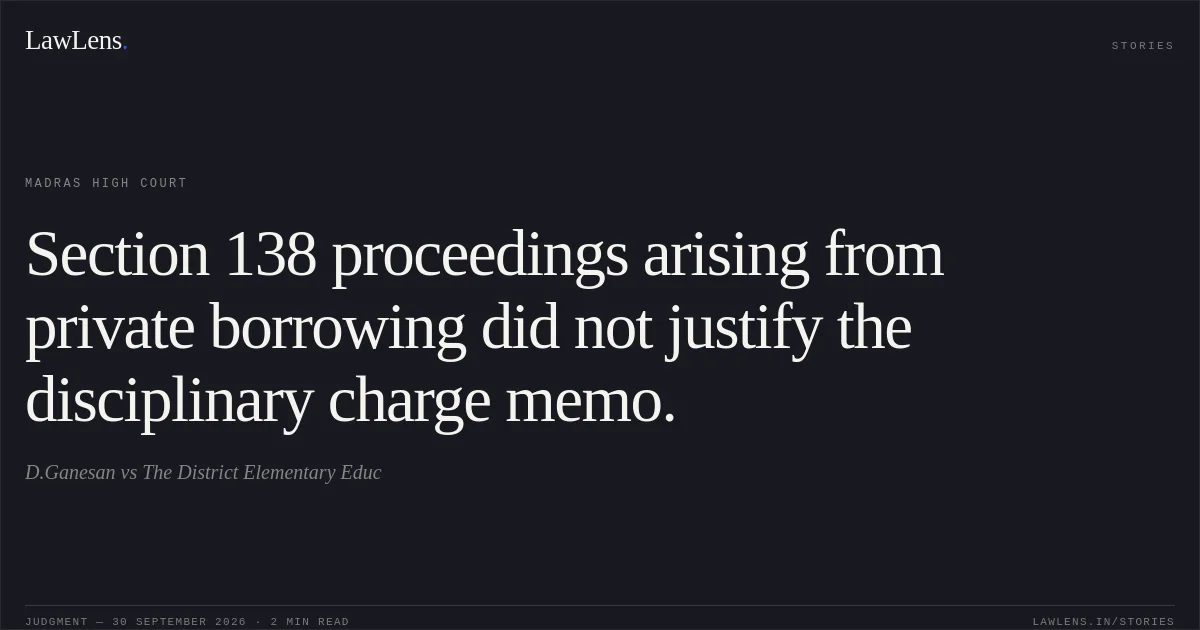
The petitioner, a middle-school Headmaster, allegedly borrowed ₹8,00,000 from a private individual and issued a cheque that was dishonoured for insufficiency of funds.
Source reference: no citationA prosecution under Section 138 of the Negotiable Instruments Act, 1881, followed.
Source reference: no citationThe first respondent issued a charge memo under Rule 17(b) of the Tamil Nadu Civil Services (Discipline and Appeal) Rules, alleging violations of Rule 64-A(1) and Rule 21 of the Tamil Nadu Government Servants’ Conduct Rules, 1973, on the ground that the petitioner had borrowed the money without informing the Department and was involved in the proceedings.
Source reference: p.2The petitioner sought certiorari to quash the charge memo dated 10 March 2025.
Source reference: p.2Issues
Whether the charge memo issued against the petitioner on the basis of his borrowing and the related Section 138 proceedings should be quashed
Source reference: pp.2, 6Whether the Court should follow its earlier decision quashing a similar charge memo arising from a Section 138 matter
Source reference: pp.3–6Law Applied
Rule 17(b) of the Tamil Nadu Civil Services (Discipline and Appeal) Rules provides the disciplinary procedure invoked against the petitioner; the alleged misconduct was framed as a breach of Rule 64-A(1) and Rule 21 of the Tamil Nadu Government Servants’ Conduct Rules, 1973.
Source reference: p.2In Kaushalya Devi Massand v. Roopkishore Khore, (2011) 4 SCC 593, the Supreme Court observed that an offence under Section 138 of the Negotiable Instruments Act is, in substance, almost a civil wrong given criminal overtones and is not equivalent in gravity to offences under the Penal Code or other criminal offences.
Source reference: pp.3–4The Court also relied on its prior decision in W.P.(MD) No.22823 of 2024, which followed earlier decisions quashing similar charge memos in Section 138-related matters.
Source reference: pp.3–6Reasoning
The Court treated the present matter as materially similar to W.P.(MD) No.22823 of 2024, in which a similar charge memo had been quashed.
Source reference: pp.3–6That decision, in turn, relied on the characterisation of Section 138 proceedings as arising from a commercial transaction and on prior rulings concerning disciplinary action based on such proceedings.
Source reference: pp.3–6Finding no reason to depart from that approach, the Court followed the earlier decision and quashed the impugned charge memo.
Source reference: p.6Holding
The Court allowed the writ petition and quashed the first respondent’s charge memo dated 10 March 2025.
No costs were ordered, and the connected miscellaneous petition was closed.
Source reference: p.7Acts & Sections Cited
1 provisions across 1 statute referred to in this judgment. Each provision opens on LawLens.
Negotiable Instruments Act, 18811
Original Court PDF
D.GanesanvsThe District Elementary Educ
Click to open original judgment
Original judgment, available to read, download and summarize on LawLens.in