Facts
The opposite party paid ₹13,50,000 in advance to the petitioner for supply of a generator, which was not delivered, leading to an earlier FIR under Sections 406 and 420 IPC.
Source reference: pp. 2–4, paras. 5–7, 15The parties subsequently settled the dispute, agreeing to repayment of ₹13,50,000 in instalments along with ₹1,35,000 as full and final compensation; the settlement and payment schedule were recorded in the compromise dated 30 September 2016 and in the bail order.
Source reference: pp. 2–4, paras. 5–7, 15During the payment process, the petitioner issued Cheque No. 591592 for ₹50,000, allegedly as advance/security towards part-payment of the fourth instalment.
Source reference: pp. 4–6, paras. 8–10The petitioner contended that the amount was subsequently paid through RTGS, including the cheque amount, and that the cheque had been misplaced and later misused.
Source reference: pp. 4–6, paras. 8–10The cheque was presented on 7 February 2017 and dishonoured due to stop-payment instructions.
Source reference: p. 5, para. 9Following service of statutory notice, the opposite party filed a complaint under Section 138 of the Negotiable Instruments Act, 1881.
Source reference: p. 5, para. 9The Magistrate took cognizance and issued summons on 4 July 2024. The petitioner challenged that order before the High Court.
Source reference: pp. 1–2, para. 3; p. 5, para. 9Issues
Whether the cheque for ₹50,000 represented a legally enforceable debt or liability so as to attract Section 138 of the Negotiable Instruments Act, 1881.
Source reference: pp. 8–12, paras. 13–18Whether, in the exercise of its inherent jurisdiction, the High Court could quash the order taking cognizance and issuing summons where the documentary material demonstrated that the settlement amounts and compensation had already been paid.
Source reference: pp. 10–12, paras. 17–19Law Applied
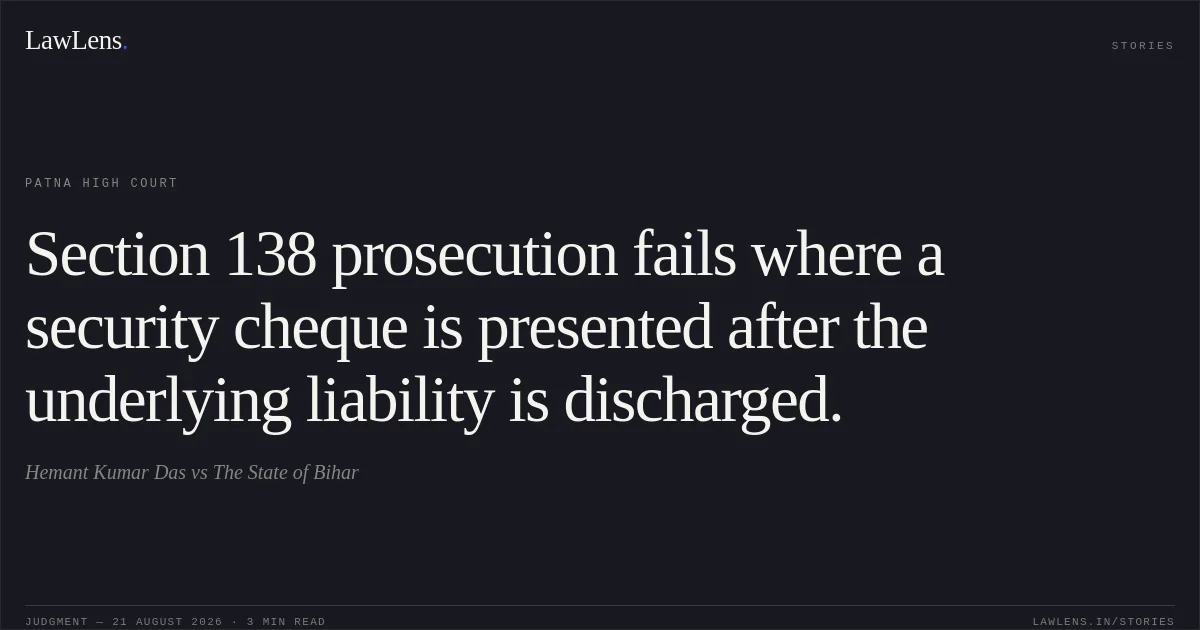
Section 138 of the Negotiable Instruments Act, 1881 applies only where the dishonoured cheque was issued towards discharge, wholly or partly, of a legally enforceable debt or liability.
Source reference: pp. 8–12, paras. 14, 16, 18Relying on Sripati Singh (Since Deceased) through his Son v. State of Jharkhand , (2022) 18 SCC 614, the Court held that a security cheque may attract Section 138 if the underlying liability has matured and remains unpaid; however, where the liability has been discharged in another manner before presentation, the security cheque cannot thereafter be presented.
Source reference: pp. 10–11, para. 16Relying on Harshendra Kumar D. v. Rebatilata Koley , (2011) 3 SCC 351, the Court further held that, in an appropriate case, incontrovertible documents having a significant bearing on the matter may be considered at the threshold to prevent abuse of process and secure the ends of justice, notwithstanding the general rule that merits are not examined at the cognizance stage.
Source reference: p. 11, para. 17Reasoning
The compromise deed, the bail order, and the payment records consistently referred to repayment of ₹13,50,000 in instalments and payment of ₹1,35,000 as full and final compensation, but contained no reference to any additional ₹50,000 compensation or liability.
Source reference: pp. 8–9, paras. 13–15The Court found the complainant’s assertion that the ₹50,000 obligation had been omitted from the compromise to be vague, unsupported by the contemporaneous documents, and never brought before the court monitoring the instalments.
Source reference: p. 8, para. 13Since the petitioner had subsequently paid the relevant instalment through RTGS and the agreed compensation had already been received, no subsisting legally enforceable debt existed when the cheque was presented.
Source reference: pp. 8–10, paras. 14–16, 18Applying Sripati Singh , the Court characterised the cheque as one issued for a specific security/advance purpose which could not be enforced after discharge of the underlying liability.
Source reference: pp. 10–12, paras. 16–18Applying Harshendra Kumar D. , it held that the undisputed settlement documents justified interference at the threshold rather than relegating the petitioner to trial.
Source reference: pp. 10–12, paras. 16–18Holding
The Court answered the issues in favour of the petitioner, holding that the ₹50,000 cheque was not issued against any subsisting legally enforceable debt or liability and therefore did not disclose an offence under Section 138 of the Negotiable Instruments Act.
The order dated 4 July 2024 taking cognizance in Complaint Case No. 1023 of 2017 and issuing summons was quashed, and the criminal miscellaneous application was allowed.
Source reference: p. 12, paras. 19–20Acts & Sections Cited
3 provisions across 2 statutes referred to in this judgment. Each provision opens on LawLens.
Negotiable Instruments Act, 18811
Indian Penal Code, 18602
Original Court PDF
Hemant Kumar DasvsThe State of Bihar
Click to open original judgment
Original judgment, available to read, download and summarize on LawLens.in