Facts
The plaintiff filed a suit for declaration and rendition of accounts concerning an alleged loan of ₹10 lakhs and sought a declaration that an agreement dated 26 April 2004 was inoperative and void to the extent of ₹3 lakhs and compounded interest claimed by the defendant.
Source reference: para. 5.1The defendant applied under Order VII Rule 11 CPC, contending that the plaintiff had no cause of action or right to seek rendition of accounts.
Source reference: paras. 7–7.2The trial Court allowed the application on 15 September 2007 and rejected the plaint.
Source reference: para. 9Instead of filing a regular first appeal under Section 96 CPC, the plaintiff initially filed a civil revision and a first appeal before the High Court.
Source reference: para. 10On 16 October 2008, the High Court disposed of those proceedings on the ground of pecuniary jurisdiction, granted liberty to the plaintiff to approach the District Judge, and directed that the period spent in the High Court proceedings be considered for the benefit claimed under Section 14 of the Limitation Act.
Source reference: para. 10The plaintiff thereafter filed an appeal before the First Appellate Court on 19 November 2008.
Source reference: para. 11Although notices were issued and the appeal was initially dismissed in default and later restored, the First Appellate Court ultimately dismissed it on 30 December 2010 as barred by limitation.
Source reference: paras. 12, 19The plaintiff challenged that order in the present revision petition.
Source reference: no citationIssues
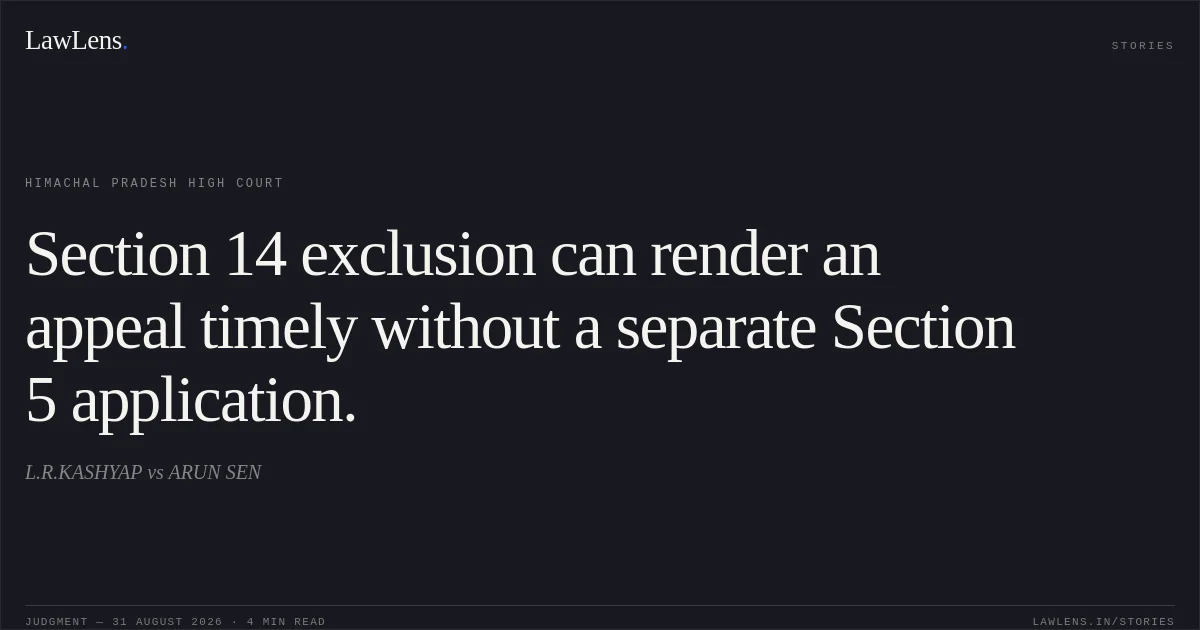
Whether the plaintiff was required to file a separate application under Sections 5 and 14 of the Limitation Act to obtain exclusion of the period spent prosecuting the earlier proceedings before the High Court.
Source reference: para. 20Whether the appeal filed before the First Appellate Court was barred by limitation despite the High Court’s order dated 16 October 2008 directing consideration of the plaintiff’s claim under Section 14 of the Limitation Act.
Source reference: paras. 23–24, 27–28Whether the First Appellate Court was justified in dismissing the appeal on limitation instead of deciding it on merits.
Source reference: paras. 26–29Law Applied
The Court applied Section 2(2) CPC, under which rejection of a plaint constitutes a decree, and consequently held that the proper remedy was a first appeal under Section 96 CPC.
Source reference: para. 15Order VII Rule 11 CPC governs rejection of a plaint on specified grounds, including absence of a cause of action.
Source reference: no citationSection 14 of the Limitation Act permits exclusion of time spent prosecuting, with due diligence and in good faith, a civil proceeding concerning the same matter in a court unable to entertain it due to want of jurisdiction or a similar cause; the provision also covers proceedings before appellate and revisional courts.
Source reference: paras. 24–25Section 5 permits admission of an appeal after limitation where sufficient cause is shown, and its Explanation recognises that being misled by an order or practice of a High Court may constitute sufficient cause.
Source reference: para. 25The Court considered State Farms Corporation of India Ltd. v. Dr. Mahendra Singh, 2013 SCC OnLine Del 4889, and the principles stated therein regarding pleading and proof of the requirements of Section 14, including due diligence, good faith, identity of the matter in issue, and inability of the former court to entertain the proceeding; however, it distinguished that decision because the High Court had itself directed consideration of the Section 14 benefit in the present case.
Source reference: paras. 22–23The Court also relied on the principle that procedural and limitation provisions should be applied liberally where a litigant has pursued a remedy bona fide and the court has issued notice in the appeal.
Source reference: para. 26Reasoning
The Court held that the High Court’s order dated 16 October 2008 had expressly reserved liberty to the plaintiff to approach the District Judge and directed that the period during which the revision and appeal remained pending before the High Court be considered for limitation under Section 14.
Source reference: paras. 10, 23–24Since that order had not been challenged by the defendant, the First Appellate Court could not disregard its operative direction by treating the appeal as time-barred solely because no separate application under Sections 5 or 14 had been filed.
Source reference: para. 24The plaintiff had disclosed in the memorandum of appeal the earlier proceedings, their disposal by the High Court, and the liberty granted to approach the District Court.
Source reference: para. 25The Court further found that, after accounting for the time spent obtaining certified copies and prosecuting the earlier proceedings, the appeal filed on 19 November 2008 was within limitation.
Source reference: para. 28In any event, issuance of notice and the surrounding circumstances required a liberal approach rather than rejection on a technical limitation ground.
Source reference: para. 26The First Appellate Court therefore erred in adopting a shortcut and denying adjudication of the plaintiff’s appeal on merits.
Source reference: para. 27Holding
The revision petition was allowed.
The High Court set aside the First Appellate Court’s order dated 30 December 2010, holding that the plaintiff’s appeal was not liable to be dismissed as barred by limitation in view of the earlier High Court order and the exclusion of the relevant period under Section 14 of the Limitation Act.
Source reference: paras. 28–29The matter was remanded to the First Appellate Court for decision on merits after hearing both parties.
Source reference: para. 29The parties were directed to appear before that Court on 22 September 2026, and the First Appellate Court was requested to decide the old appeal preferably within one month from the date of appearance.
Source reference: paras. 30–31Acts & Sections Cited
6 provisions across 2 statutes referred to in this judgment. Each provision opens on LawLens.
Code of Civil Procedure, 19083
Limitation Act, 19633
Original Court PDF
L.R.KASHYAPvsARUN SEN
Click to open original judgment
Original judgment, available to read, download and summarize on LawLens.in