Facts
On 2 July 1992, the petitioner initiated proceedings under Section 147 Cr.P.C. before the Sub-Divisional Magistrate, Hilsa, alleging that the opposite parties had obstructed his use of land bearing Khata No. 45, Khesra No. 90/547, measuring 22 decimals, as a passage.
Source reference: p. 2, para. 2(i)After hearing the parties, the S.D.M. allowed the application on 3 June 2000 and directed removal of the alleged wall, hut and other obstructions, including through police force if necessary.
Source reference: p. 2, para. 2(ii)In Criminal Revision No. 38 of 2000, the Additional Sessions Judge initially set aside the order, holding that Section 145 Cr.P.C., rather than Section 147 Cr.P.C., was the appropriate remedy.
Source reference: p. 2, para. 2(iii)Pursuant to the High Court’s order dated 1 February 2016, a fresh report was obtained from the S.D.M., who reported that the disputed plot was raiyati land, had been partitioned between two brothers, and was not a public way.
Source reference: pp. 2–3, para. 2(v)On 30 August 2016, the Revisional Court again set aside the S.D.M.’s order, holding that no case under Section 147 Cr.P.C. was made out.
Source reference: p. 3, para. 2(vi)The petitioner challenged that order under Section 482 Cr.P.C.
Source reference: no citationIssues
Whether proceedings under Section 147 Cr.P.C. could be maintained in relation to the petitioner’s alleged right to use the disputed raiyati land as a passage.
Source reference: pp. 5–8, paras. 8–9Whether the S.D.M. had validly exercised jurisdiction under Section 147 Cr.P.C. without recording satisfaction that the dispute was likely to cause a breach of peace.
Source reference: pp. 9–10, paras. 12–14Whether the dispute, arising from partition arrangements and the parties’ respective rights over private land, was essentially a private civil dispute falling within the jurisdiction of the civil court.
Source reference: pp. 12–14, paras. 17–24Law Applied
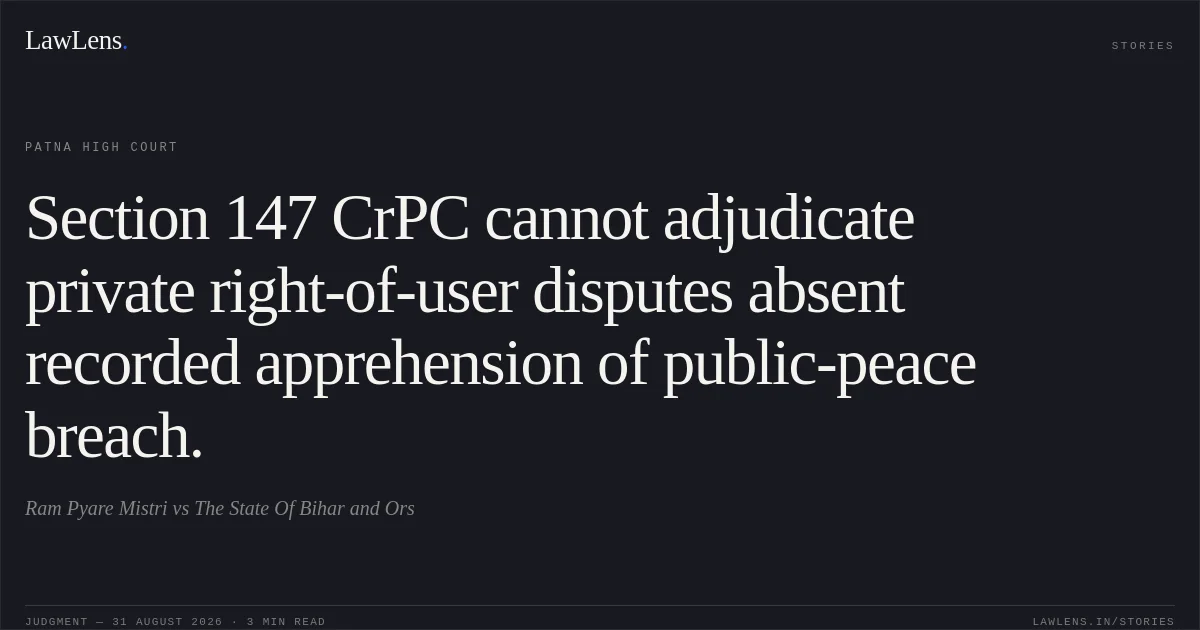
The Court applied Section 147 Cr.P.C., which empowers an Executive Magistrate to intervene where a dispute concerning an alleged right of user of land or water, including an easementary right, is likely to cause a breach of peace; the Magistrate must record the grounds of satisfaction, inquire into the alleged right, and may prohibit interference or remove obstructions only upon finding that such right exists.
Source reference: pp. 5–8, para. 8The proceedings are preventive and summary, not a substitute for a civil suit, and the Magistrate cannot finally adjudicate title, ownership, interest or possession.
Source reference: p. 7–8, para. 9; p. 10, para. 15The proviso to Section 147(3) further requires consideration of whether the right was exercised within the prescribed three-month period.
Source reference: pp. 7–8, paras. 9(viii)–(ix); pp. 10–11, para. 14Relying on Guru Govind Singh v. State of Bihar, 2017 Cri LJ 3307, Ratichandra Mandal v. State of Bihar, 2017 Cri LJ 3861, Md. Sarfuddin @ Sarfuddin Mian v. Sabir Thakur, 2005 SCC OnLine Pat 939, and Maheshwar Pratap Singh v. State of Jharkhand, 2008 Cri LJ (NOC) 814 (Jhar.), the Court held that recorded satisfaction regarding apprehended breach of peace and the recent exercise of the alleged right are essential requirements.
Source reference: pp. 9–11, paras. 13–15Reasoning
The Court found that the S.D.M. had not recorded the mandatory satisfaction that the alleged obstruction was likely to cause a breach of peace or disturb public tranquility.
Source reference: pp. 15–16, paras. 26–28Instead, the S.D.M. had adjudicated the parties’ inter se rights and directed provision of a passage based on alleged stipulations in the partition arrangement, effectively exercising civil-court jurisdiction.
Source reference: pp. 15–16, paras. 26–27The subsequent official report described the land as raiyati land divided between two brothers and not a public passage.
Source reference: pp. 2–3, para. 2(v)Since the dispute concerned the parties’ private rights arising from partition and was confined to their use of their respective shares, it was not the type of public-order dispute for which Section 147 Cr.P.C. could be invoked.
Source reference: pp. 17–18, paras. 31–33Any permanent determination of the alleged passage or easementary right was therefore reserved for the competent civil court.
Source reference: p. 14, para. 24Holding
The High Court held that the S.D.M.’s order under Section 147 Cr.P.C. was legally unsustainable because it lacked a recorded finding of apprehended breach of peace and improperly adjudicated private civil rights.
The Revisional Court’s order dated 30 August 2016, setting aside the S.D.M.’s order, was found free from legal infirmity.
Source reference: p. 18, para. 34The application under Section 482 Cr.P.C. was accordingly dismissed; the petitioner was left to pursue any substantive claim regarding the alleged passage or easement before the competent civil court.
Source reference: p. 18, para. 35Acts & Sections Cited
21 provisions across 1 statute referred to in this judgment. Each provision opens on LawLens.
Original Court PDF
Ram Pyare MistrivsThe State Of Bihar and Ors
Click to open original judgment
Original judgment, available to read, download and summarize on LawLens.in